The best sales training software combines in-application guidance, microlearning content, and analytics so that reps can build skills inside the tools they already use, without leaving their workflow. The six platforms below are the most referenced options across G2, Capterra, and Gartner for sales teams of different sizes and maturity levels.
Sales teams drive revenue, yet they remain among the hardest groups to train effectively. Reps have varying experience levels, strict quotas, and little patience for classroom-style sessions. The right sales training software benefits extend to reps, managers, and the whole organization, but only when the platform matches how your team actually works.
This guide compares six leading sales training and sales readiness software platforms, outlines the core features to evaluate, and explains what to look for before you invest.
What should you look for in sales training software?
Good sales training software serves one overriding goal: reduce the time between hire and full productivity, then keep reps sharp as products, markets, and tools evolve. These five capabilities separate the platforms that achieve that from the ones that do not.
Feature
Why it matters for sales teams
Content authoring
Products change, quotas shift, and CRM fields get updated. Editors need to push changes without involving developers.
Knowledge base
A self-service library reduces support tickets and lets reps find answers in seconds instead of pulling a manager off a call.
In-app integrated training
Reps spend most of their day inside a CRM such as Salesforce or Oracle. Training delivered inside those tools lands in context and is far more likely to stick.
Microlearning
Short, focused modules of 30 seconds to 3 minutes counter the forgetting curve and fit into a rep's selling day without requiring scheduled time off.
Ready-to-use content
Pre-built guides for market-standard tools (Salesforce, Microsoft Office 365, Oracle) eliminate the blank-page problem and accelerate onboarding.
"B2B sales reps forget 70% of the information they learn within a week of training, and 87% will forget it within a month. To realize the benefits that technology can offer for training and coaching, CSO and sales leaders must embrace its advantages and understand its impact on sales processes."
Gartner, The Evolution of Sales Training and Coaching Technology
Which sales training software platforms lead the market?
The following six platforms appear consistently in independent reviews on G2, Capterra, and Gartner Peer Insights. Each profile covers best-known strengths, ideal company size, and the key features that distinguish it from the rest.
1. Lemon Learning
Best known for: In-app microlearning, blended learning, personalized training paths
Best for: SMBs and global enterprises that want training delivered inside their existing software stack
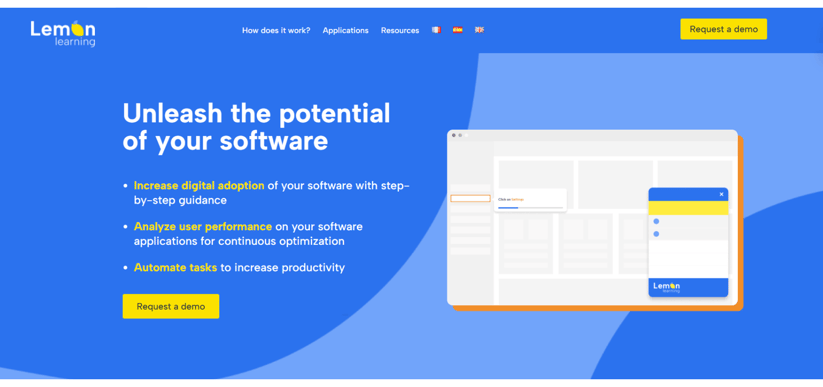
Lemon Learning is a DAP (Digital Adoption Platform) that overlays any web-based sales tool to deliver in-application prompts, guided workflows, and on-demand learning exactly where reps work. Rather than pulling reps out of their CRM for a separate training session, Lemon Learning embeds the training inside Salesforce, Oracle, Microsoft Dynamics 365, and other standard tools, so learning happens in the flow of actual selling.
Lemon Learning ships with over 100 ready-to-use content resources covering common sales tasks such as creating leads, building reports, logging opportunities, and managing contacts. Its microlearning methodology supports learning by doing, keeping modules short enough to complete between prospect calls.
For enterprises running Salesforce or Oracle implementations, Lemon Learning is particularly well-suited to onboarding new sales reps at scale without requiring dedicated training days. The Lemon Learning sales operations solution covers the full cycle from initial onboarding through ongoing adoption reinforcement.
Key features:
Ready-to-use content library: Pre-built guides and push notification templates for Salesforce, Oracle, Microsoft Office 365, and more, deployable immediately.
Code-free content authoring: Design, create, and update training content in multiple formats, including guides, videos, infographics, and GIFs, without any developer involvement.
On-demand self-service library: A searchable knowledge base centralizes all training documentation so reps can find answers at the exact moment of need.
Universal integration: Connects with any web-based tool, including custom in-house applications.
Microlearning modules: Interactive workflows with objectives lasting 30 seconds to 3 minutes reduce cognitive load and reinforce retention over time.
2. Brainshark
Best known for: Video coaching, built-in LMS (Learning Management System), sales readiness scorecards
Best for: SMBs and large organizations focused on measurable readiness programs
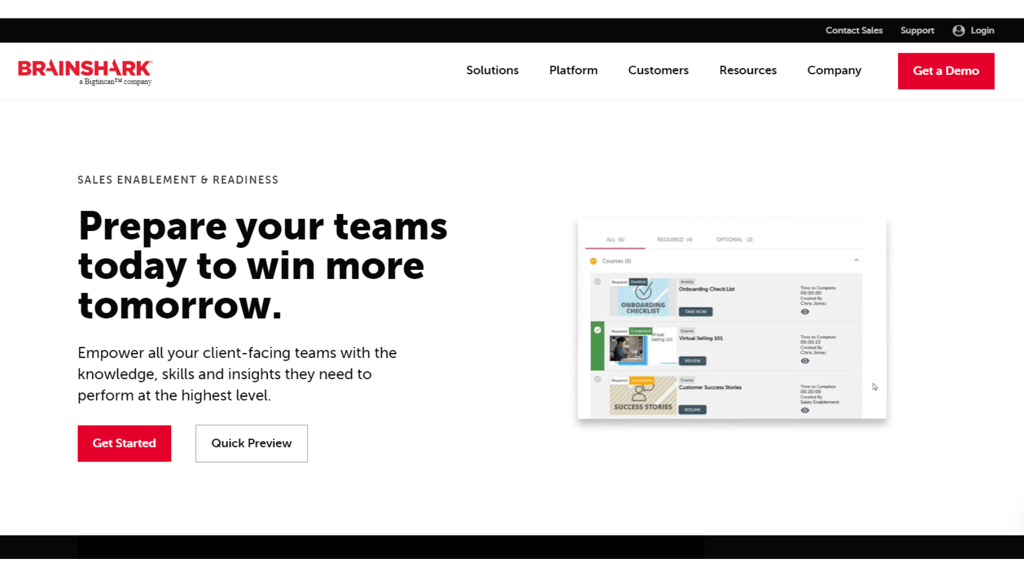
Brainshark is a sales readiness platform that combines onboarding content, manager coaching tools, and performance analytics. Its built-in LMS centralizes learning content with a particular emphasis on video-based coaching and role-specific readiness programs. Managers can set benchmarks, issue certifications, and track progress via readiness scorecards, making it a strong fit for organizations that want to link training completion directly to performance metrics.
Key features:
Coaching assessments: Video and text-based assessments prepare reps for real conversations before they happen.
Certifications and badges: Mandatory training milestones are enforced with completion-based credentials.
Online and offline content access: Content is available on any device, including offline access for reps who travel or work in low-connectivity environments.
Readiness scorecards: Dashboards give managers visibility into individual and team readiness alongside engagement metrics.
3. HubSpot Academy
Best known for: Free sales certifications, inbound sales methodology, CRM-integrated training
Best for: Sales beginners, HubSpot CRM users, and large organizations seeking free structured curriculum
HubSpot Academy is a globally recognized free training resource covering sales, inbound marketing, and CRM best practices. It offers five sales certification courses and more than 40 individual lessons spanning topics from prospecting fundamentals to advanced sales management. The Inbound Sales certification, for example, includes five structured lessons aimed at both individual contributors and sales managers.
HubSpot Academy is particularly valuable for teams adopting the HubSpot CRM, as much of the content is designed to reinforce platform usage. Companies that purchase HubSpot gain access to administrative learning analytics dashboards for tracking team progress.
Key features:
Video tutorial library: Hours of structured video content covering core sales competencies.
In-course assessments: Periodic knowledge checks during and at the end of each module.
Sales certifications and practice tests: Five sales-specific certifications with practice exams for professional accreditation.
Administrative analytics dashboard: Available to HubSpot customers for monitoring team completion and performance.
4. Mindtickle
Best known for: AI-powered sales readiness, conversation intelligence, data-driven coaching
Best for: Enterprise and mid-market companies with large sales or customer-facing teams
Mindtickle is consistently rated among the top sales readiness platforms on G2 and Capterra, particularly for enterprises that need to connect training activity to pipeline performance. Its AI analyzes recorded sales conversations to surface what top performers do differently, then uses those insights to inform personalized coaching programs.
The platform integrates with CRM systems including Salesforce and Veeva, and supports cross-departmental content collaboration so that Sales and Marketing can build shared resources together. For organizations evaluating Mindtickle against alternatives such as Lessonly by Seismic or Allego, the primary differentiator is its Sales Readiness Index, which benchmarks each rep against an ideal profile and identifies targeted development areas.
Key features:
Conversation intelligence: AI analyzes real sales calls to identify patterns, objection-handling gaps, and best-practice behaviors.
Sales Readiness Index: Creates a benchmark profile of the ideal rep and scores individuals against it to prioritize coaching.
Content collaboration: Cross-functional teams can build and curate training resources together inside the platform.
Skills-based certifications: Custom certification paths tied to specific competencies and role milestones.
5. EdApp (now SC Training)
Best known for: Mobile-first microlearning, gamification, free LMS
Best for: SMBs and mobile sales teams, field reps, and distributed workforces
EdApp, rebranded as SC Training, is a mobile-first LMS (Learning Management System) that uses gamification to increase engagement with training content. It is particularly well-suited to sales teams that work predominantly in the field, travel frequently, or operate across multiple time zones. The platform's free tier and template library lower the barrier to entry for smaller organizations.
Content creators can build original courses from scratch, import and convert existing PowerPoint decks, or draw from a library of more than 1,000 pre-built courses. Popular sales training topics for mobile teams, such as objection handling, product knowledge, and territory planning, are well represented in the existing course library.
Key features:
Mobile-first delivery: Courses are optimized for smartphones, enabling learning between customer visits or during transit.
Gamification and leaderboards: Points, badges, and competitive rankings increase completion rates.
1,000+ pre-built courses: A large ready-made library with 80+ authoring templates reduces content creation time.
PowerPoint converter: Existing slide decks can be uploaded and converted into interactive mobile lessons automatically.
6. Lessonly by Seismic
Best known for: Enablement-integrated training, real-life scenario simulations, buyer-facing content
Best for: Enterprise and high-growth companies with customer-facing teams
Lessonly, now integrated into the Seismic enablement platform, is designed for customer-facing teams including sales, marketing, and customer success. Its distinguishing feature is the tight link between training content and the actual sales materials reps use with buyers, such as pitch books, proposals, and one-pagers. This means reps practice with the real assets they will use in live deals, closing the gap between training and execution.
Key features:
Content automation: Personalized sales collateral, including proposals and pitch books, can be generated and updated from within the platform.
Role-play and scenario simulation: Interactive lessons simulate real sales conversations with video recording for manager review.
Integrations and APIs: Native connections to Salesforce, Slack, and Google Chrome, plus open APIs for custom workflows.
Unified enablement and training: Content creation, training delivery, and buyer engagement tools share a single platform, reducing tool sprawl for enterprise teams.
Free certifications and structured inbound curriculum
Yes
Mindtickle
Enterprise and mid-market
AI conversation intelligence and Sales Readiness Index
Yes
EdApp / SC Training
SMB, field and mobile teams
Gamification and free mobile-first LMS
Yes (primary)
Lessonly by Seismic
Enterprise, customer-facing teams
Unified training and buyer-facing content automation
Yes
What benefits can sales training software deliver across your organization?
Sales training software delivers measurable value at three levels: individual rep performance, manager efficiency, and company-wide outcomes. The benefits below apply to any of the platforms above when implemented consistently.
Benefits for sales reps
Continuous skill development: On-demand access to updated training means reps can learn about new product features, CRM updates, or competitive changes the moment they need to, without waiting for a scheduled session.
Personalized learning paths: Platforms can tailor content to individual role, experience level, and performance gaps, so a junior account executive sees different priorities than a senior enterprise rep.
Real-time accessibility: Whether a rep is working remotely, traveling, or between calls, training resources are available on any device at any time.
Benefits for sales managers
Data-driven coaching: Analytics on content engagement, assessment scores, and tool usage reveal exactly where each rep needs support, replacing guesswork with evidence.
Scalable program design: Code-free authoring tools let managers build and update training programs without submitting requests to IT or L&D teams.
Adaptive training paths: Real-time performance data allows managers to refine individual paths as rep capabilities develop.
Benefits for the organization
Higher software ROI: When reps actually adopt and use the CRM or sales enablement tools correctly, the return on those software investments increases directly.
Reduced turnover: Structured, accessible training signals investment in rep development, which is consistently linked to higher job satisfaction and lower attrition.
Lower support costs: A self-service knowledge base reduces the volume of repetitive questions to managers and IT, freeing both groups for higher-value work.
How should you choose the right sales training platform for your team?
Choosing based on brand name or market share alone is a common mistake. The right platform is the one that addresses your team's specific gaps. Consider these questions before shortlisting:
Where does learning need to happen? If reps spend most of their day in a CRM, in-app training (Lemon Learning) will outperform a standalone LMS. If they travel constantly, a mobile-first tool (EdApp) is the better fit.
What is the primary training gap? Onboarding speed, ongoing skill development, conversation quality, and content management are different problems that favor different platforms.
What does your existing software stack look like? Platforms with native integrations to your CRM reduce setup time and increase adoption of the training tool itself. Teams using Salesforce, for example, benefit from Lemon Learning's ready-to-use Microsoft Office 365 and Salesforce content guides, or Mindtickle's Salesforce connector.
What is the size and distribution of your team? A 10-person inside sales team and a 500-person global field force have very different training infrastructure needs.
How will you measure success? Define whether you are measuring ramp time, quota attainment, CRM data quality, or certification completion, and then confirm the platform can surface those specific metrics.
For more on evaluating and building a business case around these solutions, the reasons companies implement sales training software post covers the organizational drivers in detail.
If you want to see how in-app training works in practice for a sales team running Salesforce or Oracle, request a Lemon Learning demo to walk through a live implementation.
FAQ
Frequently asked questions
What is the best sales training program?+
The best sales training program depends on your team's size, sales motion, and toolset. Widely recognized programs include ASLAN Training and Development, The Brooks Group IMPACT Sales Training, The Challenger Sale, Dale Carnegie, and Sandler Sales Training. For software-based training that reinforces skills inside the tools reps use daily, a digital adoption platform layered on top of a formal program tends to deliver the strongest retention.
What's the best software for training new sales reps?+
For new sales reps, the best software combines onboarding structure with in-application guidance. Platforms such as Mindtickle (data-driven readiness), Allego (video-based coaching), and Lemon Learning (in-app microlearning directly inside CRM tools like Salesforce and Oracle) are consistently rated highly on G2 and Capterra for onboarding effectiveness. Choose based on whether your priority is video coaching, LMS-style curriculum, or in-the-flow-of-work guidance.
What are the 5 C's of sales?+
The 5 C's of sales are a framework used in sales training to guide rep behavior: Connect (build rapport with the prospect), Clarify (understand their needs), Collaborate (work with the prospect toward a solution), Convince (present the value case), and Confirm (close and secure next steps). Different trainers label these slightly differently, but the underlying model emphasizes relationship-led selling over purely transactional approaches.
What is the 3-3-3 rule in sales?+
The 3-3-3 rule in sales is a prospecting discipline: spend 3 minutes researching a prospect before outreach, deliver your message in 3 sentences or fewer, and follow up a maximum of 3 times before moving on. It is designed to keep outreach concise, relevant, and respectful of a prospect's time, while preventing reps from over-investing in unresponsive leads.