PLM vs ERP: What Is the Difference and When Do You Need Both?
PLM manages product design and development. ERP runs business operations. Learn the core differences between PLM and ERP, how they compare to MES,...
Cloud ERP implementation requires the right people, processes, and tools. Discover 5 practical tips to drive adoption and get the most from your ERP

Cloud ERP implementation is a long-term investment of people, resources, time, and money. The key is to anticipate every potential hurdle so that your stakeholders are ready to clear them. Ultimately, there is no successful implementation without successful end-users.
Did you know? A study by SelectHub found the biggest influencers in the ERP purchasing decision were employees from finance and accounting (23%) and IT department employees (23%).
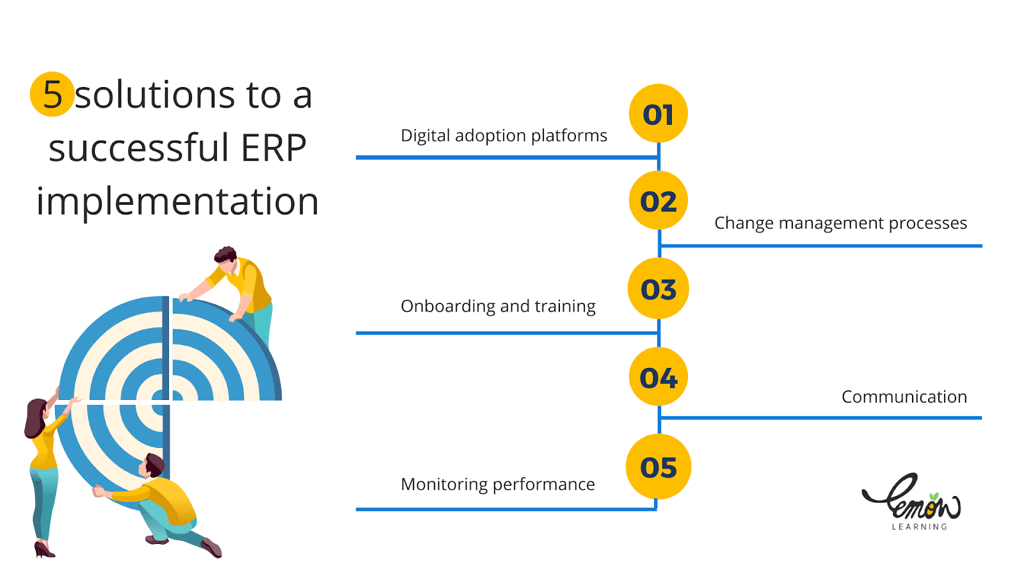
What if there was one tool to support them all? With a digital adoption platform, it is possible. A DAP integrates directly into your cloud ERP, CRM, HRIS, or procurement solution to train, onboard, and track user performance. Through interactive guides, in-app prompts, and self-service support, users can learn with full autonomy at their own pace.
As Pierre-Alexandre Mass, DSI de transition, put it: "You can run the most interesting project in the world, but if there is no support for users, adoption will be very limited. So you need tools that let people build skills on these new tools easily and intuitively." (CIO Pioneers podcast)
Without change management, a new tool quickly becomes just another tool. Your end-users are the most important factor in the success of your cloud ERP, so treat this rollout like any digital transformation: structured, communicated, and people-first.
Every transformation needs project leaders who can advocate for and clearly explain the need for change. These leaders ensure all stakeholder groups receive consistent, timely communication from the earliest planning stages. That includes mapping potential pain points and risks for each group and defining the resources needed to address them.
Anticipating resistance to change allows project leaders to adapt, address specific concerns, and keep momentum high. Successful change management is reached when end-users genuinely understand the value of the new tool and see digital transformation as a necessary step forward.
Just as legacy on-premise systems have given way to cloud ERP, traditional classroom training methods have also run their course. During change management planning, select onboarding and training approaches that meet users where they actually work.
Lemon Learning tip: You can train employees directly inside their cloud ERP, without switching context.
Solutions like Lemon Learning embed training as a second layer directly over your tool. An action-activated sequence of guides takes employees exactly where they need to go, supporting full autonomy and faster time to competency.
Communication is not a one-time project kickoff activity. It is an ongoing pillar of any cloud ERP implementation. Keeping users informed, engaged, and supported well after go-live is what separates a smooth rollout from a stalled one.
Lemon Learning tip: With a digital adoption platform, you can reach users in multiple formats, directly inside the ERP.
All of this is possible without technical constraints or geographical limitations.
To sustain your ERP investment over time, you need visibility into how users are actually engaging with the system. Learning analytics give you that visibility.
Lemon Learning tip: With a digital adoption platform, you can track every user interaction with cloud ERP training content.
You can measure both qualitative and quantitative interactions across multiple projects simultaneously, including:
The result? A sustainable ERP backed by training you can continuously track and improve, guided by real user behavior. Want to see how organizations have put this into practice? Browse our customer success stories, or get in touch to discuss how to manage your company's digital transformation.
Cloud ERP implementation is the process of deploying an enterprise resource planning system on a vendor's cloud infrastructure rather than on-premises. It covers planning, data migration, configuration, user training, and go-live support.
Most cloud ERP implementations take between 3 and 6 months for small to mid-sized businesses. Larger enterprises may require 6 to 12 months depending on complexity and scope.
PLM manages product design and development. ERP runs business operations. Learn the core differences between PLM and ERP, how they compare to MES,...
Learn what an ERP integrator does, what skills to look for, and how to choose the right one for your ERP project. A practical guide for 2026.
Learn how to build a tailored ERP training program that drives real adoption. Practical steps for end-user onboarding, role-based training, and change