How to Turn Shadow IT Data Into a SaaS Adoption Roadmap
Learn how to combine shadow IT discovery data with digital adoption analytics to prioritise SaaS rationalisation and improve adoption across your stack.
Most CIOs now have at least a partial view of their shadow IT problem. Whether through SaaS discovery tools, finance audits, or network analytics, you know there are far more applications in use than your official catalogue suggests. You may even have dashboards showing who is connecting to what. The question is what you do with that insight.
If the answer is limited to "block, blacklist, and send policy reminders," you are leaving value on the table. Shadow IT data is not just a risk register; it is a map of unmet needs, poor adoption, and broken experiences across your SaaS estate. Treated well, it becomes one of the most useful inputs into your roadmap for Salesforce, Workday, Microsoft 365, Copilot, ERP, HRIS, and the long tail of line-of-business tools.
This article looks at how to make that shift. It explores how to combine shadow IT telemetry with digital adoption analytics, using a DAP like Lemon Learning to prioritise where you improve workflows, where you rationalise vendors, and where you invest in better in-app guidance. The aim is to turn a messy inventory of unsanctioned tools into a disciplined plan for higher adoption, lower support costs, and better ROI on the platforms you have already bought.
Move beyond simple counts
The first step is to move beyond simple counts. Knowing that "we have 300 unapproved SaaS apps" is a starting point, not a strategy. You need to understand who is using those tools, for what, and how that behaviour overlaps with your sanctioned systems.
Modern SaaS management and security vendors are clear on the scale of the issue. Employees adopt unsanctioned apps primarily to get work done faster when official tools lag. Estimates suggest that well over 40% of SaaS in a typical enterprise runs without formal IT approval. Those numbers are alarming, but they are also rich input. Each unsanctioned app is a clue about a process where users felt blocked.
To turn that into something actionable, you need basic enrichment. Group shadow IT by business unit, function, and use case. Which apps are sales using, and do they duplicate CRM or CPQ capabilities you already own? Which tools sit in HR, and do they overlap with Workday, your LMS, or collaboration platforms? Which shadow AI tools are being used for drafting content that Copilot or sanctioned generative AI could handle inside Microsoft 365?
Next, overlay risk. Some of these tools will handle little or no sensitive data; others will clearly touch customer, financial, or HR information. Security and compliance teams can help you prioritise, particularly as unsanctioned tools increasingly sit next to core systems and create exposure that is easy to miss.
At this stage, many organisations stop. They have an inventory, some heatmaps, and a list of tools to block or review. But to build a roadmap, you must take one more step: connect these external behaviours to what is happening inside your sanctioned apps. That is where digital adoption analytics come in.
Turning shadow IT visibility into an adoption and ROI roadmap
Once you can see where shadow IT lives and what it does, the temptation is to react tactically: block the worst offenders, clean up contracts, tighten requests. Necessary, but not sufficient. The strategic move is to treat that visibility as the front door to an adoption roadmap that improves how people use the platforms you already have.
Tag shadow IT to your anchor platforms
Start by tagging each shadow IT cluster to one or more "anchor" platforms in your official stack. A niche sales enablement tool maps to Salesforce; a rogue time-tracking app maps to Workday; a personal kanban board maps to Microsoft 365 or your project portfolio tool. Your job is not to replicate every feature; it is to understand which workflows people are trying to fix and whether your standard platforms can credibly cover them.
Hold up a mirror to your adoption data
Then examine not just logins but workflow completion, feature usage, and support load. A CRM with high login counts but low opportunity hygiene and constant "how do I update this?" tickets is not adopted; it is used under duress. A Workday tenant where managers log in only for approvals but avoid self-service options is a magnet for side spreadsheets and untracked HR workflows.
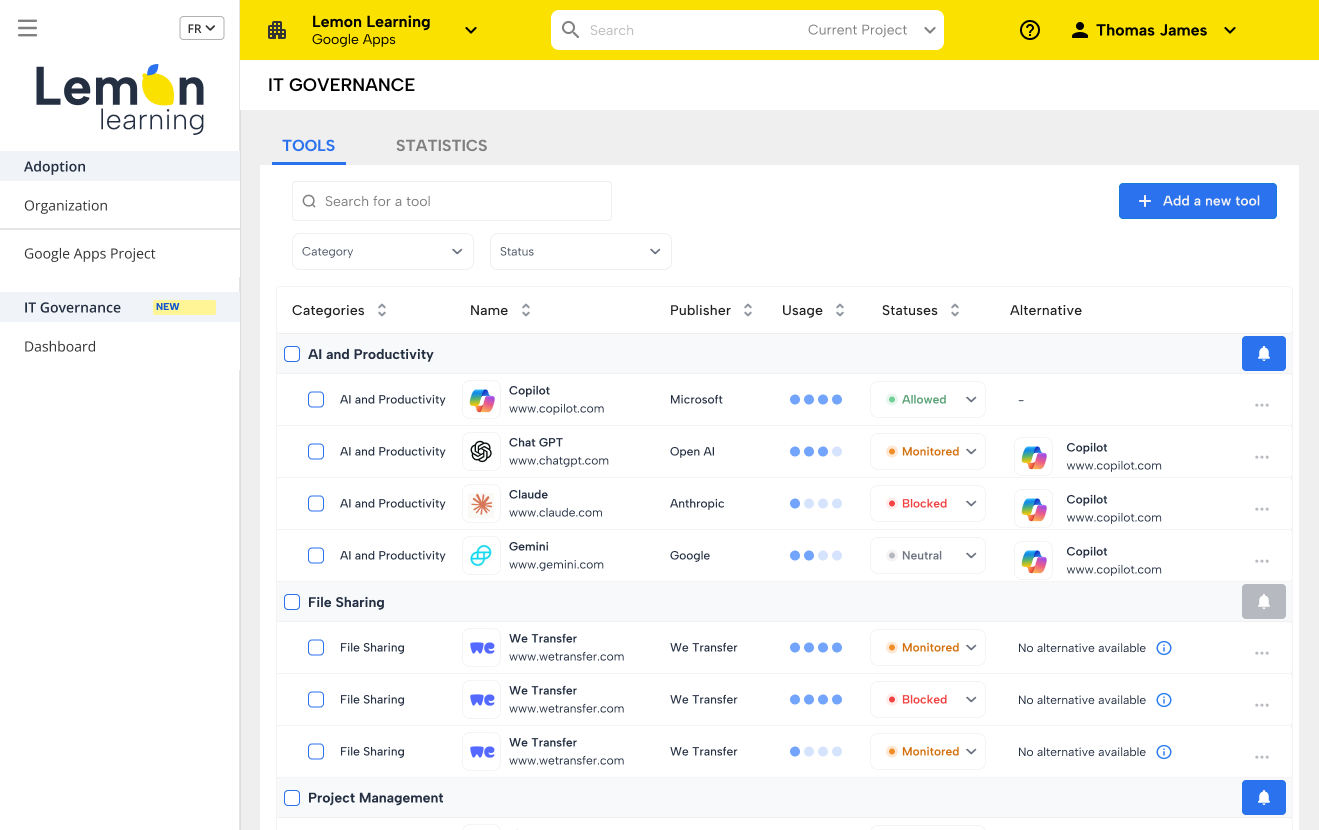
Lemon Learning's analytics give you a magnifying glass on this behaviour. You can see which in-app guides people trigger in Salesforce, Workday, or Microsoft 365, where they abandon flows, and what they search for in the help panel when they are stuck. Combined with SaaS discovery insights, this lets you answer a critical question: are shadow IT tools stepping in where you never provided meaningful guidance, or where the core tool is genuinely unfit?
As Jean-Michel Moutot, an expert in change management, put it: "A platform like Lemon Learning enables digital adoption but also, as a by-product, the real-time observation of behaviours through anonymised logs by profile." That behavioural layer is exactly what links shadow IT discovery to a credible adoption roadmap.
Build a quarterly shadow IT-to-adoption backlog
For each domain, define a small number of plays:
Consolidate: bring a widely used shadow app under contract and SSO if it materially outperforms your current platform and you are not ready to replace it.
Replace: deprecate redundant tools by improving adoption of the core platform with in-app guidance, automation, and better configuration.
Re-architect: if both shadow and sanctioned tools are struggling, you may need a process or platform redesign, not just more training.
Each play should ship with an adoption plan, not just a change request. That means in-app walkthroughs in the affected tools, short contextual announcements, and clear "before/after" KPIs on tickets, cycle times, or data quality. Shadow IT telemetry tells you where to invest; a digital adoption layer turns that investment into sustained behaviour change.
Discovery alone is not enough. CIOs need to combine observability with adoption tooling, not choose one over the other, to build digital infrastructure that employees actually use.
FAQ
Frequently asked questions
What is the first dataset I should look at to understand shadow IT?+
Start with what you already have: firewall and proxy logs, identity provider reports, expense data, and any existing SaaS discovery or SSPM tool outputs. Your goal is not perfect accuracy on day one, but a directional map of which business units and domains rely most on unsanctioned tools.
How do shadow IT insights help justify investment in a Digital Adoption Platform?+
Shadow IT shows where sanctioned tools are failing users. When you can connect those hotspots to adoption gaps inside Salesforce, Workday, Microsoft 365, or your ERP, and then show how in-app guidance reduces both shadow usage and support tickets, you have a clear ROI narrative for a DAP like Lemon Learning.
What if some shadow IT tools are genuinely better than what we have?+
Your options are to formalise them by bringing them under governance, SSO, and vendor management, or to use them as benchmarks when you reconfigure or replace your official platforms. Pretending they do not exist simply leaves you with unmanaged risk.
Where does Lemon Learning sit alongside SSPM or SaaS management platforms?+
SSPM and SaaS management tools tell you what is being used and how risky it is. Lemon Learning sits in the adoption layer: it changes how people use your sanctioned tools by adding in-app guidance and analytics. You need both sides if you want to reduce shadow IT while actually improving the day-to-day experience.