ERP (Enterprise Resource Planning) implementations fail far more often than most organizations expect. The most direct answer: most failures trace back not to the software itself, but to weak change management, inadequate training, poor planning, and the false assumption that deploying new technology automatically produces user adoption. Understanding the patterns behind ERP implementation failure can save an organization years of disruption and tens of millions of dollars.
Research cited by industry analysts shows that more than 70% of ERP implementations fail to deliver on their original business case. The financial damage compounds quickly: initial project losses, operational disruption, mitigation costs, and reputational harm. Companies often locate the causes of negative software return on investment only after the damage is done.
"Many projects fail because resources go into the project itself, neglecting employees, like millions thrown out the window." Guillaume Koch, Althea (Change-leader interview)
This article examines the real cost of ERP failure, three of the most instructive high-profile case studies including the Nike ERP failure, the Hershey ERP implementation failure, and the Revlon ERP failure, and a practical framework to prevent the same mistakes in your organization.
What does ERP implementation failure actually cost?
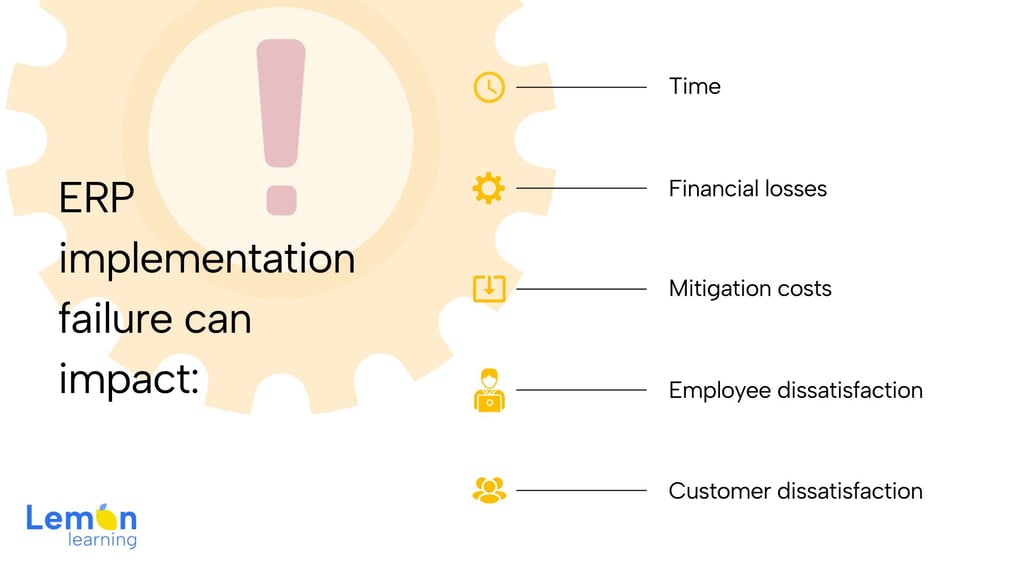
ERP implementation failure is not a single event. It unfolds across time, budget lines, workforce morale, and customer relationships. The consequences fall into five categories every organization should map before a project begins.
Time lost is rarely recovered
Companies typically lose years identifying, mitigating, and resolving the root causes of failure. Recovery requires a near-complete overhaul of the original ERP implementation approach, covering change management, training strategy, and project governance, to ensure the same mistakes are not repeated.
Financial losses extend beyond the project budget
ERP financial losses take many forms: lost sales, client attrition, shareholder pressure, stock price drops, supply chain disruption, and litigation. These are separate from, and often larger than, the original project budget overrun.
Mitigation costs are always higher than prevention costs
When organizations cut corners on change management or training to reduce costs, the price of fixing the resulting problems consistently exceeds what proper preparation would have cost. Mitigation expenses include consulting fees, replacement software, legal costs, and the operational overhead needed to restore normal productivity.
Employee dissatisfaction compounds the problem
A failed ERP project rarely stays contained to the IT department. Low software adoption creates digital frustration, employee resistance to future change, and a damaging workplace user experience. These cultural costs linger well after the technical issues are resolved.
Customer dissatisfaction is the most visible damage
Disrupted order fulfillment, product shortages, and negative press coverage all translate directly into customer distrust and, in severe cases, customer attrition. The three case studies below illustrate exactly how this plays out.
Three high-profile ERP implementation failure case studies
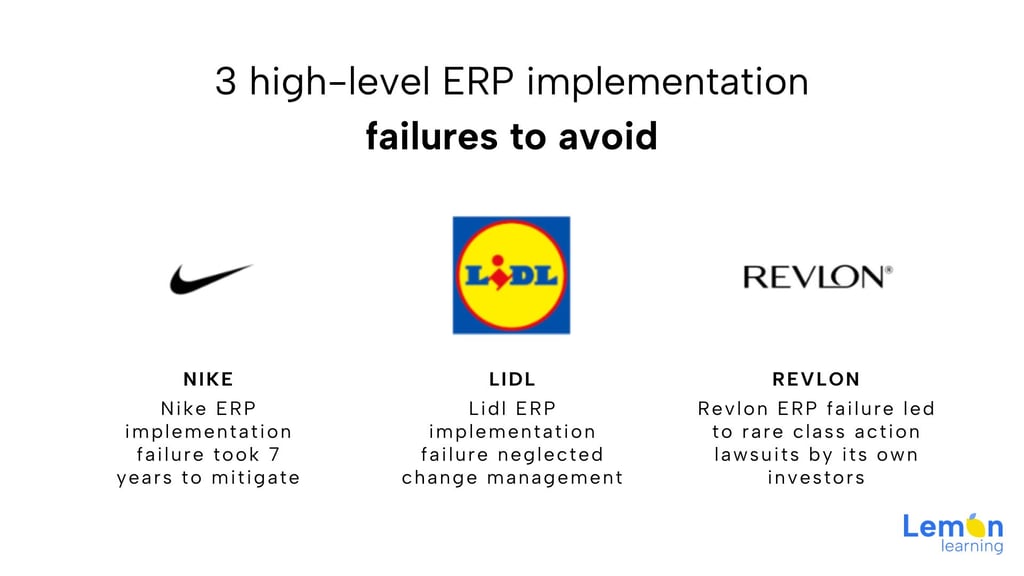
These three examples represent some of the most widely analyzed ERP failures on record. Each one demonstrates a distinct pattern of critical failure factors that organizations can use as a checklist for what to avoid.
1. Nike ERP implementation failure: seven years and $500 million to recover
The Nike ERP failure is one of the most cited examples of an enterprise resource planning failure in business history, and it started with a decision that looked reasonable on paper.
Background. In 2000, Nike was accelerating global expansion and needed to modernize its supply chain. The company committed approximately $400 million to an ERP digital transformation project intended to replace an aging legacy system, improve demand forecasting, and increase market share. The core components included a new SAP ERP system and i2 Technology supply-chain management software.
Why the Nike ERP system failed. The critical mistake was deploying the i2 Technology demand-planning software alongside the existing legacy ERP rather than integrating it properly with the incoming SAP platform. The two systems operated with different data formats and business rules. Bridging them required complex customization that introduced forecasting errors almost immediately. The system began generating inaccurate demand signals: over-ordering some products and under-ordering others. Nike's supply chain, already stretched across a growing global footprint, could not absorb the errors.
What the Nike ERP failure cost. The immediate financial impact was an estimated $100 million in lost sales. Nike's stock price fell approximately 20% following disclosure of the supply chain problems, and the company faced class action lawsuits tied to unfulfilled orders. Full recovery from the Nike i2 failure required roughly seven additional years and an estimated $500 million in further investment. Nike eventually completed the SAP ERP implementation in 2004, but the total cost of the failed first attempt dwarfed the original project budget.
The lesson from the Nike ERP implementation case study. Rushing integration between incompatible systems creates data integrity failures that cascade rapidly through supply chain operations. Unrealistic goals and compressed timelines are consistently identified as critical failure factors in ERP implementation.
2. Hershey ERP implementation failure: cutting testing short at the worst possible time
The Hershey ERP implementation failure is a textbook example of how scheduling decisions can make an otherwise sound technology project collapse at go-live.
Background. In the late 1990s, Hershey Foods Corporation launched a major ERP project worth approximately $112 million, involving SAP R/3, Manugistics supply-chain software, and Siebel Systems CRM software. The scope was ambitious, but the original 48-month timeline was later compressed to 30 months.
Why Hershey's ERP failed. According to the documented case analysis, Hershey's ERP implementation failure stemmed from two critical missteps: cutting testing phases short and selecting an unrealistic go-live date. The company chose to go live in the summer of 1999, directly ahead of the Halloween and Christmas confectionery peak season. When the system went live, it was not adequately tested under real production volumes. Order processing broke down, and the warehouse management system could not handle the demand spike.
What the Hershey ERP failure cost. Hershey was unable to fulfill approximately $100 million worth of candy orders during its most critical sales season. The company reported a 19% decline in quarterly profits and an 8% drop in net sales in Q3 1999. Retailers who could not get product from Hershey shifted shelf space to competitors, with some of that market share never returning.
The lesson from the Hershey case study. No ERP go-live date should be locked to a peak business period unless testing has been completed under realistic load conditions. Compressing timelines to meet arbitrary deadlines is one of the most consistent success and failure factors in ERP implementation analysis.
3. Revlon ERP failure: investor lawsuits and $64 million in unfulfilled shipments
The Revlon ERP failure demonstrates how poor planning at the project governance level can destroy operational capability and investor trust simultaneously.
Background. Following its 2016 acquisition of Elizabeth Arden, Revlon initiated a major SAP HANA rollout intended to integrate planning, sourcing, manufacturing, and distribution across a newly enlarged global operation.
Why the Revlon ERP project failed. Revlon was unable to complete its annual financial report because of implementation problems. The system could not accurately record or account for inventory, which meant the company was unable to manufacture the correct quantities of goods or fulfill customer orders. The integration of the post-acquisition business added complexity that the project plan had not adequately addressed.
What the Revlon ERP failure cost. Revlon experienced a 6.9% drop in stock price within 24 hours of the news becoming public. The company was unable to fulfill approximately $64 million in product shipments and spent an additional $53.6 million attempting to restore customer service levels. Investors filed class action lawsuits, a rare outcome that illustrates how severely an ERP failure can damage stakeholder confidence. Revlon was unable to recover the lost sales, and reports indicate that management attention was substantially diverted by the ongoing crisis.
The lesson from the Revlon case study. Post-acquisition ERP integration requires additional scope planning and governance. Deploying a new system without adequate controls over inventory data quality creates immediate operational failure with compounding financial consequences.
Other notable ERP failure examples
Nike, Hershey, and Revlon are among the most documented cases, but they are not isolated. A review of ERP failure examples across the last three decades reveals consistent patterns.
Company
System
Primary failure factor
Reported impact
Lidl
SAP HANA
Forcing software to match existing processes instead of adapting organizational processes; absence of change management
Abandoned after 7 years; approximately $580 million written off
Nike
i2 Technology + SAP
Incompatible system integration; unrealistic goals and compressed timeline
$100 million initial loss; 20% stock decline; 7 years to recover
Hershey
SAP R/3 + Manugistics + Siebel
Compressed timeline; go-live during peak season without adequate testing
$100 million in unfulfilled orders; 19% quarterly profit decline
The Lidl SAP implementation failure is particularly instructive for SAP implementation failure analysis. Lidl had developed more than 90 proprietary in-house solutions over time. When it attempted to consolidate these into a single SAP HANA system, the company tried to customize the software to replicate its existing processes rather than adapting its processes to the standard ERP model. The SAP system recorded inventory at retail prices; Lidl operated on purchase prices. Instead of aligning to the SAP standard, the team pursued extensive customization that created mounting technical debt. After seven years and approximately $580 million invested, Lidl abandoned the project and reverted to its original inventory management system.
The Lidl case is a direct illustration of a critical failure factor: treating an ERP implementation as a software configuration exercise rather than an organizational change program.
What are the critical failure factors in ERP implementation?
Across the case studies above and the broader body of ERP failure research, several root causes appear repeatedly. These are the digital adoption challenges that turn an ERP project from a business asset into a liability.
Lack of clear objectives and realistic scope
Projects that begin without measurable goals and a well-defined scope frequently expand during execution, a phenomenon known as scope creep. Without clear objectives, there is no mechanism to evaluate whether the implementation is on track or to prioritize decisions when trade-offs are required.
Compressed or unrealistic timelines
Both the Hershey and Nike ERP failures involved timelines that did not allow adequate time for testing. Cutting testing phases to meet a deadline is consistently cited as one of the highest-risk decisions in any large-scale ERP project.
Inadequate change management
Change management is not a communications exercise. It is the structured process of preparing the organization, its leaders, and its end users to work in a fundamentally different way. The Lidl SAP implementation failure is the clearest example: seven years of technical work collapsed in part because the organizational side of the change was never properly managed.
Insufficient user training and low adoption
ERP systems are only as effective as the accuracy and consistency of the data entered into them. If end users are not trained adequately before go-live, or if training happens too far in advance and is forgotten by launch day, the system produces unreliable outputs from day one.
"It took three or four months, and we had to make sure the training happened before go-live but not too far before, so people would not forget. Inevitably there were difficulties at launch: people had forgotten how to perform a given operation." Elder Mathias, DSI, Aftral (CIO Pioneers podcast)
This is precisely the scenario that turns a technically sound system into a failed ERP implementation. Continuous, in-context training support, available at the moment of need, is a more reliable approach than a one-time pre-launch training program.
Poor integration planning
The Nike ERP implementation failure is the defining case here. Running two systems with different data standards in parallel creates data integrity problems that amplify across every connected process. Integration architecture must be defined and tested before any system goes live.
Customizing the software to match legacy processes
Standard ERP platforms encode industry best practices. Heavily customizing the software to match existing organizational processes, as Lidl did, introduces technical complexity that makes future upgrades difficult and creates systems that are hard to support. The better approach is to adapt processes to the ERP's standard model, with customization limited to genuinely unique requirements.
Weak executive sponsorship and unclear governance
When senior leadership is not actively engaged, decision-making stalls, resource conflicts go unresolved, and the project loses organizational priority. Executive sponsorship is consistently identified as a success factor in ERP implementations that deliver on their business case.
Wrong implementation partner or internal team composition
The MillerCoors SAP implementation failure is frequently cited as an example of selecting an implementation partner without sufficient relevant expertise. The cost of replacing a partner mid-project, or of building internal capability after go-live, is substantially higher than the cost of proper partner evaluation at the outset.
10 steps to avoid ERP implementation failure
The patterns across these failure cases point to a practical prevention framework. Any organization planning or currently executing an ERP project can use these steps to reduce risk.
Choose software that fits your actual business processes. Select the best fit for your operational model, not the most prominent name in the market. Evaluate how closely the standard system matches your processes before committing to customization.
Select implementation partners based on relevant expertise. Verify that your partner has specific experience with your chosen platform, your industry, and projects of comparable scale and complexity.
Clarify roles and responsibilities for every stakeholder. Define accountability at the executive, project management, and end-user level before the project begins. Ambiguity in ownership is a direct path to stalled decisions.
Define scope, budget, timeline, and risk management parameters explicitly. A realistic project plan that accounts for testing, training, and contingency time is more likely to succeed than an aggressive schedule that leaves no room for problems.
Build a structured change management program. This means communicating the purpose and benefits of the change to the entire organization, engaging resistors early, and providing leaders with the tools to support their teams through the transition. Involving change management expertise, whether internal or external, from the project's earliest stages is a documented success factor.
Deliver training close to go-live and make it continuous. As the Aftral case above illustrates, training delivered too early is forgotten by launch. Deliver training in the weeks before go-live and supplement it with in-application guidance that users can access at the moment they need it.
Establish a risk management process with clear escalation paths. Identify the highest-risk moments in your implementation timeline, particularly system integration points and go-live, and define in advance how issues will be escalated and resolved.
Do not cut corners on testing to meet a deadline. The Hershey ERP implementation failure is the clearest evidence that going live without adequate testing during a peak business period is a decision with catastrophic consequences. If testing is not complete, delay the go-live date.
Roll out large-scale implementations incrementally. A phased or pilot-based approach creates the opportunity to identify problems at a smaller scale, adjust the strategy, and build organizational confidence before the full deployment.
Allocate dedicated resources for post-go-live optimization. The go-live date is not the end of the project. Budget and staff time for the stabilization period, which typically involves resolving data quality issues, supporting users, and optimizing workflows.
How digital adoption platforms address the human side of ERP failure
The most persistent theme across every ERP failure case study is that technology failure is almost always a people failure. Users who do not understand the system, do not trust it, or revert to workarounds undermine the data quality that the entire system depends on.
A DAP (Digital Adoption Platform) addresses this directly by embedding structured guidance inside the ERP application itself. Rather than relying on employees to remember classroom training from weeks earlier, a DAP provides step-by-step walkthroughs, contextual tooltips, and on-demand help at the exact moment a user is completing a task in the system. This approach reduces the gap between go-live and full user competency, which is the period when most data errors and process failures occur.
Lemon Learning is a digital adoption platform built to support ERP deployments on platforms including SAP, Oracle, Microsoft Dynamics, and Infor. By overlaying in-application training and support on top of the ERP, Lemon Learning enables organizations to maintain user proficiency not just at go-live but throughout the entire lifecycle of the system, including upgrades and process changes.
For organizations managing the organizational change dimension of an ERP project, the change management solutions page outlines how a digital adoption platform supports structured rollouts, reduces resistance, and accelerates time-to-competency for end users.
You can also explore the broader digital adoption platform guide or review the Lemon Learning client case studies to see how organizations have used in-application guidance to improve ERP adoption outcomes.
Key takeaways: what every organization should learn from ERP implementation failure
ERP implementation failure is not primarily a technology problem. It is a planning, governance, and change management problem. The Nike ERP failure, the Hershey ERP implementation failure, the Revlon ERP failure, and the Lidl SAP failure each had different technical profiles but shared the same underlying causes: compressed timelines, underinvestment in training and change management, poor integration planning, and insufficient attention to how real users would interact with the system from day one.
The organizations that succeed with ERP implementations treat the technology as one component of a larger organizational transformation. They invest in change management from the project's earliest stages, they test thoroughly before going live, and they provide continuous training support that does not end on the day the system is launched.
If your organization is planning an ERP implementation or working through challenges on an existing project, the steps and frameworks above represent the consolidated lessons from the most expensive ERP failures on record. The cost of applying them before go-live is a fraction of the cost of learning them afterward.
FAQ
Frequently asked questions
What is the main reason ERP implementations fail?+
Most ERP implementations fail due to a combination of poor change management, inadequate user training, unrealistic timelines, and insufficient executive sponsorship. Technology is rarely the sole cause; organizational and human factors are the most consistent root causes across documented failure cases.
What is the ERP implementation failure rate?+
Research from Gartner cited by industry sources indicates that more than 70% of ERP implementations fail to meet their original business case goals. This does not always mean a complete project collapse, but it does mean cost overruns, delayed timelines, or unrealized benefits are common outcomes.
What happened with Nike's ERP implementation failure?+
In 2000, Nike deployed i2 Technology supply-chain software alongside its existing legacy ERP instead of integrating it with a new SAP ERP. The mismatch of data formats and rules caused immediate supply chain disruptions, costing Nike approximately $100 million in initial losses, a 20% drop in stock price, and class action lawsuits. Full recovery took roughly seven additional years and an estimated $500 million more in investment.
How can organizations prevent ERP implementation failure?+
Key prevention steps include selecting software that fits the organization's actual processes, defining clear roles and project scope, budgeting adequately for change management and training, rolling out the system incrementally, and using a digital adoption platform to support ongoing user onboarding and in-app guidance after go-live.
Sales reps, SMBs, and startups all hit the same CRM adoption walls. Discover the real causes of low adoption, the hidden costs, and proven fixes that...