Microlearning delivers training as short, focused content units, each targeting a single learning objective and typically lasting between 2 and 10 minutes. Because each module is self-contained and available on demand, employees can build skills without stepping away from their work for hours at a time. This guide explains what microlearning is, why it works, how long modules should run, and how organizations use it to accelerate software adoption and continuous development.
What Is Microlearning?
Microlearning is a way of delivering knowledge that breaks content into small, purposeful chunks. The Association for Talent Development (ATD) defines it as instructional content that supports learning and performance through short pieces that learners can access on demand. Each unit addresses one clear objective, whether that is understanding a policy, completing a software task, or recalling a key process step.
The format stands apart from traditional e-learning in three ways. First, it is brief: most microlearning modules run from 30 seconds up to 10 minutes, with 2 to 5 minutes being the most common range. Second, it is targeted: one module, one goal. Third, it is accessible: content is available at the moment of need, on any device, without requiring learners to enroll in a scheduled course.
What formats does microlearning take?
Microlearning content is not limited to a single format. Common types include short explainer videos, interactive quizzes, infographics, in-app guided walkthroughs, tooltips, flashcard sets, and brief scenarios. The format should match the objective: a process walkthrough suits an interactive guide, while a concept check suits a quiz or flashcard.
How Long Should a Microlearning Module Be?
A microlearning module should be only as long as it needs to be to meet its single objective. In practice, that means 2 to 10 minutes for most content types, and as short as 30 seconds for a quiz or contextual tooltip. The guiding principle is brevity with purpose: cutting content until nothing essential remains removed, not just cutting to hit an arbitrary time target.
This time constraint also answers the question of whether microlearning can replace a quick meeting. For narrowly scoped topics, such as how to submit an expense report in a new ERP (Enterprise Resource Planning) system, a 3-minute guided walkthrough can deliver the same result as a short instructional meeting, with the added benefit that employees can replay it whenever they need a reminder.
How Does Microlearning Address Modern Training Challenges?
Corporate learning and development (L&D) teams face three persistent problems: employees have limited time to dedicate to training, budgets are under pressure, and traditional long-form courses produce low engagement and poor retention. Microlearning addresses all three.
Time constraints
Employees with packed schedules cannot always block two hours for a training session. Short modules fit naturally into existing workflows. A 5-minute module completed between tasks costs less productive time than a half-day workshop and can be repeated as needed.
Budget and production costs
Short, targeted content requires fewer resources to produce and update than long-form courses. When a process or tool changes, a single microlearning module can be revised quickly, rather than rebuilding an entire curriculum.
Low engagement and retention
Long training sessions risk cognitive overload, where learners receive more information than they can process and retain at once. By limiting each module to one objective, microlearning reduces that overload and helps learners absorb and recall information more effectively. The learning-by-doing principle reinforces this: when learners practice a skill immediately in context, retention improves significantly.
What Are the Benefits of Microlearning for Learners?
Microlearning puts control in the hands of the learner. Key advantages include the following.
Learner benefit
How microlearning delivers it
Reduced cognitive overload
One objective per module keeps information density manageable
Autonomy over learning pace
On-demand access means learners choose when and how often to engage
Just-in-time support
Content is available at the moment a task arises, not days before or after
Mobile accessibility
Short formats are well-suited to smartphones and tablets
Faster skill gaps closure
Targeted modules address specific gaps without requiring full course completion
What Does Microlearning Offer Organizations?
Beyond individual learner gains, organizations benefit from measurable operational improvements.
Precise reporting and analytics
LMS (Learning Management System) and LXP (Learning Experience Platform) platforms used to deliver microlearning content generate detailed, individualized data on completion, quiz scores, and time on task. Training managers can identify which modules are working and which need revision. For a comparison of these platform types, see the overview of LXP versus LMS platforms.
Scalability and continuous updating
Microlearning content scales easily across large workforces. Because modules are short and modular, L&D teams can add, remove, or update individual units without disrupting an entire learning program. This is especially valuable in fast-moving environments where tools and processes change frequently.
Support for a continuous learning culture
Microlearning integrates naturally into a broader continuous learning strategy, where skill development is an ongoing habit rather than a periodic event. Short, frequent learning moments reinforce knowledge over time in a way that annual training days cannot.
"PowerPoint guides are change management of the old world. The open rate of an email with a PowerPoint guide? Generally 5%."
How Does Microlearning Boost Software Adoption?
One of the highest-value applications of microlearning is in-application guidance during software rollouts. When employees encounter a new tool, they need help at the exact moment they are trying to complete a task, not in a classroom session held two weeks earlier.
In-app guided walkthroughs and tooltips
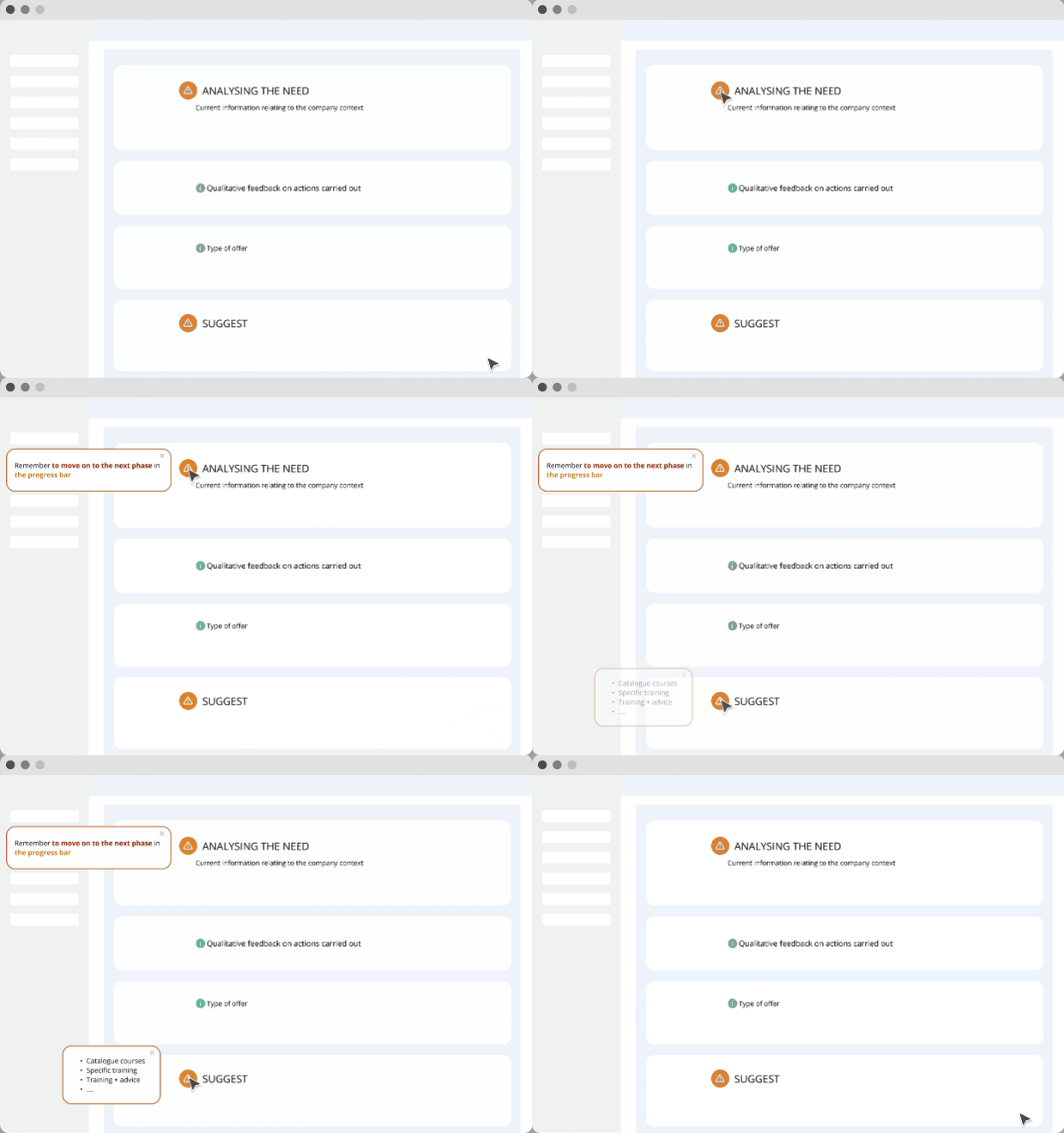
Interactive guides and contextual tooltips embedded directly inside an application deliver microlearning at the point of need. Instead of switching to a separate training portal, employees see step-by-step instructions overlaid on the interface they are already using. This approach reduces frustration, lowers support ticket volume, and accelerates proficiency.
Real-world example: OPP BTP and CRM Dynamics
OPP BTP used Lemon Learning to support its rollout of an updated CRM (Customer Relationship Management) Dynamics platform. By deploying push notifications, interactive process guides, and contextual tooltips directly inside the application, OPP BTP reduced support and training requests to near zero. Employees learned by doing, in the flow of actual work, rather than through a separate course.
What Are the Practical Applications of Microlearning?
Microlearning applies across a wide range of corporate training scenarios. Below are the most common use cases.
Digital tool onboarding
Short guided modules help employees get up to speed on new software quickly. Rather than overwhelming new users with a full-day training session, organizations deploy a series of focused modules covering one feature or workflow at a time.
Blended and remote learning programs
Microlearning modules serve as pre-work, reinforcement, or follow-up content within blended learning programs that combine in-person and remote instruction. A learner might attend a live session to understand a concept, then use a short module to practice applying it in their specific tool or process. For an overview of how different instructional approaches compare, the guide on the five main learning models provides useful context.
Compliance and process refreshers
Regulations and internal procedures change regularly. A short microlearning module can communicate an update to a specific policy or process far more efficiently than a reissued policy document or an all-hands email with an attached PDF.
Sales and customer-facing role enablement
Teams in customer-facing roles benefit from quick-access modules covering product updates, objection handling, or new tool features. Content delivered at the moment of need, before a call or meeting, is more effective than content consumed weeks earlier in a scheduled course.
How Does Lemon Learning Support Microlearning Delivery?
Lemon Learning is a Digital Adoption Platform (DAP) that embeds microlearning content directly inside business applications. Interactive guides, tooltips, and push notifications appear in context, within the software an employee is already using, so training happens in the flow of real work rather than in a separate learning environment. For organizations investing in employee training and development programs, the Lemon Learning learning and development solution shows how in-app microlearning integrates with broader L&D strategies.
Microlearning is not a replacement for structured learning programs. It is a complement that fills the gaps: delivering the right information, in the right format, at the moment an employee needs it to do their job. When designed around a single, clear objective and made available on demand, microlearning is one of the most practical tools available to modern L&D and HR teams.
FAQ
Frequently asked questions
What is microlearning?+
Microlearning is a training approach that delivers short, focused learning content aimed at a single objective. According to the Association for Talent Development (ATD), microlearning supports learning and performance through short pieces of instructional content that learners can access on demand.
How long is a typical microlearning module?+
Most sources agree that a microlearning module runs between 2 and 10 minutes. Some activities, such as a quick quiz or an in-app tooltip, can be as short as 30 seconds. The key principle is that the module covers exactly one learning objective and no more.
Does microlearning work?+
Evidence and practitioner consensus indicate that microlearning improves knowledge retention and engagement when content is focused on a single goal and delivered at the moment of need. Its effectiveness depends on clear objectives, relevant format choices, and integration with broader learning programs rather than use in isolation.
Can microlearning replace a full training session or a quick meeting?+
Microlearning is best used as a complement to, not a replacement for, structured training. However, for narrowly scoped topics such as how to complete a specific software task, a well-designed microlearning module can deliver the same outcome as a short instructional meeting, with the added advantage that learners can revisit it on demand.
Learn what a RACI matrix is, what each letter stands for, how it works in project management, and how to build one that clarifies every role on your...