How to Select the Right SaaS ERP Software for Your Business in 2026
Compare leading SaaS ERP vendors, learn how to select the right ERP software for your business, and access our free interactive ERP vendor list for 2026.
The right ERP (Enterprise Resource Planning) system can transform how your organization manages finance, operations, supply chain, and people. The short answer: the best SaaS ERP vendor for your business depends on your company size, industry vertical, budget, and integration requirements. Use the interactive vendor list below as your starting point, then apply the selection framework in this guide.
What Is SaaS ERP and Why Does It Matter?
SaaS ERP software delivers ERP (Enterprise Resource Planning) functionality over the internet on a subscription basis, eliminating the need to manage on-premise servers or lengthy upgrade cycles. Unlike traditional on-premise deployments, a SaaS ERP system is maintained and updated by the vendor, which reduces internal IT overhead and accelerates time-to-value.
One of the most cited advantages of the SaaS model comes from Jean-Severin Lerre, DSI (Chief Information Officer) at INSEE, speaking on the Lemon Learning podcast:
"One advantage I see in SaaS is that it standardises things. A traditional business function says mine is very different, whereas in SaaS mode they see the most widely used standard way of doing things, and that lets them challenge their own practices."
Jean-Severin Lerre, DSI, INSEE, on the CIO Pioneers podcast
For companies weighing the switch, the on-premise to SaaS migration journey involves more than a technical lift: it requires process re-evaluation and change management from day one.
Who Are the Leading SaaS ERP Vendors?
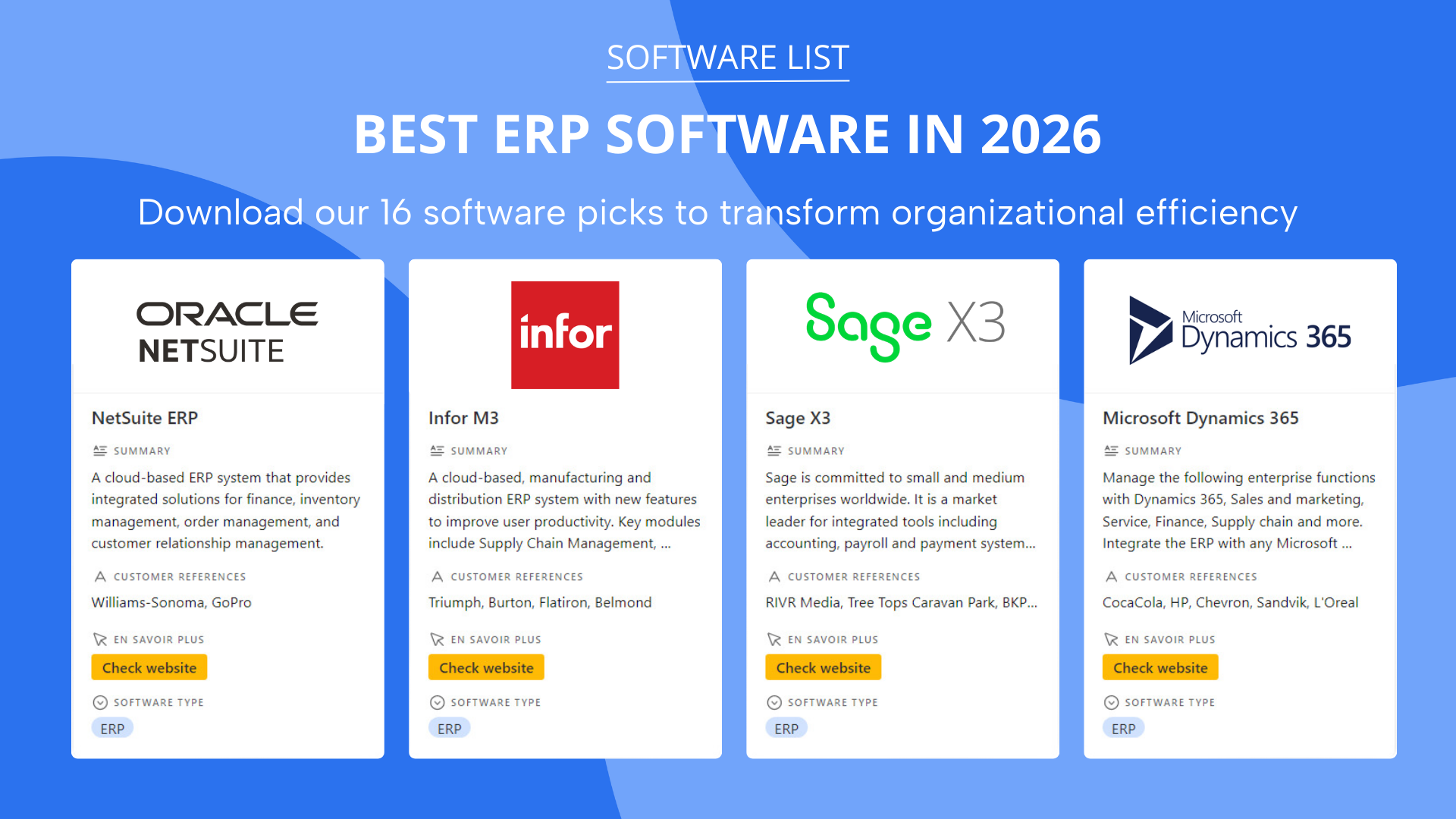
The SaaS ERP market includes vendors that serve organizations ranging from fast-growing startups to global enterprises. The table below summarizes the most frequently cited platforms by market segment.
How Do You Select the Right ERP Software for Your Business?
Selecting the right ERP system requires a structured approach. Rushing the evaluation phase is one of the most common reasons ERP projects underdeliver. Follow these steps:
1. Define Your Core Requirements
List the business processes the ERP must support: finance, procurement, inventory, HR, project management, or a combination. Prioritize must-have features versus nice-to-haves before approaching any vendor.
2. Match Vendor Strengths to Your Industry
SaaS ERP solutions are not one-size-fits-all. Manufacturing businesses benefit from vendors like Epicor Kinetic or Infor CloudSuite. SaaS companies and service businesses frequently favor Oracle NetSuite or Workday. Retail and logistics operations have their own specialist options.
3. Evaluate Total Cost of Ownership
Subscription fees are only part of the cost. Factor in implementation, data migration, training, customization, and ongoing support. For growing teams seeking the most affordable ERP software, open-source platforms such as Odoo Community or ERPNext can reduce license costs, though implementation and maintenance investment remains significant.
4. Assess Integration Capabilities
Your ERP must connect with existing tools: CRM (Customer Relationship Management), HRIS (Human Resources Information System), e-commerce platforms, and reporting tools. Verify available APIs (Application Programming Interfaces) and pre-built connectors before committing.
5. Plan for User Adoption Early
Technology alone does not deliver ROI (Return on Investment). A new ERP system is only as effective as its adoption rate. Many ERP implementations struggle not because of the software itself, but because end users lack the in-context guidance needed to build competence quickly. Lemon Learning's learning and development solution for software training helps teams build skills directly inside the ERP interface, reducing support tickets and accelerating time-to-competency.
Interactive SaaS ERP Vendor List
The embedded table below covers 16 ERP vendors across deployment type, company size, and industry focus. Use the filter and search controls to shortlist candidates that match your criteria.
What Should You Do After Choosing an ERP?
Selecting a vendor is the beginning, not the end. The implementation phase, data migration, process redesign, and user training all determine whether your investment pays off. Review the most common ERP implementation challenges before finalizing your project plan, so your team can address the most frequent failure points before they occur.
A structured onboarding and training program, supported by in-application guidance, is one of the most reliable ways to protect your ERP investment and ensure your organization gets the full value of its new SaaS ERP system.
FAQ
Frequently asked questions
What are the top 10 ERP systems?+
The most widely recognized ERP systems include SAP S/4HANA, Oracle NetSuite, Microsoft Dynamics 365, Sage X3, Epicor Kinetic, Acumatica Cloud ERP, Infor CloudSuite, Odoo, IFS Cloud, and Workday. The best fit depends on company size, industry, and deployment preference (cloud vs. on-premise).
Which ERP software is free?+
Several open-source ERP platforms are available at no license cost, including Odoo Community Edition, ERPNext, Dolibarr, and iDempiere. However, free software still requires implementation, hosting, and maintenance investment, so total cost of ownership is rarely zero.
What are common ERP software examples?+
Common ERP software examples span multiple industries and sizes. SAP and Oracle dominate large enterprises. Microsoft Dynamics 365, Sage, and Epicor are popular with mid-market businesses. Odoo and ERPNext are frequently adopted by smaller or budget-conscious organizations. NetSuite is a leading choice for SaaS companies.
What is replacing SAP?+
No single system is universally replacing SAP. Organizations moving away from on-premise SAP installations often migrate to SAP S/4HANA (SAP's own cloud ERP), Oracle NetSuite, Microsoft Dynamics 365, or Workday, depending on their industry and scale. Cloud-native and modular ERP platforms are increasingly preferred over monolithic legacy systems.