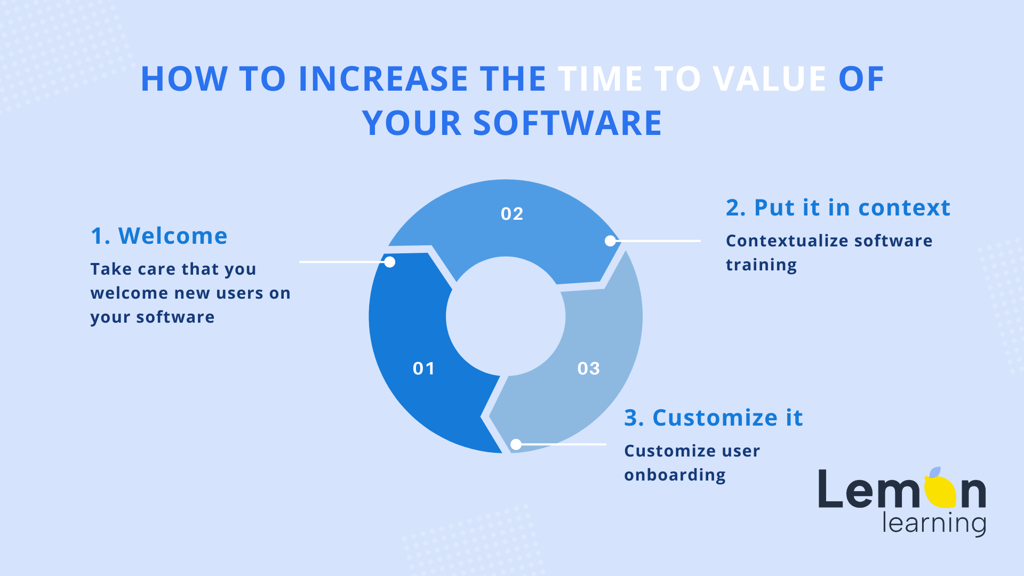
1. Welcome: make new users feel at home in their software
2. Context: provide training inside the software
3. Customize user onboarding for every role
Procurement tools, CRM, HRIS, ERP, no software escapes user onboarding. It is a foundational step for handling digital solutions, and it sits at the center of critical business outcomes: user retention, software adoption, and employee performance.
What is less obvious is that the quality of your user onboarding directly shapes your Time to Value (TTV). The better your software makes a first impression, the faster users perceive its added value, and the more likely they are to use it consistently over time.
Here are three practical steps to run user onboarding in a way that shortens Time to Value and drives sustainable software adoption.
What is Time to Value?
Time to Value (TTV) definition
Time to Value (TTV) is the time it takes for a new user to realize the added value of a solution or product. That value can be short-term or long-term. When adopting a new HRIS, for example, short-term value might be quickly submitting an expense report, while long-term value might be automating HR workflows across the organization.
In short, TTV comes down to one question:
How long does it take your users to perceive the added value of your solution?
Why Time to Value matters for software
Implementing software is a significant investment, in licensing or cloud subscriptions, and in the people needed to support deployment over time (change management, training, application support). On top of those fixed costs, there are performance costs that can be reduced:
The cost of low digital competence when users are not well trained.
The cost of abandoned software when users are not engaged.
How long does it take your users to handle their software and become fully operational?
The more your tools are actively used, the more those performance costs shrink. Improving Time to Value is one of the clearest levers for getting there.
1. Welcome: make new users feel at home in their software
You would not welcome a new employee without greeting them. The same principle applies to digital tools. Using new software is similar to starting a new job: it takes time to find your footing, adapt, and become productive. That is why it is essential to help users feel confident from the very first interaction.
The first impression is decisive for Time to Value. The more users appreciate their onboarding on their digital tools, the faster they perceive added value, and the more likely they are to use those tools consistently. A poor first experience, on the other hand, erodes both engagement and retention before momentum can build.
Communicate with new users from within their software
Think about the first time you logged into Slack, Trello, or G Suite and received a welcome message inside the app. That kind of warm, relevant, in-context communication sets the tone for the entire user experience.
With Lemon Learning, you can deliver that experience on any software. Push notifications and tooltips can be created, modified, and sent to users in just a few clicks, right from their first login, without any developer involvement.
2. Context: provide training inside the software
Software training is a cornerstone of user onboarding. But the format matters as much as the content.
Training has a direct impact on Time to Value, but only when it is delivered in a way that sticks. Engagement, relevance, accessibility: these are the real challenges. The most effective answer is simple:
Practice makes perfect, but only in the right context.
Consider a trainee blacksmith. They do not learn to forge at the dinner table or on the road. They need the right environment, with the right tools, at the right moment. New software users are no different: they cannot learn effectively outside the software itself, and they need guidance at the exact moment they need it. This is the foundation of digital adoption.
Classroom sessions and static documentation often fall flat. As Alexis de Nervaux, CDIO at Icade, put it: "PowerPoint guides are change management of the old world. The open rate of an email with a PowerPoint guide? Generally 5%."
Invest in practical, contextual software training
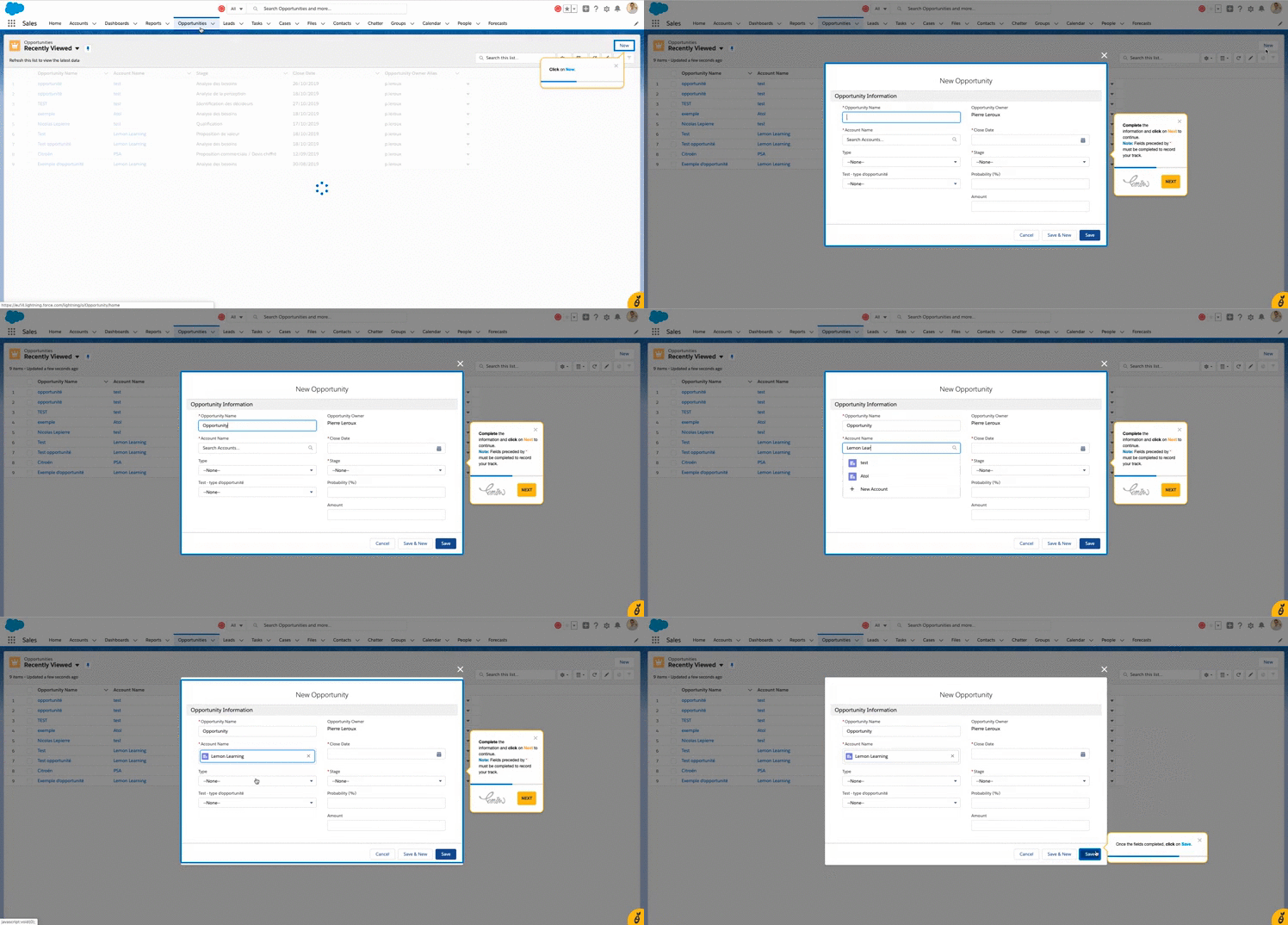
With Lemon Learning, users learn by doing. Interactive guides are available in real time, directly inside the software, so users can complete tasks and build confidence without ever leaving their workflow. Need to create a new opportunity in Salesforce or manage bookmarks in Oracle? The guidance is right there.
Think about your Netflix or Pinterest profile compared to someone else's. The content is completely different, and that personalization is precisely why those platforms are so engaging. User onboarding works the same way: generic content creates friction; relevant content creates value.
74% of potential customers may switch to a competitor if the onboarding process is too complicated. (Akita)
Personalization directly affects the quality of Time to Value. When onboarding content matches a user's role, language, and context, they reach their first moment of value faster, and they are more likely to stay engaged beyond that point.
Customization made easy
Personalizing onboarding for every employee sounds expensive in time and effort. With Lemon Learning, it does not have to be. You can push content tailored by department, language, or role with just a few clicks, no need to maintain separate training manuals, videos, or documents for each audience.
Try our solution
To sum up: user onboarding is a direct lever for improving Time to Value. Welcoming users in context, delivering contextual training at the moment of need, and personalizing content by role are the three steps that help users grasp the value of your software, both quickly and durably.
One final point worth remembering: user onboarding never truly ends. Every software update, new feature, or process change is a new onboarding moment. Building a continuous onboarding approach is what separates short-term adoption from long-term digital transformation.
SOURCES
Successful customer onboarding never stops, Inside Intercom, 2016.
Les bonnes pratiques à respecter pour réussir l'onboarding de vos utilisateurs, La Fabrique du Net, 2018.
Time to Value, Baremetrics.
Request a Demo
FAQ
Frequently asked questions
What is Time to Value in onboarding?+
Time to Value (TTV) is the time it takes a new user to experience meaningful benefit from a product or software after signing up. In onboarding, the goal is to shorten that gap so users reach their 'aha' moment as quickly as possible.
How can you reduce Time to Value during software onboarding?+
The three most effective levers are: welcoming users with in-app communication, providing contextual and hands-on training inside the software, and personalizing onboarding content by role, department, or language.