Organizational Development Strategies for a High-Performing Organization
Discover what organizational development means, the core strategies behind it, and how to measure OD success to keep your business competitive and growing.
Organizational development (OD) is a planned, systematic process of changing strategies, structures, and culture to improve organizational performance. In practical terms, it means putting deliberate interventions in place so that every part of the business, from leadership to frontline teams, operates with greater effectiveness. This article explains what OD involves, the strategies that drive it, and how to measure whether those strategies are working.
What is organizational development and why does it matter?
Organizational development is an effort that is planned, organization-wide, and managed from the top, aimed at increasing an organization's effectiveness and long-term health. According to the Association for Talent Development, OD improves a company's capability through the alignment of strategy, structure, people, rewards, metrics, and management processes. It goes beyond fixing immediate problems: OD creates the conditions for sustained growth and adaptability.
OD draws on three intersecting dimensions: the rational (structures, processes, and metrics), the relational (team dynamics and communication), and the emotional (values, culture, and trust). By working across all three, organizations can eliminate sources of friction and build environments where people perform at their best.
OD can be applied to a single team, a department, or an entire enterprise. Regardless of scope, it requires deliberate planning, specialist expertise, and ongoing assessment. Practitioners involved may include HR (Human Resources) professionals, organizational design consultants, change managers, and social auditors, depending on the complexity of the initiative. Understanding the key steps of organizational change is a useful starting point before deploying any OD strategy.
What are the key strategies for effective organizational development?
While every organization faces a unique context, a set of proven strategies underpins most successful OD initiatives. The four described below form a practical framework that can be adapted to different organizational sizes and industries.
Strategic leadership
Effective organizational development starts at the top. Change agents and team leaders must work in alignment, setting clear objectives and guiding their teams to achieve them. Strong OD leaders share several characteristics: they communicate transparently, analyze situations carefully before acting, and adapt their plans as circumstances evolve. Leadership is not simply a driver of organizational change; it is also the most visible signal to employees that the organization is serious about improvement.
In practice, strategic leadership in OD means cascading goals from the executive level into team-level priorities, ensuring everyone understands how their work contributes to broader organizational outcomes.
Agile change management
Organizational change, when handled poorly, disrupts daily routines and erodes employee confidence. An agile approach to change management minimizes this disruption by breaking transformations into iterative cycles rather than forcing a single large rollout. Each iteration is reviewed, adjusted, and improved before the next begins.
The agile method works because it is built on transparency and active stakeholder involvement. Employees are not simply told what is changing; they participate in shaping and refining the process. This increases buy-in, reduces resistance, and makes the overall OD program more resilient. A structured change management process that incorporates these principles gives organizations a repeatable model for handling both major transformations and incremental adjustments.
Innovation and technology adoption
Technology is a critical enabler of organizational development. Digital tools improve collaboration, streamline communication, and allow teams to complete complex tasks more efficiently. Keeping pace with technological developments, from cloud-based collaboration platforms to AI-assisted analytics, helps organizations respond faster to market shifts and customer needs.
A Chief Information Officer (CIO) often leads the digital transformation dimension of OD, ensuring that new tools are adopted effectively and that they genuinely improve rather than complicate workflows. Lemon Learning's change management solution supports this by guiding employees through software adoption in real time, reducing the learning curve that typically accompanies new technology rollouts.
SWOT analysis as a strategic planning tool
SWOT (Strengths, Weaknesses, Opportunities, and Threats) analysis is one of the most widely used tools in organizational development planning. It gives decision-makers a structured way to assess internal capabilities and external conditions before committing to a development strategy.
SWOT Element
Focus
OD Application
Strengths
Internal advantages
Build strategies that leverage existing capabilities
Weaknesses
Internal gaps
Identify process or skills deficiencies to address first
Opportunities
External conditions
Align OD initiatives with market trends or unmet needs
Threats
External risks
Build organizational resilience against competitive or regulatory pressures
A thorough SWOT analysis examines every relevant indicator: technology capabilities, brand perception, organizational values, and the quality of interpersonal relationships across teams. The output is a set of concrete actions that convert weaknesses into opportunities. For instance, if the analysis reveals that poor working conditions are affecting performance, targeted interventions can be designed and measured.
How do you evaluate the effectiveness of organizational development strategies?
Measuring OD success requires both quantitative and qualitative methods. Using at least two complementary approaches gives a more complete and reliable picture of progress.
SMART objectives and KPIs
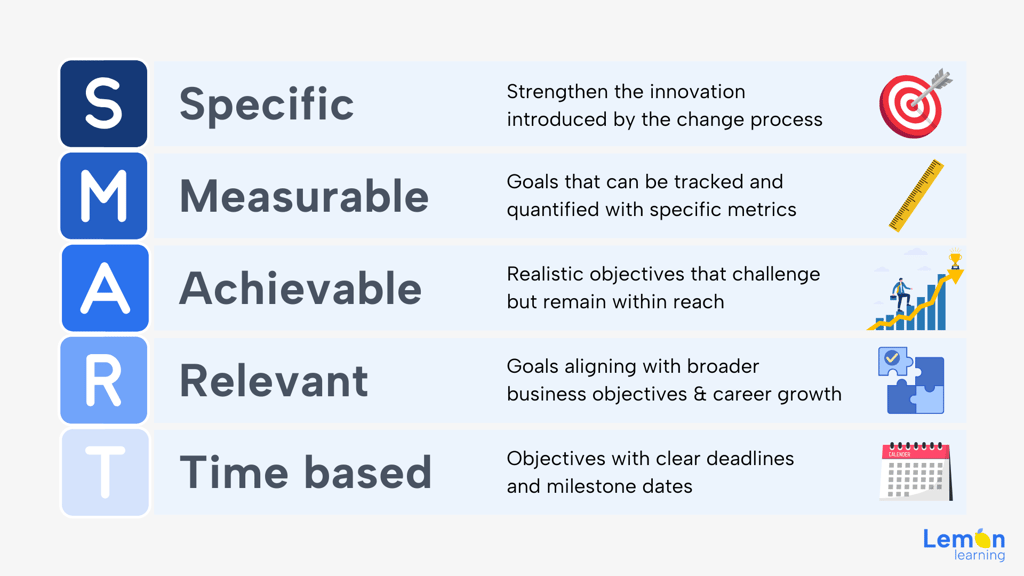
The most reliable starting point is defining SMART (Specific, Measurable, Achievable, Relevant, and Time-bound) objectives before any initiative begins. Once objectives are set, KPIs (Key Performance Indicators) tied to teams, customers, and business outcomes allow progress to be tracked at regular intervals. Examples include employee engagement scores, turnover rates, productivity metrics, and customer satisfaction results.
Direct employee feedback
Quantitative data tells you what is happening; employee feedback helps explain why. Surveys, one-on-one interviews, and focus groups give employees a structured way to share their perceptions of the change process. This qualitative layer often surfaces issues, such as communication gaps or unresolved concerns, that KPIs alone would not reveal. Regular feedback loops also reinforce the culture of transparency that effective OD depends on.
Benchmarking against peers
Comparing your organization's performance against similar organizations in the same sector provides external context for your results. Benchmarking helps distinguish between progress that is genuinely strong and progress that is merely acceptable relative to industry norms. It also highlights areas where competitors may have advanced further, signaling where future OD investments may be needed.
Frequently asked questions about organizational development
Question
Answer
What is the meaning of organizational development?
Organizational development (OD) is a planned, systematic process of improving an organization's effectiveness by aligning strategy, structure, people, rewards, metrics, and management processes. It uses evidence-based interventions to support growth, innovation, and cultural transformation.
What is the difference between HR and OD?
HR focuses on managing the employee lifecycle, including hiring, compensation, and compliance. OD focuses on planned change at a systems level, improving culture, team effectiveness, and organizational performance. HR manages people processes; OD redesigns how the organization works.
What are the 4 pillars of OB?
The four pillars of organizational behavior (OB) are people, structure, technology, and environment. Together these pillars explain how individuals and groups behave within organizations and how the organization adapts to its context.
What skills are needed for OD jobs?
OD professionals typically need skills in change management, data analysis, facilitation, organizational design, coaching, and communication. A background in business, psychology, or human resources is common, and many practitioners hold a master's degree in a related field.
FAQ
Frequently asked questions
What is the meaning of organizational development?+
Organizational development (OD) is a planned, systematic process of improving an organization's effectiveness by aligning its strategy, structure, people, rewards, metrics, and management processes. It uses evidence-based interventions to support growth, innovation, and cultural transformation.
What is the difference between HR and OD?+
Human Resources (HR) focuses on managing the employee lifecycle, including hiring, compensation, and compliance. Organizational development (OD) focuses on planned change at a systems level, improving culture, team effectiveness, and organizational performance. HR manages people processes; OD redesigns how the organization works.
What are the 4 pillars of OB?+
The four pillars of organizational behavior (OB) are typically identified as people, structure, technology, and environment. Together these pillars explain how individuals and groups act within organizations and how the organization adapts to its context.
What skills are needed for OD jobs?+
Organizational development professionals typically need skills in change management, data analysis, facilitation, organizational design, coaching, and communication. A background in business, psychology, or human resources is common, and many practitioners hold a master's degree in a related field.
Discover how the Kirkpatrick Model's four levels - Reaction, Learning, Behavior, and Results - help you measure training effectiveness and prove ROI...