The Best Procurement Software Tools for 2026: 21 Solutions to Know
Compare 21 top procurement software tools for 2026. Download the full list to find the best purchasing and procurement management solution for your...
Explore 9 product management frameworks used by Spotify, Amazon, Google, Netflix, and more. Find the right methodology to prioritize features and drive
Product management is the process of strategizing, developing, and optimizing a product throughout its lifecycle to meet both business and customer needs. It involves market research, roadmapping, feature prioritization, and aligning cross-functional teams. To structure these efforts efficiently, companies rely on product management frameworks -- methodologies that streamline decision-making and execution.
This article covers nine of the most effective product management frameworks and methodologies used by leading companies including Spotify, Amazon, Google, Facebook, and Netflix. Understanding these frameworks can help product managers optimize workflows, prioritize features, and drive sustainable growth.
Product teams rely on a range of frameworks to guide their work. The list below covers the most widely used product management frameworks, spanning prioritization models and strategic approaches adopted by leading companies.
A product management framework is a structured approach that guides how teams ideate, prioritize, develop, and iterate on products. These frameworks help teams stay aligned on goals, improve decision-making, and scale efficiently. Some focus on team structures (e.g., Spotify Squads), while others emphasize decision-making models (e.g., Amazon's Working Backwards).
Many successful companies have developed or adopted their own product management frameworks to enhance workflows and stay competitive. The sections below explore the approaches that industry leaders use to optimize product development.
Spotify popularized the Squad-based Agile model in the early 2010s to scale agile teams without bureaucracy. It was designed to balance autonomy and alignment across multiple product teams.
| Pros | Cons |
|---|---|
| Encourages independent decision-making | Hard to maintain alignment between squads |
| Promotes cross-functional collaboration | May lead to duplication of work |
| Scales agile development efficiently |
Amazon developed the Working Backwards method to prioritize customer needs over internal assumptions.
| Pros | Cons |
|---|---|
| Keeps customer needs at the center of product decisions | Time-intensive documentation process |
| Prevents wasted resources on low-impact features | Requires deep market understanding |
Google introduced the HEART framework to help product teams measure user experience (UX) metrics effectively.
HEART focuses on five key UX metrics:
| Pros | Cons |
|---|---|
| Provides quantifiable UX insights | Metrics can be subjective and hard to measure consistently |
| Helps optimize feature usability |
Facebook and other growth-focused companies use the North Star Metric (NSM) to align teams around a single key success indicator.
| Pros | Cons |
|---|---|
| Keeps teams focused on growth-driving activities | Can lead to short-term metric obsession |
| Helps align cross-functional teams | Not always suitable for early-stage products |
Netflix relies on A/B testing to validate features before full-scale deployment, making experimentation a core part of its product development process.
| Pros | Cons |
|---|---|
| Reduces the risk of failed product launches | Can slow down innovation cycles |
| Data-driven decision-making | Requires high user volume for accuracy |
Basecamp created the Shape Up methodology as an alternative to Scrum and Kanban, designed to give teams more focused, uninterrupted time to build.
| Pros | Cons |
|---|---|
| Prevents scope creep | Requires strong upfront planning |
| Encourages focused execution | Not ideal for fast-moving startups |
Effective prioritization helps product teams allocate resources wisely and focus on high-impact work. The three models below are among the most widely used in the industry.
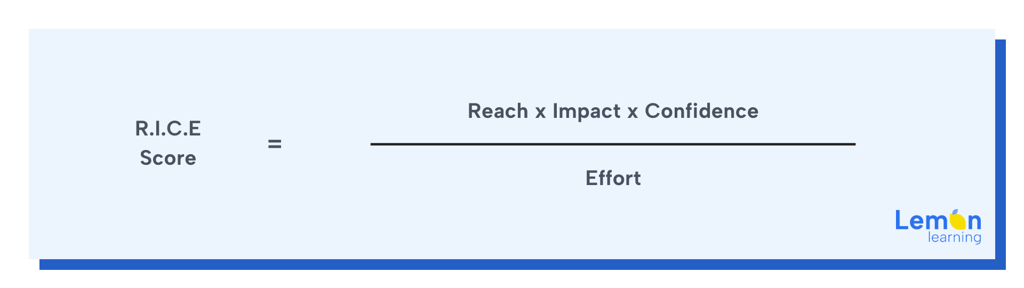
The RICE scoring model was developed by Intercom, a customer messaging platform, to help product teams objectively prioritize projects and features based on four key factors: Reach, Impact, Confidence, and Effort.
The RICE framework assigns numerical values to each of the following criteria:
The final RICE score is calculated using this formula:
| Pros | Cons |
|---|---|
| Objective Decision-Making -- Helps teams make data-backed prioritization decisions. | Requires Accurate Estimates -- Subjective scoring can lead to inaccurate prioritization. |
| Prevents Bias -- Encourages rational decision-making by breaking down assumptions. | May Not Capture Customer Sentiment -- Focuses on impact metrics rather than user perception. |
| Balances Effort vs. Impact -- Ensures that high-impact, low-effort tasks are prioritized first. |
Developed in the 1980s by Professor Noriaki Kano, the Kano model helps product teams categorize features based on how they impact customer satisfaction.
The model classifies features into three main categories:
The Kano model is especially useful for balancing customer expectations with development effort.
| Pros | Cons |
|---|---|
| Customer-Centric -- Helps teams prioritize based on real user needs. | Difficult to Quantify -- Requires customer surveys and qualitative insights. |
| Balances Effort vs. Satisfaction -- Ensures resources are used wisely. | Features Can Change Over Time -- Today's excitement features may become basic expectations later. |
| Enhances Innovation -- Encourages teams to introduce delightful features. |
The MoSCoW method was introduced by Dai Clegg while working at Oracle in the 1990s. It provides a simple framework for prioritizing product requirements based on business needs.
Features are divided into four categories:
| Pros | Cons |
|---|---|
| Simple & Intuitive -- Easy for teams to understand and apply. | Lacks Quantitative Scoring -- Decisions can be subjective. |
| Helps with Scope Management -- Prevents unnecessary features from creeping in. | May Overlook Customer Needs -- Focuses more on business needs than user desires. |
| Aligns Stakeholders -- Encourages agreement on priorities. |
Different frameworks serve different product needs. Use this quick reference to find the best starting point:
Many teams combine frameworks to maximize effectiveness. A company might use Spotify Squads for team structure while leveraging A/B Testing for product decisions -- and RICE scoring to prioritize what gets built next.
Frameworks guide product decisions, but understanding how users actually interact with your product is equally important. Digital Adoption Platforms (DAPs) provide the behavioral data and in-app support that help product teams act on their chosen frameworks more effectively. Lemon Learning, for example, can:
More specifically, a digital adoption platform enables product teams to:
By integrating DAP insights with product frameworks, teams can make more informed, user-centric decisions at every stage of the product lifecycle.
There is no one-size-fits-all approach to product management. The best product teams do not follow a single framework; instead, they adapt, combine, and refine different models to fit their unique challenges.
Whether you are using Spotify's Squads to encourage autonomy, Amazon's Working Backwards to stay customer-focused, or the RICE model to prioritize with data, the key is to stay flexible. Great product management is not just about following a framework -- it is about knowing when to adapt the rules to build something truly valuable.
Which framework fits your product team best?
Common product management frameworks include Spotify Squads, Amazon's Working Backwards, Google's HEART, the North Star Metric, RICE Scoring, the Kano Model, and the MoSCoW Method. Each addresses a different aspect of product development, from team structure to feature prioritization.
The 4 Ps of product management are Product, Price, Place, and Promotion. They form a classic marketing mix that helps teams position a product effectively in the market.
The four Agile frameworks most commonly referenced are Scrum, Kanban, SAFe (Scaled Agile Framework), and XP (Extreme Programming). Each provides a structured approach to iterative product development.
Compare 21 top procurement software tools for 2026. Download the full list to find the best purchasing and procurement management solution for your...
Learn what business process adoption means, why BPM adoption fails, and four proven steps to improve process adoption and user engagement across
Organizational change shapes every business. Learn the key types, proven frameworks like Kotter's 8-step model, and practical strategies for managing