ServiceNow runs IT service management, HR workflows, and customer operations for some of the largest organizations in the world. Yet deploying ServiceNow and getting your people to use it consistently are two different challenges. The gap between go-live and genuine ServiceNow adoption is where most enterprises lose time and budget.
This guide walks you through the tools, metrics, and frameworks CIOs need to evaluate and drive ServiceNow user adoption in 2026. You will find practical guidance on Digital Adoption Platforms (DAPs), in-app guidance, analytics, ROI tracking, and the organizational structures that keep adoption moving forward after the initial rollout.
Lemon Learning gives CIOs a structured way to accelerate ServiceNow adoption by delivering step-by-step interactive guides directly inside the platform, so your employees get help exactly when and where they need it.
Key Takeaways: ServiceNow Adoption Tools
- Successful ServiceNow adoption requires dedicated tools and ongoing measurement, not just a one-time deployment effort.
- Digital Adoption Platforms layer in-app guidance on top of ServiceNow to reduce support tickets and accelerate proficiency.
- User adoption metrics such as login frequency, feature engagement, and process completion rates reveal adoption health.
- ROI tracking connects adoption data to measurable business outcomes like reduced support costs and improved data quality.
- Lemon Learning delivers interactive in-app walkthroughs and analytics that help CIOs track and improve ServiceNow adoption.
What Is a ServiceNow Adoption Tool?
A ServiceNow adoption tool is any software or capability designed to help employees learn, use, and master ServiceNow workflows after the platform goes live. These tools sit on top of or integrate with ServiceNow to deliver contextual support at the moment employees need it.
The category includes Digital Adoption Platforms, in-app guidance systems, analytics dashboards, and AI-powered assistants. Each addresses a different aspect of the adoption challenge, from onboarding new users to tracking whether long-term employees are using the platform correctly.
The core principle is straightforward: technology only generates value when people use it as intended. Adoption tools close the gap between what ServiceNow can do and what your employees actually do with it.
Why Do Enterprises Need Dedicated ServiceNow Adoption Tools?
ServiceNow has hundreds of modules, configuration options, and workflow variants. For the average employee, navigating this depth is a real challenge. Without structured support, employees default to workarounds, email chains, or manual processes that undermine the entire investment.
According to a Prosci study on change management and project success, projects with structured change management are up to seven times more likely to meet their objectives. The same logic applies to ServiceNow: deployment without adoption support is a recipe for underperformance.
Dedicated adoption tools address three specific problems. First, they reduce time-to-competency by giving employees hands-on help inside the application. Second, they lower support costs by reducing the volume of repetitive help desk tickets. Third, they give IT leaders measurable data to demonstrate ROI to the executive team.
How Digital Adoption Platforms Support ServiceNow
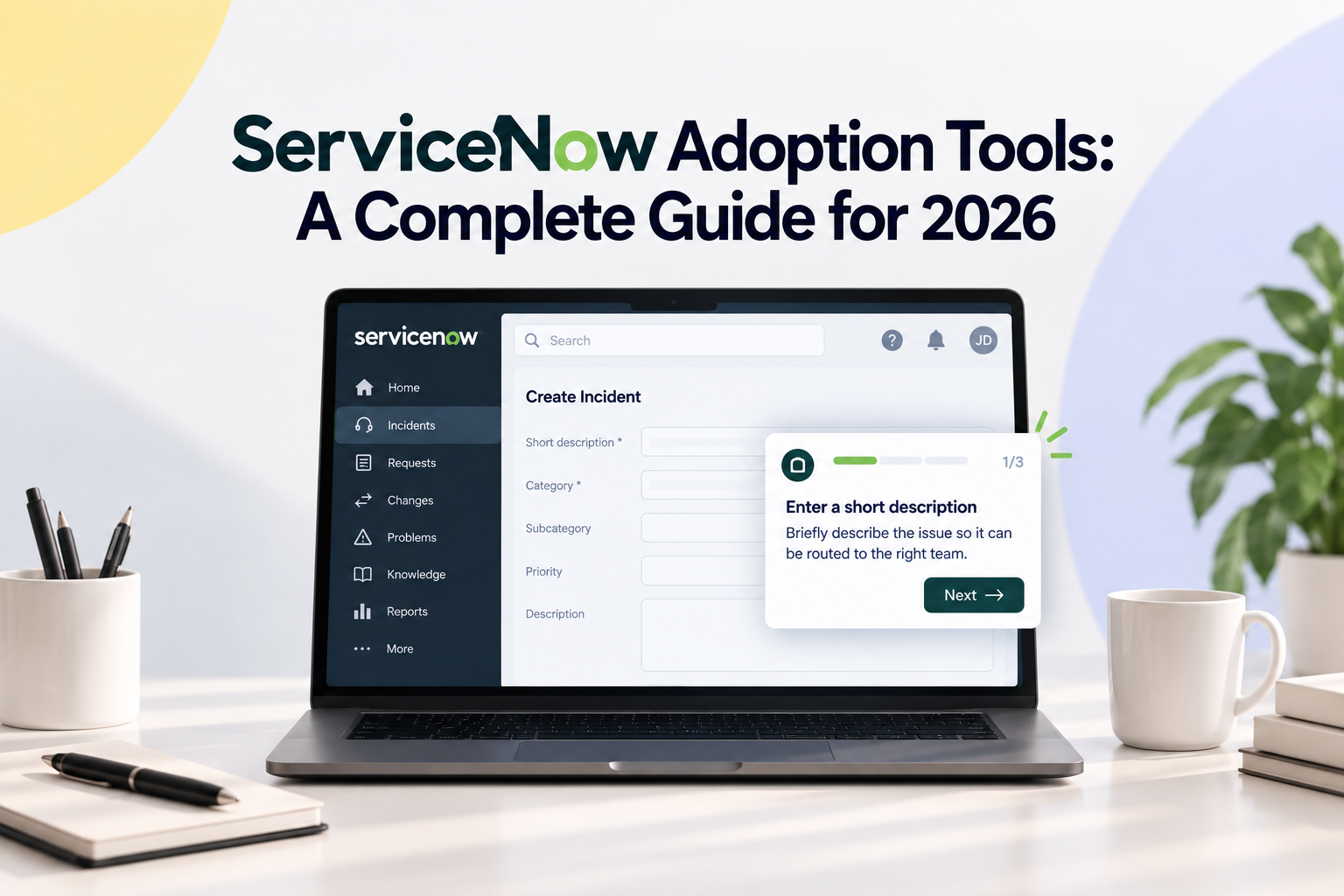
A Digital Adoption Platform (DAP) is a software layer that sits on top of ServiceNow and delivers in-app guidance to employees as they work. DAPs typically include interactive walkthroughs, tooltips, announcements, and resource centers, all designed to help users complete tasks without leaving the application.
For ServiceNow, a DAP means your employees do not need to recall what they learned in a training session weeks ago. Instead, they follow step-by-step instructions overlaid on the live interface, moving through incident management, HR case creation, or change requests with guided support.
The advantage of a DAP over ServiceNow's native adoption features is flexibility. A dedicated platform can cover ServiceNow along with your other enterprise applications, creating a consistent experience across your entire software portfolio. Lemon Learning supports ServiceNow as well as more than 300 other applications, including desktop and legacy tools that most DAPs do not support.
What Types of In-App Guidance Work for ServiceNow?
Not all in-app guidance formats serve the same purpose. Selecting the right format for each use case improves adoption outcomes significantly.
Interactive Walkthroughs for ServiceNow Workflows
Interactive walkthroughs guide employees through a process step by step, highlighting each button, field, and action in sequence. These are most valuable for complex, multi-step workflows such as incident creation, change management, or procurement requests.
Your employees follow a guided path through the live ServiceNow interface. Each step appears only when the previous one is completed, keeping the user on track without information overload.
Tooltips and Contextual Hints for ServiceNow Fields
Tooltips attach brief explanations to specific interface elements. When an employee hovers over or clicks on a confusing field in ServiceNow, they see a short description that clarifies what information is required.
This format works well for fields that have organizational-specific meanings, custom labels, or data entry requirements that differ from the ServiceNow default. Tooltips reduce data entry errors and improve record quality.
In-App Announcements for ServiceNow Updates
ServiceNow releases quarterly updates that introduce new features and interface changes. In-app announcements push targeted messages to specific user groups, informing them about what changed and where to find help.
Instead of sending an email that competes with hundreds of other messages, you reach employees directly inside the platform where the change is relevant. This approach ensures your communication lands at the right moment.
Self-Service Resource Centers Inside ServiceNow
A resource center creates a searchable hub inside the application where employees can find guides, documentation, and frequently asked questions on demand. When an employee gets stuck, they open the resource center and search for help without leaving ServiceNow.
This model supports employees who prefer to learn independently and reduces pressure on help desk teams. Over time, it builds a culture of self-sufficiency around ServiceNow usage.
How AI Assistance Accelerates ServiceNow Adoption
AI-powered assistants represent a newer category of adoption tool that answers employee questions in natural language directly inside the application. Instead of searching documentation or submitting a support ticket, employees type a question and receive a relevant answer or are directed to the appropriate guide.
ServiceNow's own Now Assist feature brings AI capabilities natively into the platform. However, activating Now Assist does not guarantee employees will use it effectively. The technology needs to be paired with organizational change management and clear communication about what it can and cannot do.
Lemon Learning's AI Assistant works inside ServiceNow to answer user questions and point them to the right interactive guide, reducing support load while keeping employees productive. This combination of AI response and guided action ensures employees get both immediate answers and hands-on help.
What ServiceNow User Adoption Metrics Should You Track?
Measuring adoption is essential for understanding whether your investment in ServiceNow is paying off. Without metrics, you are making decisions based on assumptions rather than evidence. The following categories of metrics give you a clear picture of adoption health.
Login and Usage Frequency Metrics
Track how many employees log in to ServiceNow, how often, and for how long. A steady decline in logins after the initial rollout period signals an adoption problem. Growing or stable usage indicates the platform is becoming a regular part of daily work.
Segment this data by department, role, and location. You may find that one business unit adopted ServiceNow quickly while another barely uses it. This granularity allows you to target interventions precisely.
Feature Engagement and Module Usage Metrics
Beyond logins, track which specific features and modules employees actually use. Incident management might see heavy traffic while HR service delivery remains barely used. This data helps you prioritize where to invest in additional guidance or communication.
Feature engagement metrics also reveal opportunities. If a feature is available but unused, it may indicate a training gap rather than a lack of need.
Process Completion and Drop-Off Rates
Process completion metrics track whether employees finish the workflows they start. If a significant number of users abandon a change request form at a specific step, that step has a problem that guidance can address.
Lemon Learning's guidance analytics show exactly where employees drop off during guided workflows. When you identify a consistent drop-off point, you can create or refine an in-app guide targeting that specific moment.
Support Ticket Volume and Topic Analysis
Support tickets are a lagging indicator of adoption failure. When employees cannot figure out how to do something in ServiceNow, they submit a ticket or call the help desk. Tracking ticket volume and categorizing tickets by topic tells you where adoption support is missing.
After deploying in-app guidance for a specific topic, monitor whether ticket volume decreases. This closed-loop measurement demonstrates the direct impact of your adoption tools.
How to Track ServiceNow Adoption ROI
Demonstrating return on investment keeps leadership engaged and secures resources for ongoing adoption work. ROI tracking connects your adoption metrics to business outcomes that executives understand.
Calculating Time Savings from Improved Adoption
Time savings are often the most visible benefit. Track the average time employees spend on key ServiceNow workflows before and after deploying adoption tools. Multiply the time saved per employee by your total user population and average labor cost.
For example, if 2,000 employees each save 8 minutes per day on ServiceNow tasks, that adds up to more than 5,500 hours annually. Translated into labor cost, the financial impact becomes concrete and presentable to your CFO.
Quantifying Support Cost Reduction
Every help desk ticket carries a cost: the agent's time, the employee's wait time, and the distraction from higher-value work. Track ticket volume for ServiceNow-related topics before and after your adoption initiatives.
Organizations using in-app guidance and analytics often report support ticket reductions of 50 percent or more for covered topics. With average ticket costs varying by organization, even a modest reduction translates into significant savings.
Measuring Data Quality and Process Compliance Improvements
When employees follow guided workflows, they enter data more consistently and make fewer errors. This improvement cascades through your organization: reports become more reliable, downstream processes run more smoothly, and audit findings decrease.
Track error rates, required corrections, and compliance audit results as indicators. While harder to quantify in direct financial terms, improved data quality is a high-value long-term benefit of better adoption.
Step-by-Step Guide to Evaluating ServiceNow Adoption Tools
Selecting the right adoption tool for your ServiceNow environment requires a structured evaluation process. The following steps help you move from requirements to a confident decision.
Step 1: Map Your Highest-Impact Workflows
Begin by identifying the ServiceNow workflows that touch the most employees or carry the most business risk. Incident management, HR case creation, change management, and procurement are common starting points.
Prioritize based on current pain points. Where are support tickets highest? Which processes have the most errors? Which departments report the lowest satisfaction with ServiceNow? These answers define where adoption tools will generate the most value.
Step 2: Audit Your Current Adoption Gaps
Review support ticket data, interview power users, and analyze any existing usage analytics. The goal is to understand where employees currently get stuck, which workflows they avoid, and what workarounds they have created.
This audit prevents you from investing in tools that address problems you do not have while overlooking the gaps that matter most.
Step 3: Define Your Evaluation Criteria
Key criteria for evaluating ServiceNow adoption tools include platform compatibility, no-code editing for non-technical teams, multi-application support, analytics depth, AI capabilities, localization for global teams, and integration with your existing technology stack.
Cross-application coverage is especially important if your organization runs ServiceNow alongside other enterprise platforms like SAP, Oracle, or Microsoft Dynamics 365. A tool that only covers ServiceNow leaves gaps in your broader adoption strategy.
Step 4: Run a Controlled Pilot
Deploy your shortlisted tools on two or three high-impact workflows with a defined user group. Measure support ticket volume, process completion rates, and user satisfaction before and after the pilot.
A pilot gives you real performance data rather than relying on vendor claims. It also reveals integration challenges, content creation effort, and the learning curve for your L&D or operations team.
Step 5: Measure Pilot Results and Scale
Compare pilot metrics against your pre-deployment baseline. Did support tickets decrease? Did process completion rates improve? Did employees report higher confidence with ServiceNow?
Successful pilot results justify a broader rollout. Plan your scale-up by department, region, or workflow, using the pilot learnings to refine your approach as you expand.
How to Build a ServiceNow Adoption Governance Structure
Adoption tools work best when they operate inside a governance framework that keeps the effort organized, funded, and aligned with business objectives.
Establishing a Center of Excellence for ServiceNow
A Center of Excellence (CoE) acts as the central authority for ServiceNow adoption. The CoE typically includes representatives from IT, L&D, HR, and business operations. Its responsibilities include setting adoption standards, prioritizing guide creation, and monitoring adoption metrics.
Executive sponsorship is essential. When leadership visibly supports the CoE and references adoption data in business reviews, employees take the initiative seriously.
Aligning Adoption Efforts with ServiceNow Release Cycles
ServiceNow releases quarterly updates that introduce new features and interface changes. Each release is both an opportunity and a risk for adoption. New features can accelerate value if employees know they exist and how to use them. Interface changes can break existing habits if employees are not warned and supported.
Plan your adoption communications and guide updates around ServiceNow's release schedule. Before each release, review the change log, update affected guides, and deploy in-app announcements to prepare your users.
How to Scale ServiceNow Adoption Across Global Teams
Multinational enterprises face additional adoption challenges around language, time zones, and regional business processes. A tool that works for your London office may need significant adaptation for your Tokyo or São Paulo teams.
Multi-Language In-App Guidance for ServiceNow
Employees learn most effectively in their native language. Delivering in-app guidance in multiple languages ensures your global workforce receives the same quality of support regardless of location.
Lemon Learning delivers guidance in any language through its integrated localization and user segmentation capabilities. Your administrator in Paris receives guides in French. The help desk agent in Berlin sees them in German. The HR coordinator in Tokyo gets Japanese guidance. Each employee receives relevant, localized support without any additional configuration burden on your IT team.
Role-Based Content Personalization for ServiceNow
A global rollout involves employees with vastly different relationships to ServiceNow. IT administrators, help desk agents, HR generalists, and end users all need different guidance at different levels of depth.
Content personalization adapts the guidance each employee receives to their role, department, and progress. This prevents the experienced IT administrator from seeing basic navigation tips while ensuring a new employee gets the onboarding support they need.
How to Address Resistance to ServiceNow Adoption
Even with the right tools and governance structure, some employees will resist changing their established habits. Addressing resistance requires understanding its root causes and responding constructively.
Identifying Sources of Adoption Resistance
Resistance to change is a predictable human response, not a sign of organizational failure. Employees may worry about looking incompetent, fear increased workload, or doubt that ServiceNow will be easier than their current methods. Previous failed software rollouts can also create deep skepticism.
These concerns are legitimate. Dismissing them or applying pressure does not resolve them. Acknowledging the difficulty and showing a clear pathway forward builds the trust necessary for sustained adoption.
Practical Strategies for Reducing Adoption Resistance
Involve employees early. When people participate in user acceptance testing or help shape workflows, they develop ownership over the outcome and become advocates rather than critics.
Highlight early wins publicly. When a team reduces ticket resolution time or completes more requests without errors, share those results. Visible success builds momentum and gives skeptics concrete evidence that the effort is worth it.
Make help invisible and immediate. In-app guidance allows employees to get support without admitting they need it. There is no social cost to following a walkthrough that appears on screen, which removes one of the most common barriers to asking for help.
Comparing In-App Guidance, AI Assistants, and Analytics for ServiceNow
These three categories of adoption tools serve different purposes and work best in combination. Understanding what each one does helps you build a complete adoption strategy.
In-app guidance (walkthroughs, tooltips, announcements) addresses the "how" question. It shows employees exactly what to do and where to click. This is the foundation of any adoption program because it directly reduces confusion and errors at the point of work.
AI assistants address the "what" question. They answer employee inquiries in natural language, surface relevant resources, and direct users to the right guide. AI assistants reduce help desk load and speed up answers for employees who prefer to ask rather than browse.
Analytics address the "whether" question. They tell you if adoption is happening, where it is breaking down, and what interventions are working. Without analytics, you cannot prioritize efforts, demonstrate ROI, or make data-driven decisions about where to invest next.
Lemon Learning combines all three capabilities in a single Digital Adoption Platform, connecting in-app guidance, AI assistance, and detailed analytics into one adoption system for ServiceNow and your broader application portfolio.
In Conclusion: Choosing the Right ServiceNow Adoption Approach
ServiceNow adoption is not a one-time project. It is an ongoing discipline that requires the right tools, the right metrics, and the right organizational structure. The tools you choose should deliver contextual, in-app support that meets employees where they work, track meaningful metrics that connect usage to business outcomes, and scale across your global operations.
Start by mapping your highest-impact workflows and auditing where adoption gaps exist today. Evaluate tools against criteria that matter for your organization: cross-application coverage, analytics depth, localization, and no-code editing. Run a controlled pilot, measure the results, and scale based on evidence.
The organizations that treat adoption as an ongoing investment rather than a deployment checkbox are the ones that extract real, measurable value from ServiceNow year after year.
FAQs