Comparison
The best WalkMe alternatives for 2026
WalkMe is a capable digital adoption platform, but since its acquisition by SAP its roadmap now answers to a parent company with its own priorities. For organizations built around Salesforce, Microsoft 365, Workday or custom tools, that changes the calculation. Here is a side-by-side look at the strongest WalkMe alternatives and how to choose.
Why look beyond WalkMe?
The best WalkMe alternatives, in one line each
WalkMe comes with real trade-offs for non-SAP organizations: a roadmap shaped by SAP, heavy technical implementation, opaque pricing and tiered support costs. If those constraints matter, these are the strongest alternatives to weigh.
- Lemon Learning. Best for European enterprises that need a fully supported, easy-to-deploy DAP with AI-powered guidance and EU data sovereignty.
- ClickLearn. Best for teams that need to produce training documentation at scale, in several formats, from a single process recording.
- Tango. Best for teams that want process experts, not developers, to build step-by-step guides and in-app walkthroughs across the browser-based tools they use.
- Whatfix. Best for large enterprises that need agentic AI, simulation-based training and governed content operations across complex, multi-application environments.
- Userlane. Best for organizations seeking straightforward, scalable in-app guidance with fast deployment and Microsoft 365 Copilot integration.
- Apty. Best for compliance-heavy enterprises that need adoption to extend beyond onboarding into day-to-day process execution and workflow accuracy.
- Newired. Best for public sector and enterprise teams that want a low-invasive guidance overlay for web-based applications.
What to look for in a WalkMe alternative
DAP evaluations that start with feature checklists often end with the wrong choice. Before comparing platforms, get clear on the decisions that actually move the needle for a non-SAP organization.
How the WalkMe alternatives compare
Lemon Learning
Our pickBest suited to: European enterprises that need a simple, sovereign and fully supported DAP covering the full adoption lifecycle, from onboarding to long-term governance.
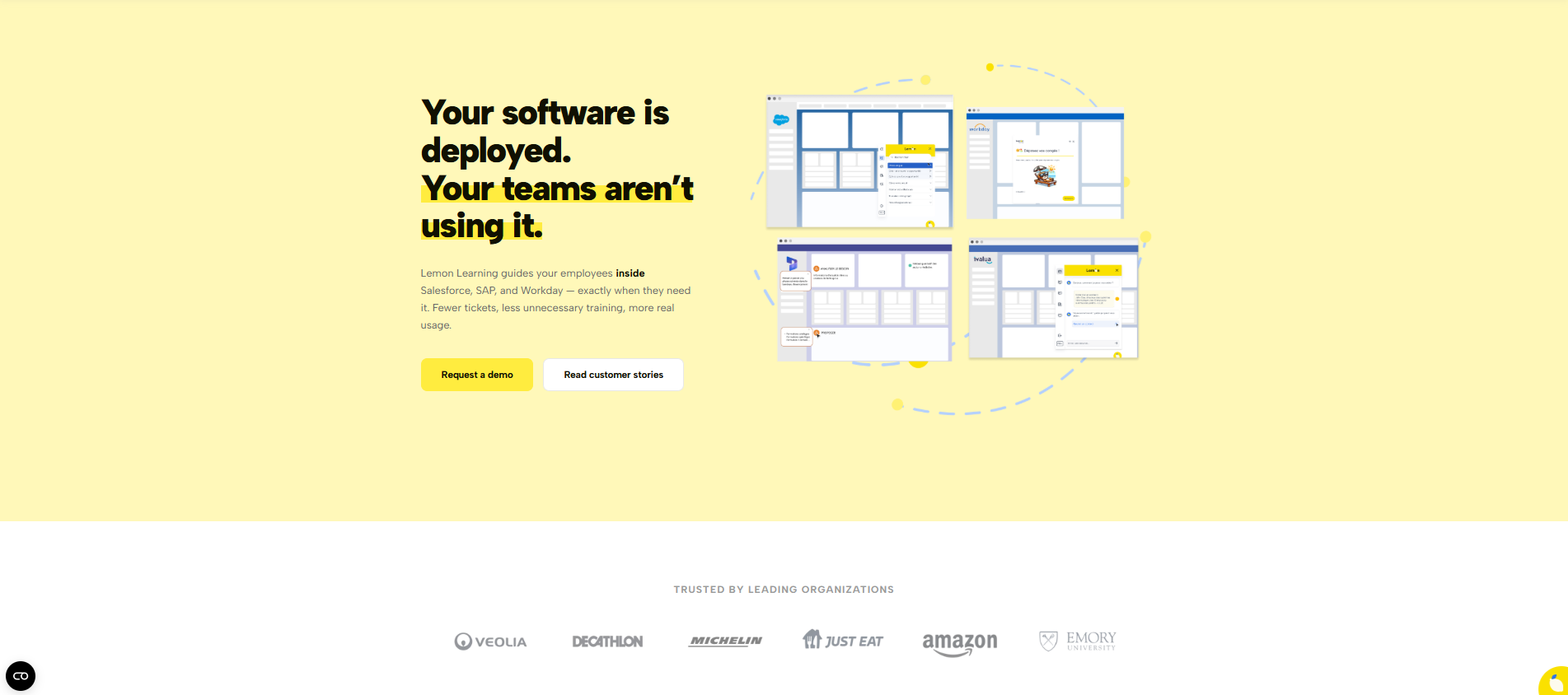
Lemon Learning is a European DAP referenced in the Gartner Market Guide for Digital Adoption Platforms (September 2025), with over 300 enterprise customers worldwide including BNP Paribas, Decathlon, Veolia, Schneider Electric and the French National Gendarmerie. It is built around a single premise: your software works, your teams just need to use it correctly. Crucially for buyers leaving WalkMe, it is independently operated, with no parent company agenda steering the roadmap.
What makes it different from WalkMe
For organizations evaluating both platforms, our Lemon Learning vs WalkMe comparison breaks down deployment, support, pricing, AI capabilities and enterprise readiness side by side.
- Deployment in days, not months. Integration is a JavaScript snippet or browser extension, and new admins are producing content in about three hours, versus weeks of technical configuration with WalkMe.
- Unlimited support included. Every license includes unlimited local support with a dedicated project manager, instructional designer and technical manager. No implementation fees, no escalating support costs.
- EU-sovereign by default. Hosted in Europe and GDPR-compliant by design. No configuration required and no verification with a legal team, which is a structural advantage for public sector, healthcare and financial services.
- Independent roadmap. No SAP ecosystem agenda. Investment and AI development stay aligned with customer needs across SAP, Salesforce, Microsoft 365, Workday and in-house tools alike.
- Governance beyond onboarding. Lemon Governance monitors software usage across tools, prevents Shadow IT and tracks adoption over time, taking the platform well into long-term program management.
- No desktop software for authors. Guides are built in the browser. The WalkMe Editor is a desktop application to install on Windows or macOS (WalkMe public documentation, read on November 18, 2026).
AI capabilities in 2026
- AI Assistant. The AI Assistant resolves user questions in natural language inside the app and launches the right guide automatically, cutting support ticket volume at scale.
- AI Content Creator. The AI authoring generates structured, step-by-step guides from a simple text prompt, with automated translation into any language.
Limitations to consider
Lemon Learning is built for internal employee adoption. If your primary need is customer-facing SaaS product onboarding, a product-led tool may fit better.
ClickLearn
Best suited to: Teams that need to produce training documentation at scale, in several formats, from a single process recording.
ClickLearn records a business process once and automatically generates step-by-step documents, videos and slides, ready to publish to an LMS or a knowledge base. When the application changes, the process can be re-recorded and the materials regenerated rather than rewritten by hand, which reduces the maintenance work that usually follows a large software rollout.
Where it fits
Organizations whose adoption program runs on formal training materials and LMS content, and that want one recording to feed every format their trainers and end users need.
Compared to Lemon Learning
ClickLearn focuses on producing training materials; Lemon Learning guides users inside the application while they work and measures real usage. Some teams use both: documentation for formal training, in-app guidance for day-to-day support.
Tango
Best suited to: Mid-market and enterprise teams that want the people who already know a process to turn it into guides and in-app walkthroughs across the browser-based tools they use, without a dedicated adoption team.
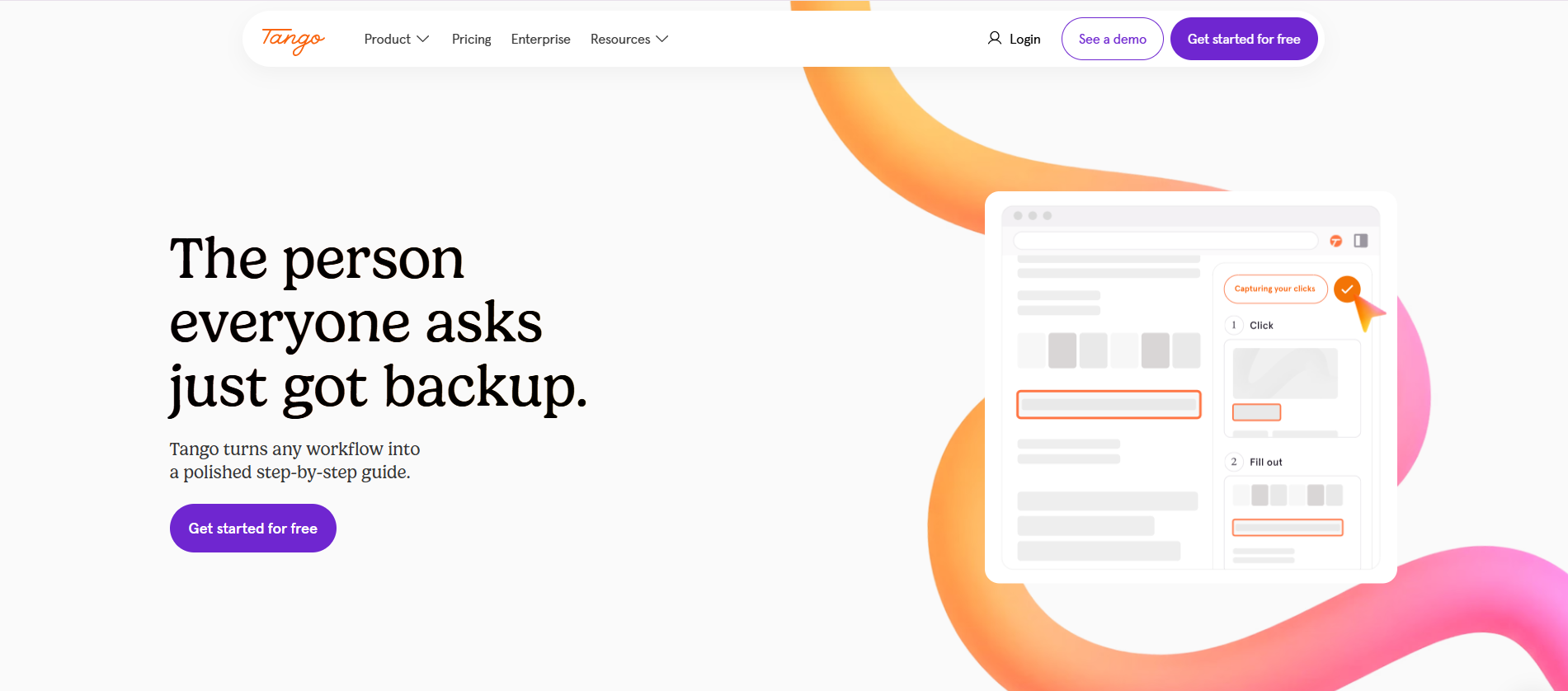
Tango is a browser extension that captures a workflow while someone performs it and turns it into a step-by-step guide with annotated screenshots. Guides can be shared as a link, embedded in SharePoint or a knowledge base, or surfaced inside the application, where Guide Me walks users through each click. Tango reports more than 1 million users and holds a 4.7/5 rating on G2 from over 500 reviews.
Where it excels
Deployment is light. There is no code snippet to install and no editor tied to a single application, so one walkthrough can carry a user from Salesforce into Oracle and then into a custom internal tool. Content is built by subject-matter experts rather than a central build team, which removes the request queue that tends to form around WalkMe. Enterprise pricing is a platform fee based on user count and covers unlimited applications. Enterprise plans also add automatic PII redaction, translation into 15 languages, SSO and SCIM, and Tango is SOC 2 Type II compliant.
Where it falls short
Tango offers less configuration than WalkMe. If you need branded pop-ups, segmented announcements or heavily customized tooltip campaigns, a traditional DAP gives you more control. In-app guidance runs in the browser, so it does not cover desktop-only applications, and Tango is a US-based provider.
Compared to Lemon Learning
Both avoid WalkMe's heavy technical deployment. Lemon Learning is the stronger fit for European organizations that need EU-sovereign hosting, dedicated support included in the license, and coverage of desktop and legacy applications. Tango fits teams that need documentation (SOPs, PDFs, embedded guides) as much as in-app guidance, and want process owners building it themselves across many web tools.
Whatfix
Best suited to: Large enterprises that need agentic AI, simulation-based training and governed content operations across complex, multi-application environments.
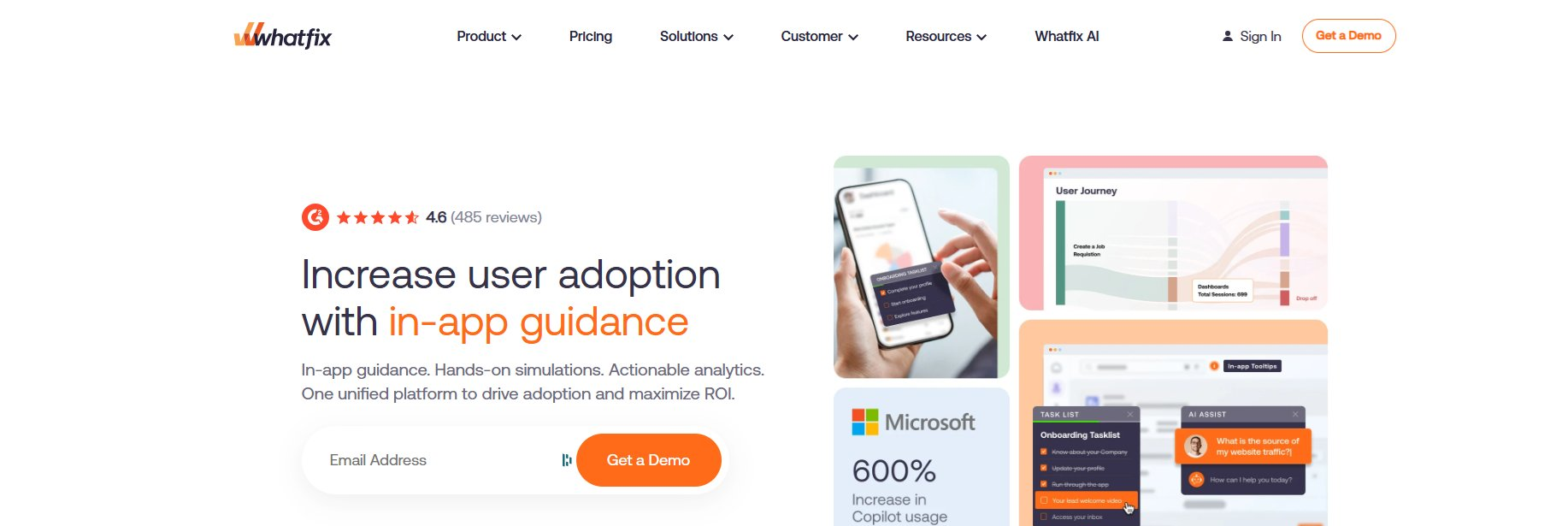
Whatfix is an enterprise DAP that runs as a suite of three products: the core DAP for in-app guidance, Product Analytics for behavior tracking, and Mirror for simulation-based training in pre-production environments.
Where it excels
Its AI features include an Authoring Agent, a Guidance Agent and an Insights Agent. For non-SAP buyers, its roadmap is not subject to SAP's priorities.
Where it falls short
Cost and complexity. Entry-level contracts typically start around $24,000 annually, with larger multi-application deployments running $40,000 to $70,000 or more per year. Product Analytics and Mirror are sold separately, and coverage of desktop applications is limited.
Compared to Lemon Learning
Lemon reaches production in days through lightweight integration and includes support in the license; Whatfix carries a heavier setup and sells key modules as add-ons. If you do not need Mirror simulation, the complexity premium is hard to justify.
Userlane
Best suited to: Organizations seeking straightforward, scalable in-app guidance with fast deployment and strong Microsoft ecosystem integration.
Userlane is a Munich-based DAP founded in 2015, built around simplicity and speed of deployment.
In 2025 it partnered with Microsoft on an AI Assistant integrated with Microsoft 365 Copilot. Its HEART framework (Happiness, Engagement, Adoption, Retention, Task Success) gives transformation leaders a structured way to measure outcomes across the program lifecycle.
Compared to Lemon Learning
Both deploy faster than WalkMe, whose average contract value sits around $79,000 per year. Userlane fits heavily Microsoft-dependent estates; Lemon Learning goes deeper on included support, desktop coverage, ready-to-use content libraries and full-lifecycle governance.
Apty
Best suited to: Compliance-heavy enterprises that need adoption to extend beyond onboarding into daily process execution, data accuracy and workflow standardization.
Apty is an AI-powered DAP built for enterprises where adoption means consistent process compliance, accurate data entry and measurable workflow outcomes. Apty PULSE gives a continuous diagnostic view of the technology stack with live adoption signals, Apty OneX is a GenAI copilot for cross-application workflows, and data validation flags incorrect or incomplete inputs during task completion, which is valuable in regulated industries.
Compared to Lemon Learning
Where compliance, audit trails and workflow enforcement are the primary requirement, Apty merits serious evaluation, and its pricing is structured around workflow depth rather than MAU escalations. Where the brief is adoption velocity, change management and included support, Lemon Learning is the stronger fit.
Newired
Best suited to: Public sector and enterprise teams that want a low-invasive guidance overlay for web-based applications.

Newired adds an interactive guidance overlay to web-based applications without programming, with a low-invasive integration model. It includes a chat interface that draws on existing knowledge bases, and a launcher that groups journeys, playbooks and resources.
Compared to Lemon Learning
Both aim for light deployment compared with WalkMe. Lemon Learning goes further on coverage, guiding native desktop applications such as SAP GUI, Citrix and .NET alongside web apps, and includes a dedicated project team with every license. It also measures real usage across your application landscape, adds governance with Shadow IT detection, and is ISO 27001 certified and hosted in Europe by default.
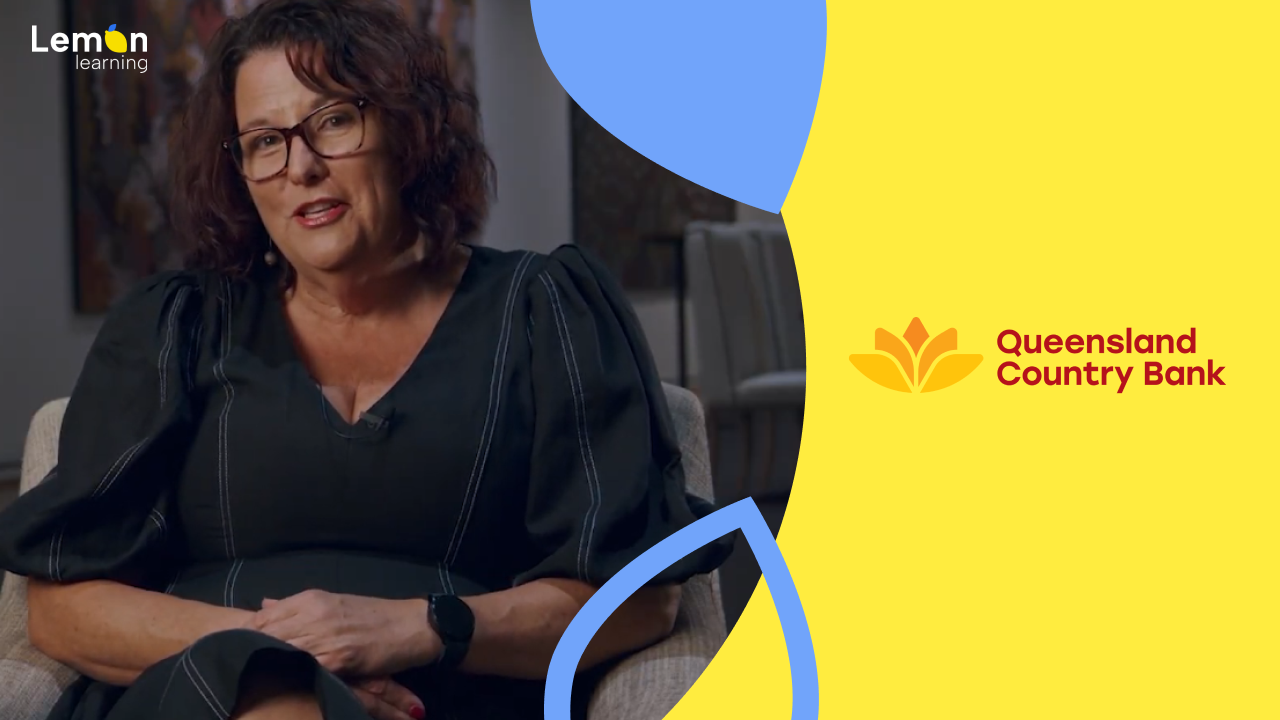
300+ bank staff guided in-app, with zero technical specialists
"Compared with other applications we had considered, which felt technical, process-driven, and even daunting, Lemon Learning stood out for its ease of use."
WalkMe alternatives, common questions.
What is the best WalkMe alternative? +
There is no single best one; it depends on your stack and constraints. For European or non-SAP enterprises that want simplicity, included support and EU sovereignty, Lemon Learning is the strongest fit. For simulation training, Whatfix. For Microsoft-heavy estates, Userlane. For process compliance, Apty. Our best digital adoption platforms guide compares them in depth.
Why are companies moving away from WalkMe? +
Since SAP completed its acquisition in September 2024, WalkMe's roadmap has been steered toward deep SAP ecosystem integration and the "Joule everywhere" AI strategy, with a WalkMe and SAP Enable Now consolidation scheduled for 2026/2027. For organizations built around Salesforce, Microsoft 365 or Workday, that creates a structural misalignment, on top of heavy implementation and opaque pricing.
How much does WalkMe cost? +
WalkMe pricing is custom and opaque, with average contract values around $79,000 per year according to Vendr data, and support billed in separate tiers. Lemon Learning pricing is available upon request, with per-tool or corporate annual licensing and unlimited local support included.
Is WalkMe still independent after the SAP acquisition? +
No. WalkMe is now part of SAP and embedded into SuccessFactors, Ariba, Concur and S/4HANA. SAP has committed to continued support for non-SAP applications, but product investment and AI development flow toward SAP's priorities, and the vendor relationship now runs through a company that competes with several platforms WalkMe sits on top of.
Who are WalkMe's main competitors? +
WalkMe's main competitors include Lemon Learning, Whatfix, Userlane, Apty and Newired. Each one is assessed on this page on price, setup effort and how autonomous your teams can be.
Is there a GDPR-compliant WalkMe alternative? +
Yes. Lemon Learning is EU-hosted by default and GDPR-compliant by design, with no US data-residency exposure, which is why it is often shortlisted by public sector, healthcare and financial-services teams leaving WalkMe. Userlane, based in Munich, is another European option.
Compare them on your own stack.
In 30 minutes we will run Lemon Learning on the actual tools you are evaluating, whether it is Salesforce, SAP, Workday or an in-house application. No generic walkthrough, just a tailored demo relevant to you.
Book a demo