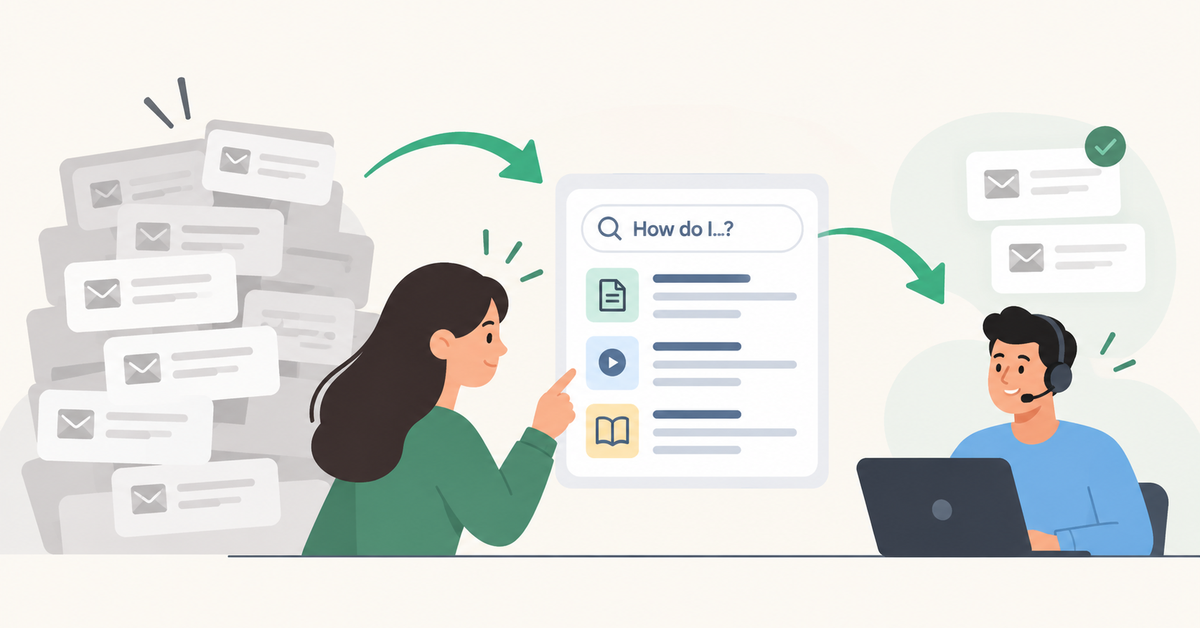
Every enterprise software rollout generates its own wave of support tickets. The same how-to questions land on your help desk week after week, pulling IT staff away from incidents that demand real expertise.
Lemon Learning gives CIOs a structured approach to support ticket deflection by delivering contextual guidance directly inside the applications your teams already use.
Choosing the right deflection tool requires more than a feature checklist. You need to evaluate application coverage, content creation speed, and measurement capabilities. This article walks through the key factors that separate effective deflection tools from the ones that add complexity instead of reducing it.
Key Takeaways: What to Look for in Support Ticket Deflection Tools
- Contextual in-app guidance reduces repetitive tickets by answering questions at the exact moment of need.
- Cross-application coverage ensures guidance follows users through processes that span multiple enterprise systems without gaps.
- No-code authoring lets L&D and operations teams build and update deflection content without any developer dependency.
- Lemon Learning delivers analytics that connect guide usage to measurable ticket reduction and adoption outcomes.
- Desktop and legacy application support closes the guidance gap that most browser-only adoption tools leave unaddressed.
Factors That Define an Effective Ticket Deflection Tool
1. Contextual In-App Guidance That Answers Questions Where They Arise
A deflection tool should place step-by-step instructions directly on the screen where your employee encounters a problem. When the answer appears inside the application, users resolve the issue themselves instead of opening a ticket.
Look for tools that trigger guidance based on the page, action, or user behavior. This context-sensitive delivery replaces the need for users to leave their workflow to search a knowledge base. According to a 2025 HDI report, self-service capabilities remain the highest-priority initiative for IT support leaders.
2. Cross-Application Workflow Coverage
Most enterprise processes span more than one application. An expense report might start in your HRIS, move through a finance tool, and end in an approval workflow on a separate platform. If your deflection tool can only guide users inside a single application, it leaves gaps wherever the process crosses system boundaries.
Evaluate how each tool handles multi-application guidance. Lemon Learning offers cross-app guidance that follows your users through a single process across several systems, keeping the workflow guided from start to finish.
3. No-Code Content Creation and Maintenance
Speed matters when your processes change. Quarterly software updates, new compliance requirements, and organizational restructuring all demand fresh guidance. If every content update requires a developer ticket, your deflection content will always lag behind reality.
Prioritize tools with a no-code editor that your L&D, HR, or operations teams can use independently. The goal is a content owner who is productive in hours, not weeks, and who can publish updates the same day a process changes.
4. Analytics That Connect Guidance to Ticket Reduction
Deploying guides is only useful if you can measure their effect. A deflection tool should track guide completions, drop-off points, and the relationship between content engagement and ticket volume over time.
Lemon Learning's guidance analytics show you exactly which steps cause abandonment and where users still need additional support. This data lets you iterate on your content based on evidence rather than assumptions, so each improvement cycle compounds the ticket reduction. METRO France, for example, reported an 80% drop in tickets after deploying in-app guidance.
5. Desktop and Legacy Application Support
Browser-based adoption tools cover only part of your enterprise stack. Many organizations still rely on thick-client software such as SAP GUI, Citrix-hosted environments, or custom .NET applications. If your deflection tool cannot reach these systems, the tickets they generate remain unresolved.
Confirm whether each tool supports desktop and legacy applications, not only modern SaaS. Lemon Learning extends in-app guidance to native desktop software, so the systems that generate the most repetitive questions are no longer left without guidance.
6. Self-Service Resource Center Inside the Application
A searchable, in-app hub centralizes guides, documents, videos, and procedures in one place. Instead of opening a separate portal or searching through multiple knowledge repositories, your employees access everything from a single panel inside the tool they are already working in.
This approach changes user behavior. When the path to an answer is shorter than the path to a support ticket, self-service becomes the default. Lemon Learning's resource center embeds that self-service hub directly in each application.
7. AI-Powered Assistance for Instant Answers
Some questions do not fit neatly into a step-by-step guide. Users may need to ask a specific question in natural language and receive an immediate, relevant answer. An AI assistant embedded in the application can handle these queries by drawing on your published guidance and knowledge base content.
This reduces the gap between structured guidance and ad hoc questions. When your published content powers the AI responses, accuracy stays high and your support team handles only the cases that require human expertise.
8. User Segmentation and Content Personalization
Different roles encounter different problems in the same application. A sales representative and a finance manager using the same CRM need different guidance on different screens. A deflection tool that sends the same content to every user misses opportunities to resolve role-specific questions before they become tickets.
Look for tools that let you segment users by role, department, geography, or language. Targeted content is more likely to answer the right question at the right moment, which directly reduces ticket volume.
9. Localization for Global Teams
If your organization operates across multiple countries, your deflection content must be available in the languages your employees work in. A tool that requires you to manually recreate every guide in each language multiplies your content workload and delays rollouts.
Lemon Learning includes built-in AI translation that converts a single source guide into multiple languages. Country leads validate the output, and the same content reaches every region without duplicating effort. This single-source model means one update propagates across all language versions simultaneously.
10. Measurable Integration with Your Existing IT Ecosystem
Your deflection tool must coexist with your current infrastructure. Evaluate how it integrates with your SSO provider, your analytics and reporting tools, and your existing knowledge base. A tool that creates another data silo adds administrative overhead instead of reducing it.
Confirm deployment options, hosting location, and compliance certifications. For regulated industries, European data hosting and native GDPR compliance are often non-negotiable requirements. Ask each vendor how data is encrypted in transit and at rest before shortlisting.
Why Lemon Learning Is the Best Ticket Deflection Platform for Enterprise IT
The factors above share a common thread: the most effective deflection tool is one that embeds structured, measurable guidance directly inside every application your teams use, including the desktop and legacy systems that browser-only tools cannot reach.
Lemon Learning covers that full scope. It delivers interactive guides, tooltips, a self-service resource center, and AI-powered assistance across 300+ applications, with no-code authoring, role-based segmentation, and analytics that tie guide performance to ticket reduction.
If you are ready to measure the impact on your own help desk, request a personalized demo on your actual applications.
FAQ