Change Fatigue: How to Recognize It and Help Your Team Recover
Change fatigue drains productivity and raises turnover. Learn to recognize the symptoms and apply proven strategies to restore employee energy and resilience.
Change fatigue is the exhaustion and passive disengagement employees develop when they face too many organizational changes in too short a period. It is a real and measurable barrier to productivity, retention, and morale, and it can be addressed with the right leadership behaviors and support systems. This article explains what change fatigue is, how to spot it, and what organizations can do about it.
What exactly is change fatigue?
Change fatigue is a general sense of apathy or passive resignation toward organizational change. According to Wikipedia's entry on change fatigue, it arises when too much change is introduced too quickly, leaving employees feeling that they have no control over their environment. Unlike active resistance, which is visible and vocal, change fatigue is quieter and therefore easier to miss until productivity has already dropped.
It can be triggered by any combination of organizational restructuring, leadership transitions, technology rollouts, process redesigns, or shifts in strategy. Because modern organizations routinely run several of these simultaneously, the condition has become widespread. Employees who experience it do not necessarily oppose any single change; they are simply overwhelmed by the cumulative load.
Change fatigue matters because its consequences are concrete. Disengaged employees make more errors, produce less, and are more likely to leave. That last point carries a financial cost that is difficult to ignore: replacing a single employee typically costs a significant fraction of their annual salary, and elevated turnover compounds quickly across a team.
What are the symptoms of change fatigue?
Recognizing change fatigue early allows leaders to intervene before the condition becomes entrenched. The following are the most reliable signals to watch for.
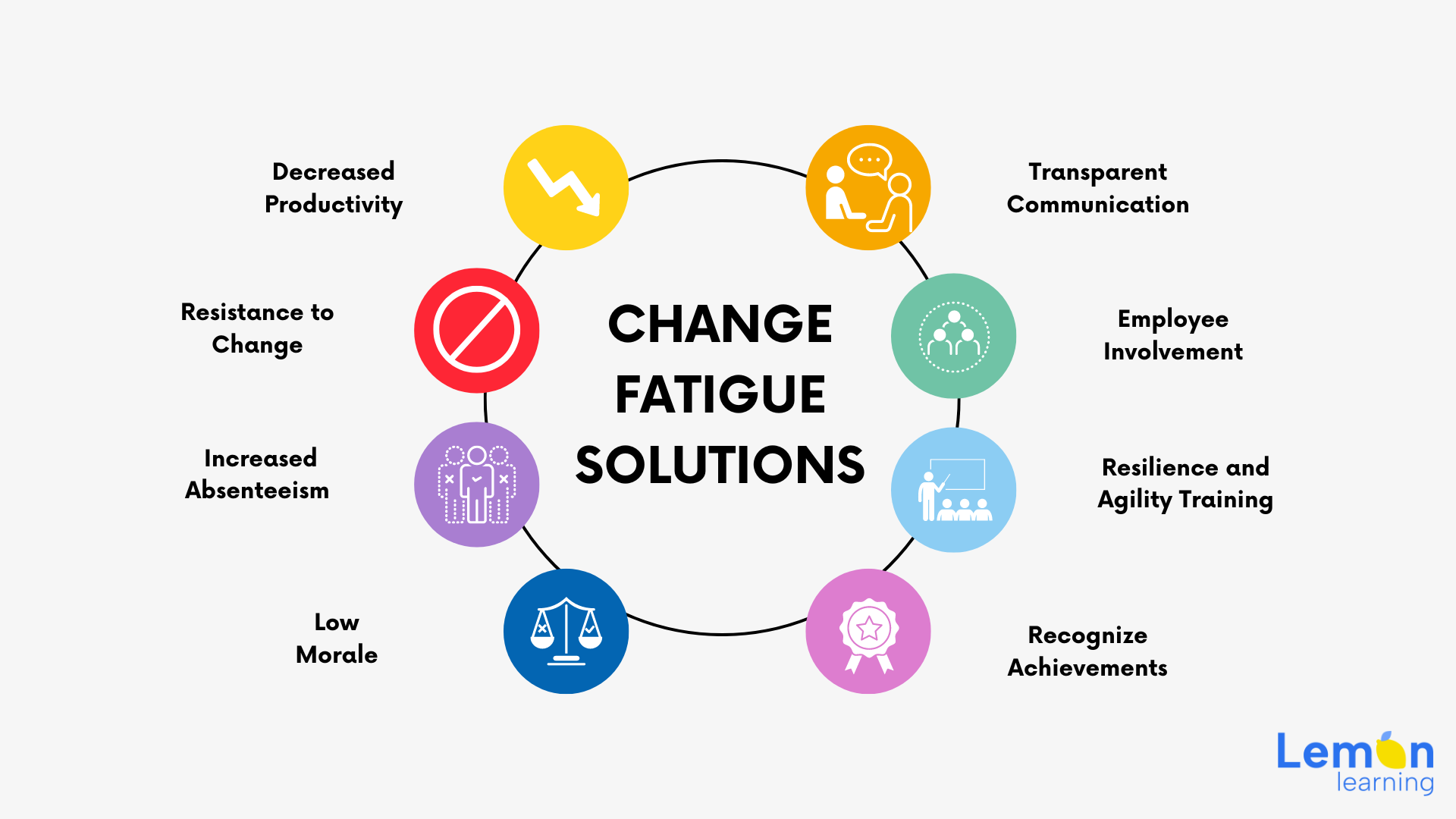
Decreased productivity
When employees are navigating unfamiliar processes or tools while also managing uncertainty about their roles, their output slows. Tasks that were once routine require more cognitive effort, deadlines slip, and error rates rise. This is not a motivation problem in isolation; it is a cognitive load problem caused by too many competing demands on working memory.
Resistance to change
Individuals affected by change fatigue often cling to familiar workflows even when a new approach is clearly better. This passive resistance is a common indicator that the change management process has not adequately prepared or supported the people it affects. Addressing the resistance without addressing its root cause rarely works.
Increased absenteeism
Employees who feel overwhelmed by change frequently disengage physically as well as emotionally. Rising unplanned absences are an early warning sign. Left unaddressed, absenteeism often precedes voluntary turnover, which is far more costly to the organization.
Low morale and cynicism
A pervasive sense of disillusionment can spread through a team surprisingly quickly. Research consistently shows that negative emotional states are socially contagious in workplace settings. One openly cynical employee can shift the tone of an entire group, reducing collaboration and psychological safety. The Center for Creative Leadership (CCL) notes that early signs of change fatigue often appear as aggressive cynicism before more visible disengagement sets in.
Physical symptoms
Sustained organizational stress can manifest physically. Employees experiencing change fatigue commonly report disrupted sleep, headaches, and persistent tiredness. When physical symptoms accompany emotional withdrawal, the individual is likely approaching or already experiencing burnout, which requires more structured intervention than change fatigue alone.
What causes change fatigue in organizations?
Understanding the causes helps leaders prevent the condition rather than simply treat it after the fact.
Cause
Why it contributes to fatigue
High volume of simultaneous changes
Employees cannot absorb and adapt to multiple initiatives at once; cognitive and emotional resources become depleted.
Poor or inconsistent communication
When the rationale for change is unclear, employees fill the gap with anxiety and rumor, increasing perceived threat.
Lack of employee involvement
Changes imposed from above without consultation remove employees' sense of agency, a primary driver of fatigue.
Insufficient training and support
Employees asked to use new tools or follow new processes without adequate preparation feel exposed and incompetent.
No recognition of effort or progress
Constant change with no acknowledgment of what has been achieved reinforces the feeling that nothing ever stabilizes.
Change overload without recovery time
Organizations that stack initiatives back-to-back leave no space for employees to consolidate learning and regain energy.
How can organizations overcome change fatigue?
Addressing change fatigue requires a structured, people-centered approach. The following strategies draw on established change management research and reflect the practical consensus of HR and leadership practitioners.
1. Communicate with clarity and consistency
Transparent communication is the single most cited intervention in change management research. Leaders should explain the reason for each change, describe what employees can expect, and provide honest updates when timelines or plans shift. Vague or infrequent messaging amplifies uncertainty. A consistent communication cadence, even when there is little new information to share, signals to employees that they are not being kept in the dark. This is a foundational element of any effective change management training program.
2. Involve employees in the change process
Participation reduces the sense of powerlessness that sits at the heart of change fatigue. Soliciting feedback, forming representative working groups, and incorporating employee suggestions into implementation plans all increase buy-in. Involvement does not require consensus on every decision; it requires that employees feel genuinely heard. This collaborative approach also surfaces practical problems earlier, when they are still easy to fix. Done well, it significantly helps with reducing resistance to organizational change.
3. Manage the change load deliberately
Not all changes are equally urgent. Organizations that sequence initiatives thoughtfully, building in consolidation periods between major rollouts, reduce the cumulative burden on employees. Before launching a new program, leaders should audit what is already in flight and assess whether the timing is realistic. Descaling daily operational demands to create capacity for change is a practical step that is often overlooked.
4. Provide targeted training and support
Change fatigue often intensifies when employees lack the skills to operate in the new environment. Providing timely, role-specific training reduces feelings of incompetence and helps people build confidence in unfamiliar processes. Support should be available at the point of need rather than delivered once in a classroom and then withdrawn. Lemon Learning's digital adoption platform embeds guidance directly inside the tools employees use, reducing friction during technology transitions and keeping support accessible throughout the change lifecycle. This on-the-job reinforcement approach is a practical way to address the skills gap that fuels fatigue, particularly in change management initiatives.
5. Recognize progress and celebrate milestones
One of the most corrosive aspects of constant change is the feeling that nothing ever settles or is ever good enough. Leaders can counter this by actively naming what has been accomplished. Recognition does not need to be elaborate; consistent, specific acknowledgment of effort and progress from direct managers is consistently rated as more meaningful than formal reward programs. Celebrating milestones, even small ones, gives employees a moment to pause and register that their work has had an effect.
6. Build a culture of psychological safety
Employees who feel safe raising concerns, admitting confusion, or asking for help adapt to change more effectively than those who do not. Psychological safety is not the same as a conflict-free workplace; it means that people can speak up without fear of embarrassment or punishment. Leaders build it through their own behavior: modeling vulnerability, responding constructively to bad news, and visibly valuing honesty over positivity.
7. Invest in resilience and agility skills
Resilience training equips employees with practical coping techniques that make them more adaptive over time. This can include stress management workshops, mindfulness programs, or structured reflection practices. Agile methodologies, which emphasize iterative progress and regular retrospectives, also help teams absorb change incrementally rather than in large disorienting waves. The goal is not to make employees indifferent to change but to give them reliable tools for processing it.
What role do leaders play in causing and solving change fatigue?
Leaders are both a primary cause of change fatigue and the most important lever for reducing it. Research published by Harvard Business Review points out that managers who introduce changes without adequate preparation, who communicate inconsistently, or who underestimate the cumulative burden on their teams are frequently the direct source of the fatigue their employees experience.
Conversely, leaders who act as "change agents" by maintaining energy and optimism, acknowledging difficulty honestly, and protecting their teams from unnecessary initiative overload can substantially reduce fatigue even in periods of intense organizational change. The CCL recommends that leaders consider their employees' change history before introducing anything new, treating each person's accumulated change experience as a finite resource that must be managed carefully.
Practical leadership behaviors that reduce change fatigue include:
Auditing the change load on any given team before approving new initiatives
Being honest about what is known, what is uncertain, and what will be communicated when
Checking in individually with employees rather than relying solely on group updates
Modeling adaptive behavior rather than projecting false certainty
Actively removing obstacles that slow adoption of new processes
Is change fatigue the same as burnout?
Change fatigue and burnout are related but distinct. Burnout is a state of chronic occupational stress that results in emotional exhaustion, depersonalization, and a reduced sense of personal accomplishment. Change fatigue is a specific condition triggered by change overload, and it is one of the pathways that can lead to burnout if left unaddressed.
An employee experiencing change fatigue may recover relatively quickly once the pace of change slows and adequate support is provided. An employee who has reached burnout typically requires a more substantial intervention, which may include reduced responsibilities, professional support, or extended recovery time. Organizations benefit from treating change fatigue as an early warning sign and intervening before it crosses into burnout territory.
Reducing change fatigue with the right tools and training
Change fatigue is not a passing trend or a matter of employees being resistant to progress. It is a predictable consequence of change being introduced faster than people can absorb it, without sufficient support, communication, or recovery time. Organizations that recognize this invest in the conditions that make change sustainable: clear communication, genuine employee involvement, structured training, and leadership that actively manages the change load.
Lemon Learning supports organizations navigating complex technology and process transitions by embedding guidance directly in the tools employees use every day. Rather than relying on one-off training sessions that fade quickly, the platform delivers contextual, on-demand support that reduces cognitive overload and builds genuine capability over time. The result is faster adoption, lower support costs, and a workforce better equipped to absorb whatever comes next.
Frequently asked questions about change fatigue
What is meant by change fatigue?
Change fatigue is a general sense of apathy, exhaustion, or passive resignation that employees develop when they are exposed to too many organizational changes in too short a time. It differs from ordinary stress in that it dulls motivation rather than triggering active resistance, leaving people feeling overwhelmed and disengaged.
How do you overcome change fatigue?
Overcoming change fatigue requires transparent communication about why changes are happening, involving employees in the process, spacing out initiatives to reduce change load, providing targeted training and support, recognizing achievements along the way, and building a psychologically safe culture where concerns can be raised openly.
Is change fatigue the same as burnout?
Change fatigue and burnout overlap but are not identical. Burnout is a state of chronic stress that leads to physical and emotional exhaustion, cynicism, and reduced professional efficacy. Change fatigue is a specific trigger that can accelerate burnout, but an employee can experience change fatigue without meeting the clinical threshold for burnout.
What are the 5 C's of change?
The 5 C's of change is a leadership framework that stands for Clarity, Communication, Consistency, Coaching, and Commitment. Together they provide a structure for guiding teams through transitions while reducing the uncertainty and overload that fuel change fatigue.
FAQ
Frequently asked questions
What is meant by change fatigue?+
Change fatigue is a general sense of apathy, exhaustion, or passive resignation that employees develop when they are exposed to too many organizational changes in too short a time. It differs from ordinary stress in that it dulls motivation rather than triggering active resistance, leaving people feeling overwhelmed and disengaged.
How do you overcome change fatigue?+
Overcoming change fatigue requires transparent communication about why changes are happening, involving employees in the process, spacing out initiatives to reduce change load, providing targeted training and support, recognizing achievements along the way, and building a psychologically safe culture where concerns can be raised openly.
Is change fatigue the same as burnout?+
Change fatigue and burnout overlap but are not identical. Burnout is a state of chronic stress that leads to physical and emotional exhaustion, cynicism, and reduced professional efficacy. Change fatigue is a specific trigger that can accelerate burnout, but an employee can experience change fatigue without meeting the clinical threshold for burnout.
What are the 5 C's of change?+
The 5 C's of change is a leadership framework that stands for Clarity, Communication, Consistency, Coaching, and Commitment. Together they provide a structure for guiding teams through transitions while reducing the uncertainty and overload that fuel change fatigue.
Learn the 6 key steps of an instructional design project — from needs analysis to continuous optimization — and build training programs that deliver...