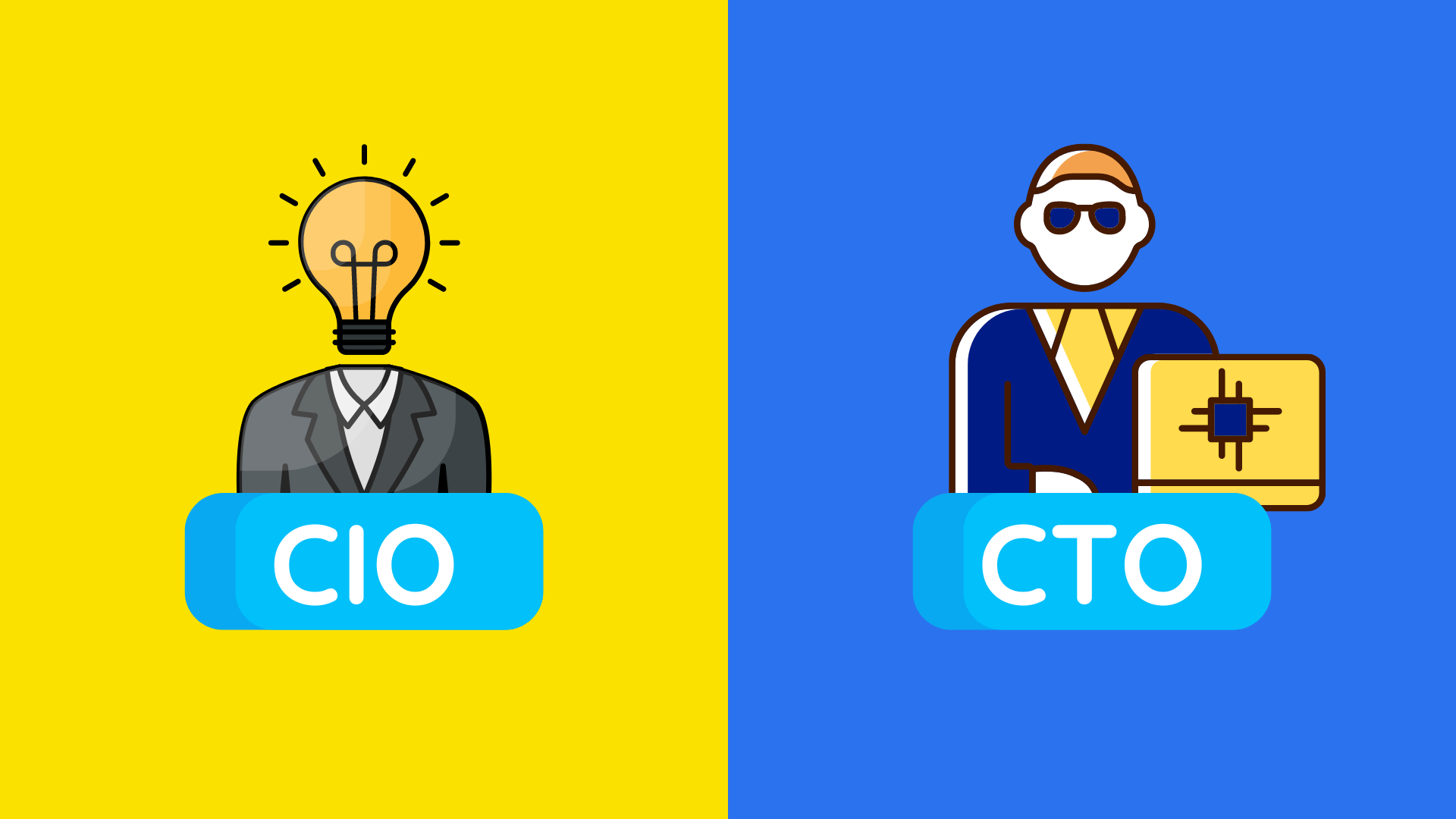
CIO vs CTO: Breaking Down the Key Differences for Technology Leaders
The CIO focuses on internal IT operations and business efficiency; the CTO drives external innovation and product strategy. Learn the full breakdown of
The CIO (Chief Information Officer) and CTO (Chief Technology Officer) are both technology executives in the C-suite, but they own fundamentally different mandates: the CIO focuses inward on IT operations and business efficiency, while the CTO focuses outward on product innovation and revenue-generating technology. Understanding where each role begins and ends is increasingly important as organizations navigate digital transformation.
What is a CIO and what do they do?
A CIO is the senior executive responsible for the internal technology strategy of an organization. The Chief Information Officer role emerged in the early 1980s alongside growing enterprise dependence on IT systems. William Synnott is widely credited with popularizing the title during his tenure at Metropolitan Life Insurance Company, helping establish the CIO as a recognized seat in corporate leadership.
In practice, a CIO harmonizes IT systems and processes so they operate efficiently and support broader business goals. When a department needs a new CRM platform, updated training software, or an upgraded security architecture, the CIO evaluates whether it fits the IT strategy and approves implementation. The CIO also oversees data accessibility, service continuity, and the organization's overall cybersecurity posture.
Business leadership: A CIO works across business units to understand operational needs, builds relationships with senior managers, and translates those needs into an actionable IT roadmap that supports digital transformation.
ROI and cost optimization: The CIO identifies how technology can reduce costs, increase productivity, and improve profitability. Maximizing the return on IT investment is a core accountability of the role.
Innovation enablement: CIOs foster organizational agility by building a culture that can absorb continuous technological change. This includes establishing shared goals and creating accountability frameworks across departments.
Key metrics a CIO tracks
CIOs evaluate IT effectiveness using a range of operational and strategic indicators:
Metric
What it measures
System performance
Speed, uptime, and efficiency of IT infrastructure
Systems availability
Consistent access to IT services for daily operations
Security posture
Cybersecurity incident rates and compliance status
Software adoption
Usage rates for newly deployed technologies
IT ROI
Cost efficiency and resource allocation across IT spend
What is a CTO and what do they do?
A CTO is the senior executive responsible for the external application of technology: building products, driving innovation, and creating new revenue streams. Like the CIO, the CTO role evolved in response to rising enterprise dependence on technology, but with a forward-looking, market-facing orientation.
Where a CIO manages the technology an organization runs on, a CTO builds the technology an organization sells or delivers to customers. CTOs lead engineering and development teams, evaluate emerging technologies such as artificial intelligence (AI), machine learning, and cloud platforms, and determine how those technologies can be turned into competitive products or services.
Core CTO responsibilities
Technology innovation: CTOs track emerging technologies, anticipate market shifts, and translate technical possibilities into strategic roadmaps. They act as internal thought leaders, influencing other C-suite executives on the direction of the product portfolio.
Revenue generation: CTOs drive growth by developing new products, identifying monetization opportunities, and often participating directly in the sales cycle to address technical questions from enterprise customers or partners.
Technological infrastructure: CTOs, working alongside engineering teams, are responsible for maintaining the reliability, scalability, and security of the systems that underpin the organization's products and services.
Key metrics a CTO tracks
Metric
What it measures
Technology ROI
Financial return on technology investments
Scalability
Ability of systems to handle growth and increased demand
Security compliance
Incident rates and adherence to regulatory standards
Customer satisfaction (NPS)
Net Promoter Score (NPS) and user experience ratings for products
Cost management
IT budget utilization and total cost of ownership (TCO)
CIO vs CTO: Side-by-side comparison
The simplest way to distinguish the two roles is by direction of focus. According to SERP consensus across multiple industry sources, the CIO looks inward to optimize the business, while the CTO looks outward to build and grow it.
For a deeper look at how these roles intersect during large-scale technology projects, the CIO and CTO digital transformation guide covers how both executives can align on shared priorities.
Is the CIO or CTO higher in the organization?
Neither role is universally "higher" than the other. In most large enterprises, the CIO and CTO are peers who both report directly to the CEO. However, organizational structure varies by company type and stage of growth.
In technology-product companies where engineering drives the business model, the CTO may hold broader authority, and in some cases the CIO reports to the CTO. In large corporations where IT infrastructure and compliance are central, the CIO may carry greater organizational weight. In smaller organizations, a single executive sometimes holds both responsibilities before the company scales to a point where separation becomes necessary.
The key point is that both roles are complementary. A CIO who optimizes internal systems frees the CTO to focus on innovation, and a CTO who builds competitive products gives the CIO a clear technology direction to support.
How CIOs and CTOs collaborate on digital transformation
Digital transformation is one area where the CIO and CTO mandates genuinely overlap, and where misalignment between the two roles creates the greatest organizational risk. Effective collaboration between the two requires shared goals around technology adoption, clear ownership of internal versus external systems, and joint accountability for the outcomes of major technology initiatives.
Both executives face the same underlying challenge: technology changes faster than organizations can absorb it. Keeping pace requires strategic planning across several dimensions:
AI adoption strategy: Artificial intelligence is reshaping both internal operations (a CIO concern) and external products (a CTO concern). Organizations benefit when both executives align on an AI roadmap rather than pursuing parallel and potentially conflicting initiatives.
Workforce upskilling: As technology stacks evolve, employees need structured support to adopt new tools effectively. Bridging skills gaps requires investment in training and in digital adoption infrastructure.
Continuous learning culture: Both roles benefit from active engagement with industry conferences, peer networks, and customer feedback loops to stay ahead of emerging trends.
Fostering organizational agility: The ability of a workforce to absorb new tools and processes is a shared responsibility. CIOs and CTOs both have a stake in building organizations that can change without losing productivity.
"We often had adoption problems: people constantly had to relearn how the tools worked. We realised we needed solutions to help them gain autonomy faster, and that is when we became interested in Lemon Learning."
Supporting both CIOs and CTOs in driving adoption of new technologies is a core use case for Lemon Learning's IT adoption and application support solution, which provides in-application guidance to reduce the time employees need to become proficient with new tools.
CIO and CTO role taxonomy: Which does your organization need?
Understanding the difference between a CIO and CTO also informs hiring decisions. The right choice depends on where the organization's technology gap lies.
If the primary challenge is IT reliability, data security, system integration, or technology cost management, the organization needs a strong CIO.
If the primary challenge is building competitive products, scaling engineering capacity, or monetizing emerging technologies, a strong CTO is the priority.
If both challenges exist simultaneously, both roles are warranted, with clear boundaries established to avoid overlap and conflict.
Some organizations also explore fractional or on-demand technology leadership models, where an experienced executive fills a CIO or CTO function on a part-time or contract basis. This is increasingly common in mid-market companies that need strategic technology leadership without the cost of a full-time C-suite hire.
For a full overview of the CIO role specifically, the Chief Information Officer resource page covers responsibilities, skills, and how the role continues to evolve.
Key takeaways: CIO vs CTO
The CIO and CTO are both essential technology leaders, but they serve different organizational purposes. The CIO optimizes how the business runs internally; the CTO drives how the business competes externally. Neither role is subordinate to the other by default, and the most effective organizations treat them as complementary rather than competing. As AI, cloud infrastructure, and digital transformation continue to reshape the technology landscape, the ability of a CIO and CTO to collaborate effectively will be one of the defining factors in organizational success.
FAQ
Frequently asked questions
What is the main difference between a CIO and CTO?+
The main difference is focus: a CIO (Chief Information Officer) looks inward, managing internal IT systems, infrastructure, and business efficiency, while a CTO (Chief Technology Officer) looks outward, driving product innovation and using technology to serve customers and generate revenue. Both roles sit in the C-suite and often collaborate closely, but they own distinct domains.
What are the 4 types of CTO?+
Industry analysts commonly describe four CTO archetypes: (1) the Infrastructure CTO, who focuses on internal systems reliability and security; (2) the Product CTO, who drives external product development and engineering; (3) the Strategic CTO, who acts as a technology visionary and advisor to the CEO; and (4) the Customer-Facing CTO, who engages directly with clients and partners to align technology with market needs. The dominant type depends on the company's size, industry, and stage of growth.
What are the 4 faces of the CIO?+
The four faces of the CIO framework describes the CIO as: (1) a Business Strategist, aligning IT with company goals; (2) a Change Leader, driving digital transformation across the organization; (3) an Operational Excellence champion, ensuring reliable, efficient IT delivery; and (4) an Innovation Driver, identifying new technologies that create business value. Most CIOs must balance all four faces simultaneously.
Can a CIO report to a CTO?+
Yes, in some organizational structures a CIO reports to a CTO, particularly in technology-product companies where the CTO holds broader authority over all technical functions. However, in most large enterprises the CIO and CTO are peers, both reporting directly to the CEO. The reporting line depends on how the company defines each role and where technology strategy sits in the business hierarchy.