A digital transformation model is a structured reference that describes the stages, dimensions, or building blocks an organization must address when integrating digital technology across its operations and business model. The right model gives leaders a shared language, a diagnostic lens, and a roadmap, turning an abstract ambition into an actionable plan. This guide covers the most widely used digital transformation models, explains how they differ, and shows how to choose the one that fits your organization's context.
What is a digital transformation model?
A digital transformation model is a conceptual or operational framework that helps organizations plan, execute, and sustain the integration of digital technology into every area of the business. Unlike a one-size-fits-all playbook, models acknowledge that transformation is non-linear: it touches strategy, culture, processes, workforce skills, and technology simultaneously.
Digital transformation models and change management models overlap but are not identical. Change management models, such as the ADKAR (Awareness, Desire, Knowledge, Ability, Reinforcement) model, focus on the human side of any organizational change. Digital transformation models specifically address how digital technology reshapes the way value is created and delivered, which may require updating the business model itself, not just its processes.
Understanding which category a given model belongs to helps you combine them effectively: a process transformation model tells you what to change; a change management model tells you how to bring people along.
What are the main types of digital transformation models?
Researchers and practitioners group digital transformation models into several broad families. Knowing these categories makes it easier to select the right tool for a given challenge.
Category
Primary focus
Typical use case
Strategic models
Organizational alignment and vision
Setting transformation priorities at the executive level
Phased / stage models
Sequential milestones
Roadmap planning and progress tracking
Maturity models
Capability benchmarking
Diagnosing current digital readiness
Business model innovation models
Value creation and revenue logic
Launching new digital business models or revenue streams
People and culture models
Adoption and behavior change
Managing workforce transition and resistance
Operating model frameworks
Governance, structure, and processes
Redesigning how work gets done day-to-day
What are the leading digital transformation models in practice?
The following models appear most frequently in practitioner literature and academic research. Each is explained on its own terms so you can assess its fit independently.
McKinsey 7S Model
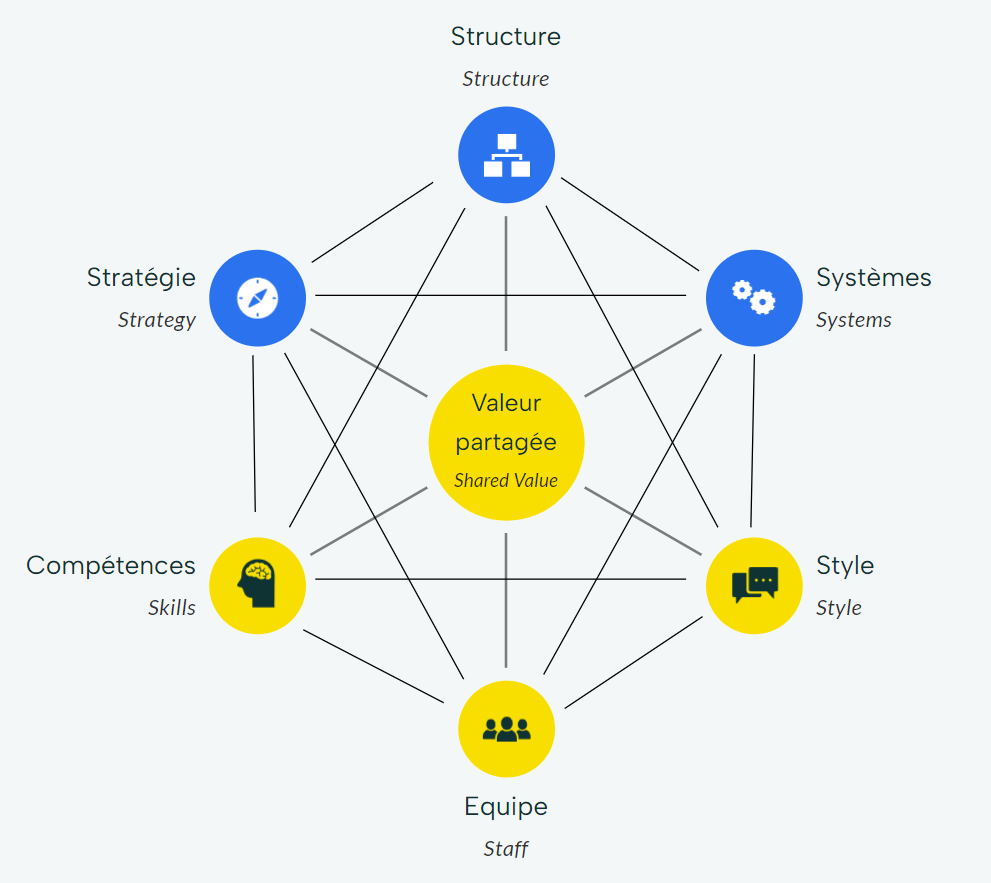
The McKinsey 7S Model, developed by consultants at McKinsey and Company, maps seven interdependent elements that must be aligned for any transformation to succeed: Strategy, Structure, Systems, Shared Values, Skills, Style, and Staff. In a digital context, "Systems" expands to include the entire technology stack, while "Shared Values" addresses whether the organization has developed a genuinely digital culture.
The model's strength is its insistence on alignment: changing one element without addressing the others creates friction. A new CRM (Customer Relationship Management) system fails if the staff lack the skills to use it, or if the organizational structure does not support cross-functional data sharing. The McKinsey 7S framework is therefore especially useful at the diagnostic stage, before a roadmap is built.
ADKAR Model
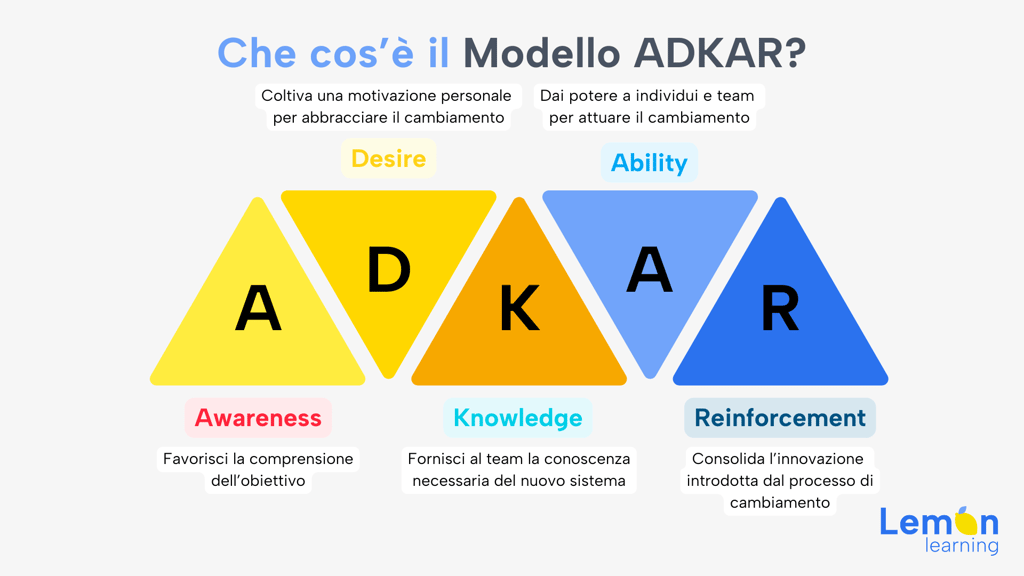
The ADKAR (Awareness, Desire, Knowledge, Ability, Reinforcement) model, developed by Prosci, focuses on the individual journey through change rather than the organizational structure. Each letter represents a milestone: a person must first be aware that change is needed, then desire to support it, then gain the knowledge to act, then develop the ability to perform new behaviors, and finally be reinforced to sustain them.
In a digital transformation context, ADKAR is most valuable when rolling out new software platforms or redesigned workflows where user adoption is the critical success factor. It pairs naturally with a platform such as Lemon Learning's change management solution, which delivers in-application guidance at the exact moment employees need it, directly addressing the Knowledge and Ability stages of the model.
Kotter's 8-Step Model
John Kotter's 8-Step Model for leading change provides a sequenced process: create urgency, build a guiding coalition, form a strategic vision, communicate the vision, remove obstacles, generate short-term wins, consolidate gains, and anchor the change in culture. Although it predates the current wave of digital transformation, its logic maps directly onto large-scale technology programs where executive sponsorship and cultural embedding are common failure points.
The model is particularly well suited to organizations where transformation resistance is high or where previous initiatives have stalled. The "short-term wins" step is especially relevant: digital programs that take years to show results lose momentum, so identifying and celebrating early indicators of success is critical.
Digital Maturity Model
A digitalization model, or Digital Maturity Model, assesses an organization's current capabilities across multiple dimensions, technology adoption, data use, process automation, workforce skills, and customer experience, and maps them to maturity stages. Common stage labels include Initiation, Experimentation, Scaling, Integration, and Optimization, though different vendors and researchers use different terminology.
The value of a maturity model is diagnostic: it produces a baseline that makes prioritization objective. Organizations at the Initiation stage should not attempt the governance complexity of the Optimization stage. Maturity models also enable benchmarking against industry peers, which is useful for building the business case for investment.
This category directly addresses the GSC query "digitalization model", maturity-based frameworks are the most searched sub-type of digital transformation model, reflecting a real practitioner need to know where an organization stands before committing to a roadmap.
Crawl, Walk, Run Model
The Crawl, Walk, Run model is a phased approach to digital transformation. It prescribes starting with small, low-risk initiatives (Crawl), building confidence and capability before expanding scope (Walk), and then pursuing full-scale transformation once the organization has proven its execution ability (Run). The model is intuitive and easy to communicate to non-technical stakeholders, making it popular for governance conversations and board-level reporting.
Its main limitation is that it can give organizations permission to move too slowly in markets where competitors are accelerating. The "Run" phase must have a defined timeline, not just a description.
Digital Business Model Canvas
Adapted from Alexander Osterwalder's Business Model Canvas, the Digital Business Model Canvas adds digital-specific lenses to each of the original nine building blocks: value proposition, customer segments, channels, customer relationships, revenue streams, key resources, key activities, key partnerships, and cost structure. In a digital context, "channels" expands to include digital touchpoints and platform ecosystems; "key resources" must account for data assets and algorithms.
This tool is especially relevant for the secondary keywords around digital transformation creating new business models and digital transformation opportunities to create new business models. It forces a structured conversation about how digital technology changes the logic of value creation, not just its execution. Organizations using this canvas often discover that their most significant opportunity is not process efficiency but an entirely new revenue model, for example, a manufacturer moving from selling products to selling outcomes via connected devices.
Technology Adoption Lifecycle
The Technology Adoption Lifecycle, popularized by Everett Rogers and later Geoffrey Moore, categorizes users by their willingness to adopt new technology: Innovators, Early Adopters, Early Majority, Late Majority, and Laggards. In a digital transformation program, this model is most useful for sequencing rollouts and for tailoring communication and training to each segment.
Targeting Early Adopters first generates internal champions who influence the Early Majority. Treating all employees as a homogeneous group is a common mistake that leads to wasted training effort and poor adoption rates.
4I Innovation Framework
The 4I Framework guides organizations through four stages of innovation-driven transformation: Ideation, Incubation, Integration, and Institutionalization. It is most relevant for organizations where digital transformation is primarily about developing new products or services rather than operational efficiency. At the Ideation stage, cross-functional teams generate hypotheses about digital opportunities. Incubation tests them at small scale. Integration connects proven innovations to the core business. Institutionalization embeds them into standard operating procedures and culture.
Three-Stage Model of Digital Transformation
Academic research, including work published on ResearchGate by Jiaqi Jin (2021), describes a Three-Stage Model that moves organizations from Digitization (converting analog information to digital formats), through Digitalization (using digital data to change processes and interactions), to Digital Transformation (fundamentally restructuring the business model and value creation logic). This distinction matters because many organizations claim to be undergoing digital transformation when they are, in practice, still at the digitization or digitalization stage.
How does digital transformation reshape business models?
The impact of digital transformation on business models goes beyond efficiency. Digital technology enables entirely new revenue logics: subscription models, platform models, data monetization, and outcome-based pricing. The role of digital transformation in modern business models is therefore not just to support existing operations but to open new value frontiers.
Key patterns in digital business model innovation include:
Platform models: Connecting suppliers and customers in a two-sided marketplace, with the platform capturing value through transaction fees or data.
Outcome-as-a-service: Selling a guaranteed result (uptime, yield, health outcome) rather than a product, enabled by IoT (Internet of Things) sensors and real-time analytics.
Ecosystem models: Building a network of complementary digital services that increase switching costs and customer lifetime value.
Data-driven personalization: Using behavioral data to move from mass-market products to individualized offers at scale.
The moment where digital meets physical, for example, a retailer embedding sensors in physical stores to feed a digital recommendation engine, is often described as the most complex transition, because it requires simultaneously redesigning physical operations and digital capabilities. The Digital Business Model Canvas is the most practical tool for mapping this intersection.
"An application or a feature must be useful, usable and used. If it is not useful, usable and used, you are producing digital waste."
What are the best practice enablers for a digital transformation roadmap?
Selecting a model is only the starting point. The following enablers consistently distinguish successful programs from stalled ones, based on the consensus across practitioner and research literature.
Assess your current digital maturity
Run a structured assessment before committing to a model. Use a Digital Maturity Model to score your organization across technology, processes, data, people, and governance. This produces a defensible baseline, identifies the highest-value gaps, and prevents the common mistake of investing in advanced capabilities before foundational ones are in place.
Account for industry-specific constraints
Regulated industries such as financial services, healthcare, and energy face compliance and data sovereignty requirements that directly constrain which technologies and operating models are viable. A model that works in a digital-native retail environment may require significant adaptation in a regulated sector. Understanding these constraints early prevents costly rework.
Build workforce digital skills deliberately
Technology deployment without workforce enablement consistently produces underperformance. Evaluate existing digital skill levels across roles, map gaps to the capabilities required by your target model, and build a training plan that is timed to go-live, neither so early that skills decay before they are used, nor so late that employees are unprepared.
In-application guidance tools address the timing problem by delivering contextual support at the moment of need, inside the software itself. This is directly relevant to the Ability stage of the ADKAR model and to the early phases of any phased rollout.
Align the model to your organizational culture
A model that requires rapid experimentation will not work in an organization with a strong risk-averse culture unless the cultural change is addressed first. The McKinsey 7S Model is useful here because it makes the relationship between strategy and culture explicit. Consider your digital transformation strategy a living document that is updated as the organization's maturity and culture evolve.
Design for scalability from the outset
Pilot programs that cannot be scaled are a common source of wasted investment. When selecting a model and designing the first phase, explicitly document the conditions under which each initiative will be expanded, the governance mechanisms that will manage scale, and the technology architecture that will support it. Scalability is not just a technical consideration; it also applies to the operating model and the training infrastructure.
Embed compliance and security into the model
Cybersecurity and data protection must be designed into the transformation from the start, not retrofitted at the end. Relevant standards such as ISO 27001 certification provide a structured approach to information security management that can be integrated into any digital transformation roadmap. Regulatory alignment, particularly in sectors subject to GDPR (General Data Protection Regulation) or sector-specific rules, should be a checkpoint at every stage gate.
Establish a clear governance model
A digital transformation governance model defines who makes decisions, who has accountability for outcomes, how conflicts between business units are resolved, and how progress is measured and reported. Without it, even well-designed transformation programs fragment into disconnected initiatives. Governance structures typically include a transformation steering committee, a program management office, and clear ownership of each workstream, with defined escalation paths and regular cadence reviews.
How do you choose the right digital transformation model?
No single model is universally superior. The choice depends on the primary problem the organization is trying to solve:
If the primary challenge is organizational alignment: Start with the McKinsey 7S Model to identify misalignments before building a roadmap.
If the primary challenge is user adoption: Use the ADKAR model to structure the people-change program alongside the technology deployment.
If the primary challenge is knowing where to start: Use a Digital Maturity Model to benchmark current capabilities and prioritize gaps.
If the primary challenge is business model innovation: Use the Digital Business Model Canvas to redesign value creation logic before selecting enabling technologies.
If the primary challenge is managing a large-scale cultural shift: Use Kotter's 8-Step Model to sequence the organizational change program.
If the primary challenge is managing risk in a complex organization: Use a phased model such as Crawl, Walk, Run, combined with a governance framework.
In practice, most large-scale programs combine elements from several models. A common pattern is to use a Digital Maturity Model for diagnosis, the McKinsey 7S Model for strategic alignment, the Digital Business Model Canvas for business model redesign, and ADKAR for workforce transition, each serving a distinct purpose within the same program.
The key principle is that the model should serve the organization's context, not the reverse. Forcing an organization into a model that does not fit its culture, scale, or industry is one of the most consistent predictors of transformation failure.
For a deeper look at how digital adoption tools support each stage of these frameworks in practice, the guide to measuring IT strategy performance covers the metrics and governance mechanisms that connect model choice to measurable business outcomes.
FAQ
Frequently asked questions
What are the 4 pillars of digital transformation?+
The four pillars most commonly cited are technology, people, process, and data. Technology provides the tools; people drive adoption; process redesign ensures efficiency gains translate into value; and data underpins decision-making at every stage. Some frameworks substitute 'culture' for 'data,' but all four dimensions must be addressed for a transformation to succeed.
What are the 4 P's of digital transformation?+
The 4 P's are People, Process, Platform, and Performance. People refers to building digital skills and a change-ready culture. Process covers the redesign of workflows to eliminate manual steps. Platform describes the technology stack that enables new capabilities. Performance means defining clear metrics to measure whether transformation goals are being met.
What are the 4 D's of digital transformation according to McKinsey?+
McKinsey describes four stages it labels Discover, Design, Deliver, and De-risk. Discover involves diagnosing where value can be unlocked. Design means building the solution, often in agile sprints. Deliver is the scaling of working solutions across the organization. De-risk covers governance, cybersecurity, and change management practices that protect the program throughout.
What is the difference between a digital transformation model and a digital transformation framework?+
The terms are often used interchangeably, but there is a practical distinction. A model describes the stages or dimensions of transformation (what the journey looks like), while a framework provides the structured process, tools, and governance mechanisms for executing it (how to move through each stage). Many organizations use a model to diagnose where they stand and a framework to plan and manage the work.
Discover the most effective change management tools for 2026, from digital adoption platforms to project management software, and learn how to choose...