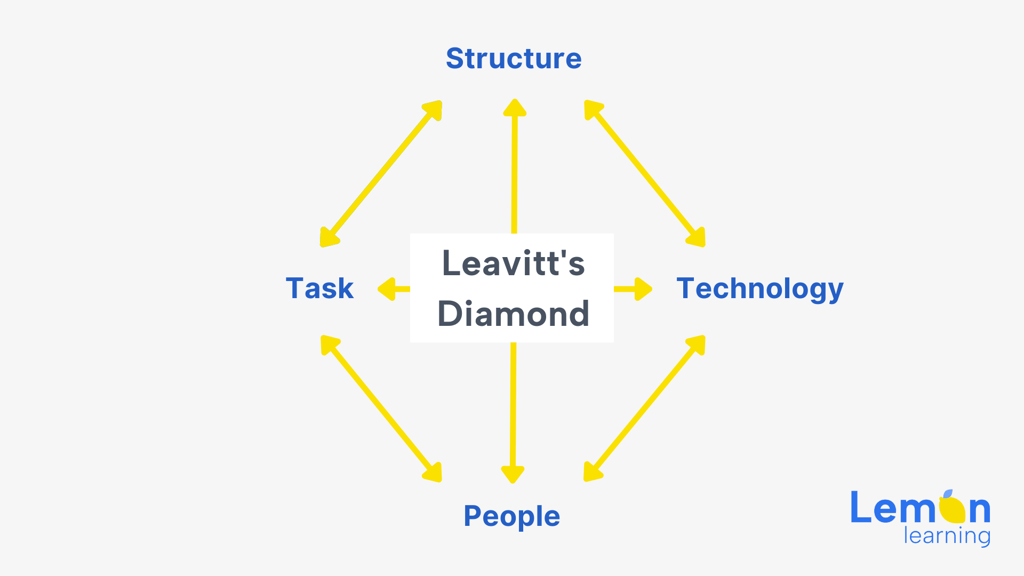
Leavitt's Diamond is a four-variable organizational change model created by Harold J. Leavitt in 1965. It holds that any organization is shaped by the interaction of People, Tasks, Structure, and Technology, and that a change to any one variable will produce ripple effects across all three others. Understanding those interdependencies before a change initiative begins is what makes the model valuable for change management leaders and project teams.
What is Leavitt's Diamond Model?
Leavitt's Diamond Model is a systemic diagnostic framework for organizational change. Harold J. Leavitt, an American industrial psychologist, introduced the model in 1965 as a way to map the organizational-wide effects that any change strategy produces. It is also referenced as Leavitt's System Model in academic literature.
Leavitt argued that four variables are intrinsic to every organization:
People (Actors) - employees, their skills, knowledge, behaviors, and attitudes
Tasks - the work processes, objectives, and activities the organization performs
Structure - the hierarchy, authority distribution, division of labor, and coordination mechanisms
Technology - the tools, systems, equipment, and methods that support work
These variables are not independent. They form a diamond shape in which each node is directly connected to the other three. A modification to any single variable creates pressure on the remaining three, which must then adapt. This systemic perspective is what distinguishes Leavitt's approach from simpler, linear change models and makes it a practical diagnostic tool when planning a structured change management process.
Structure: What Is the Organizational Foundation Variable?
Structure defines how authority and responsibility are distributed across an organization. It covers the formal hierarchy, the division of labor, reporting lines, coordination mechanisms, and the rules and information flows that govern daily work. In short, structure is the framework within which tasks are accomplished.
Structure is sensitive to changes in every other variable:
People changes: Recruiting highly skilled individuals can reduce the number of supervisory layers required. Conversely, investing in training an existing employee may allow a team to flatten its reporting lines.
Task changes: A departmental merger, a relocation, or a subdivision of a business unit will directly redistribute responsibilities and require a structural redesign.
Technology changes: Automating, computerizing, or virtualizing processes often eliminates certain roles and creates new ones, reshaping the organizational chart in the process.
Leaders who treat structure as fixed during a technology rollout, for example, are likely to experience friction because the formal hierarchy no longer reflects how work actually flows.
Tasks: How Do Work Processes Interact with the Other Variables?
Tasks represent the core work of the organization: the processes, objectives, and activities that produce value. For teams to operate efficiently, tasks must be well defined and appropriately assigned. Any change elsewhere in the diamond will create pressure on tasks.
People changes: Hiring a specialist - for example, a dedicated data analyst - makes existing manual reporting processes redundant. The tasks must be redefined to capture the value the new skill set brings.
Structure changes: Moving from a traditional hierarchical pyramid to a flat organization redistributes decision-making authority and requires processes and objectives to be renegotiated at every level.
Technology changes: Adopting a new enterprise resource planning (ERP) system or a collaboration platform replaces old workflows entirely. Teams that are not supported through that transition will default to workarounds, undermining the intended benefits.
Clearly mapping which tasks will change - and in what sequence - before a project launches is one of the most practical uses of the Leavitt Diamond in project management planning.
People: Why Are Actors the Central Variable in Change?
People are the human dimension of the model and, in practice, the variable most likely to determine whether a change succeeds or fails. Leavitt's framework treats people holistically: not just through the positions they hold, but through their full range of abilities, knowledge, skills, attitudes, and relationships.
Structure changes: A reorganization requires employees to understand their new responsibilities, build relationships with new colleagues, and sometimes relinquish authority they previously held.
Task changes: New or modified processes demand that employees acquire new skills or adapt existing ones, typically through targeted training.
Technology changes: A new system is only as effective as the people using it. Without adequate onboarding and ongoing support, adoption stalls and the intended productivity gains are lost.
"Every technological change must be accompanied, often step by step. Teams sometimes told me, a year and a half later: I finally understand why you changed that six months ago."
Resistance to change is a predictable consequence when the people variable is underestimated. Leaders who involve employees early, communicate the reasons behind a change, and provide adequate training significantly reduce that resistance. Lemon Learning's change management solution is built around this principle, supporting software adoption directly within the tools employees use every day.
Technology: How Does Technology Drive Organizational Transformation?
Technology includes all the tools, systems, equipment, and technical methods that assist or facilitate the work of employees. It is often the trigger variable in modern change initiatives - a new platform, an automation project, or a migration to cloud infrastructure sets off a chain of adaptations across the other three variables.
People impact: New technology demands new competencies. Training programs must be designed around the actual tool, timed so that employees are supported at the moment of use rather than weeks before go-live.
Task impact: New capabilities often make certain tasks obsolete while creating entirely new categories of work. Job designs and performance objectives must reflect that shift.
Structure impact: Automation can eliminate supervisory roles or centralize functions that were previously distributed. Organizational charts and reporting lines should be reviewed alongside any major technology change.
Technology is also the variable where costs and timelines are most visible, which can cause organizations to underinvest in the people and task adaptations that determine whether the technology delivers its expected return.
How Is Leavitt's Diamond Applied in Practice?
Leavitt's Diamond is most useful as a diagnostic and planning tool at the start of a change initiative. The practical steps below reflect how teams apply the model in organizational development and project management contexts.
Step
Action
Purpose
1. Identify the trigger variable
Determine which of the four components is driving the change (often Technology or Structure)
Establishes the starting point for impact analysis
2. Map the ripple effects
Trace how the change in the trigger variable will affect each of the other three
Surfaces hidden dependencies and second-order consequences
3. Prioritize adaptations
Rank the required adjustments by urgency and feasibility
Focuses resources where disruption is greatest
4. Design balanced interventions
Create workstreams for each affected variable (not just the technical one)
Prevents single-variable thinking that leaves gaps
5. Monitor and iterate
Track adoption and performance indicators across all four variables post-launch
Allows course correction before small gaps become large failures
The model is compatible with other change frameworks. For example, teams using the Burke-Litwin Change Model for deeper causal analysis often use Leavitt's Diamond at the diagnostic stage because its four-variable structure is simpler to communicate to non-specialist stakeholders.
What Are the Strengths and Limitations of Leavitt's Diamond?
Leavitt's Diamond has endured for decades because of its simplicity and systemic logic. Its strengths and limitations are worth understanding before applying it.
Strengths
Limitations
Simple enough to communicate to a broad audience quickly
Does not explicitly address culture, leadership style, or external environment
Encourages holistic thinking by connecting all four variables
Four variables may be too few for complex, large-scale transformations
Applicable across industries and organization sizes
Does not prescribe a sequence or methodology for implementing change
Useful in project management as well as organizational development
Weights all four variables equally, which may not reflect every situation
For organizations navigating complex, multi-layered transformations, Leavitt's Diamond works best as a first diagnostic pass rather than a complete change methodology. Pairing it with a more detailed framework - such as those covered in our overview of the four types of change management - produces a more complete picture of what a transformation requires.
Balancing All Four Variables for Lasting Organizational Change
Leavitt's Diamond Model remains one of the most accessible and durable frameworks in change management precisely because it captures a simple but often ignored truth: organizations are systems, not collections of independent parts. Changing technology without adapting people, tasks, and structure is a common reason change initiatives underdeliver. Harold J. Leavitt's model, introduced in 1965 and still cited in organizational development literature today, gives change leaders a clear lens through which to see and address those interdependencies before they become problems.
For teams rolling out new software or business processes, applying Leavitt's Diamond at the planning stage, and supporting the people variable with in-application guidance throughout, significantly improves the probability that all four variables reach a new equilibrium and the change delivers lasting value.
FAQ
Frequently asked questions
What is Leavitt's Diamond Model?+
Leavitt's Diamond Model is an organizational change framework developed by American industrial psychologist Harold J. Leavitt in 1965. It identifies four interdependent variables in any organization: People (Actors), Tasks, Structure, and Technology. The model holds that a change to any one variable will trigger ripple effects across the other three, so leaders must account for all four when planning organizational change.
What are the 4 components of Leavitt's Diamond?+
The four components are: (1) People (Actors) - the employees, their skills, knowledge, and behaviors; (2) Tasks - the work processes, objectives, and activities the organization performs; (3) Structure - the hierarchy, authority distribution, and coordination mechanisms; (4) Technology - the tools, systems, and equipment that support work. Each component is directly linked to the others, so adjusting one forces adjustments in the rest.
What is the Leavitt model of organizational development?+
The Leavitt model of organizational development is a systemic diagnostic tool that treats an organization as a network of four interacting variables (People, Tasks, Structure, Technology). By mapping how a planned change in one variable affects the others, leaders can design more balanced change initiatives, anticipate resistance, and avoid unintended consequences. It is widely used in organizational diagnosis, project management, and change management planning.
What is the McKinsey 7-S model of change management?+
The McKinsey 7-S model is a separate change management framework that identifies seven interdependent organizational elements: Strategy, Structure, Systems, Shared Values, Style, Staff, and Skills. Unlike Leavitt's Diamond, which uses four variables, the 7-S model adds softer cultural elements. Both models are used for organizational diagnosis, but Leavitt's Diamond is considered simpler and more focused on the operational levers of change.