How to Choose the Right Procurement Software for Your Organization
Compare leading procurement software solutions — Ivalua, SAP Ariba, Oracle, and more — and learn how to choose the right cloud or direct procurement
Learn how the RICE scoring model works, how to calculate your RICE score, and how product teams use Reach, Impact, Confidence, and Effort to prioritize

The RICE scoring model is a product prioritization framework that assigns a numerical score to each feature or initiative using four criteria: Reach, Impact, Confidence, and Effort. Product managers use this score to rank competing ideas objectively and allocate development resources to the work most likely to drive results. If you are looking for a structured, data-driven way to build your product roadmap, the RICE scoring method gives you a repeatable system grounded in measurable inputs rather than opinion. For broader context on where RICE fits among competing approaches, see this overview of product management frameworks.
RICE is an acronym for the four factors used to evaluate each initiative: Reach, Impact, Confidence, and Effort. Each factor is measured independently and then combined into a single score. The model was developed by the product team at Intercom as an internal scoring system and has since become one of the most widely used prioritization methods in product management. Understanding each criterion is essential before applying the formula.
Reach is the number of users or customers affected by a feature within a defined time period, such as a month or a quarter. It answers the question: how many people will this change touch? Reach is a quantitative figure drawn from real data sources such as monthly active users, new sign-ups, or transaction counts.
A feature used by 5,000 users per month will naturally score higher on Reach than one used by 200. When your goal is to increase product adoption, an onboarding improvement with broad Reach should move up the priority list accordingly.
Impact estimates how meaningfully a feature will affect users or a key business metric. It is typically scored on a discrete scale: 3 for massive impact, 2 for high, 1 for medium, 0.5 for low, and 0.25 for minimal impact. The specific scale can be adapted to your team's conventions, but consistency across features is critical for the scores to be comparable.
A high-impact feature might drive a measurable lift in conversion rate, reduce churn, or significantly improve user satisfaction. A cosmetic change to a rarely visited screen would score near the lower end of the scale.
Confidence reflects how certain you are about your Reach and Impact estimates. It is expressed as a percentage. A feature backed by multiple rounds of user research and quantitative data might carry a confidence level of 90%. An idea based on a single anecdotal request from one customer might score closer to 50%.
Confidence is the RICE model's built-in check against overconfidence. It prevents teams from inflating scores for speculative ideas that lack supporting evidence, keeping the ranking honest.
Effort is the total work required to design, build, and ship a feature, expressed in person-months. It is the only factor in the denominator of the RICE formula, meaning that higher effort reduces the final score. This directly rewards efficiency: a feature delivering strong Reach and Impact with low Effort will outscore a similar feature that requires far more resources to implement.
Estimating Effort accurately requires input from engineering, design, and QA. A minor interface improvement might cost 0.5 person-months, while a full data infrastructure change could require 6 or more.
The RICE score formula is straightforward:
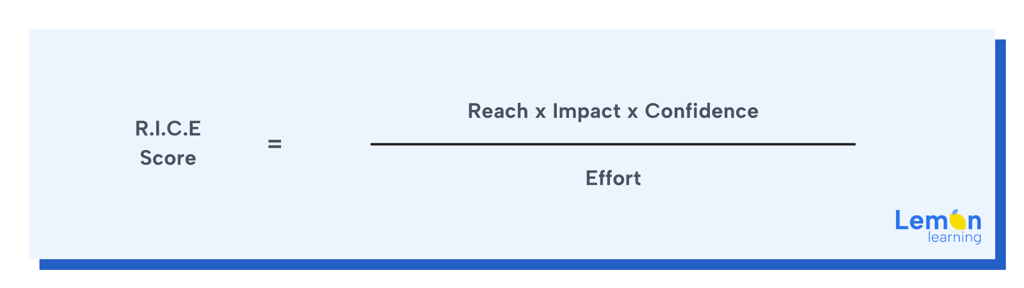
RICE Score = (Reach x Impact x Confidence) / Effort
A worked example makes the RICE score formula concrete. Suppose a feature has the following estimates:
| Factor | Value |
|---|---|
| Reach | 1,000 users per month |
| Impact | 3 (massive) |
| Confidence | 80% (0.8) |
| Effort | 2 person-months |
RICE Score: (1,000 x 3 x 0.8) / 2 = 1,200
Calculate the score for every candidate feature using the same formula and the same definitions for each factor. The resulting ranked list tells you, in objective terms, which features return the most value per unit of effort invested.
Once scored, features can be grouped into strategic buckets to guide roadmap planning:
| Bucket | Characteristics | Action |
|---|---|---|
| Quick Wins | High score, low Effort | Ship as soon as possible |
| Strategic Projects | High score, high Effort | Plan carefully, allocate dedicated capacity |
| Fill-Ins | Moderate score, low Effort | Schedule in available capacity |
| Deprioritized | Low score regardless of Effort | Defer or remove from backlog |
The RICE scoring method also structures stakeholder conversations. When a senior stakeholder pushes for a feature, a transparent RICE score invites a productive discussion: if they believe the score is wrong, they need to justify a higher Reach or Impact estimate with data, rather than relying on seniority alone.
The RICE model is a strong foundation for prioritization, but it has real constraints that product teams should understand before relying on it exclusively.
Used alongside qualitative judgment and regular score reviews, these limitations are manageable. The RICE framework is a tool to support decisions, not replace them.
RICE is not the only prioritization method available to product teams. Depending on your context, one of the following may be a better fit or a useful complement:
A well-rounded product team will often use more than one framework, applying RICE for data-rich environments and leaning on MoSCoW or Kano when speed or customer insight matters more than numerical precision.
The RICE scoring model brings discipline to one of the hardest problems in product management: deciding what to build next when every option seems important. By translating subjective judgments into consistent, comparable scores, it reduces bias, improves transparency, and gives teams a shared language for roadmap discussions.
The four RICE criteria cover the dimensions that matter most: how many people benefit, how much they benefit, how sure you are, and what it costs to deliver. No prioritization model is perfect, but RICE is practical, fast to apply once calibrated, and credible enough to hold up in stakeholder reviews.
For product teams looking to strengthen the way they communicate and roll out new features, Lemon Learning's learning and development solutions can support the training and adoption work that follows once prioritization decisions are made.
The RICE scoring model is a product prioritization framework that evaluates each initiative across four factors: Reach, Impact, Confidence, and Effort. Each factor is measured and combined into a single numerical score. Higher scores indicate higher priority. The model was originally developed by the team at Intercom as an internal scoring system and has since been widely adopted by product managers.
The RICE score formula is: (Reach x Impact x Confidence) divided by Effort. Reach is the number of users affected in a given period. Impact is scored on a scale such as 0.25 to 5. Confidence is expressed as a percentage (for example, 0.8 for 80%). Effort is estimated in person-months. Example: (1,000 x 3 x 0.8) / 2 = 1,200. Features are then ranked from highest to lowest score.
Product teams use scoring frameworks such as RICE, the MoSCoW Method, or the Kano Model to rank features objectively. The key is to evaluate each candidate feature against consistent criteria such as user impact, business value, confidence in estimates, and cost of implementation, then rank them to build a data-informed roadmap rather than relying on opinion alone.
The 5-5-5 rule is an informal guideline sometimes used when calibrating RICE scores. It suggests capping Impact at 5, Confidence at 100% (or 1.0), and normalizing Effort in whole person-months, so that scores remain comparable across different initiatives. It is not an official standard but a practical heuristic to prevent any single factor from distorting the final score.
Compare leading procurement software solutions — Ivalua, SAP Ariba, Oracle, and more — and learn how to choose the right cloud or direct procurement
SaaS vs on-premise software compared: costs, security, licensing models, and how to choose the right deployment option for your business in 2026.
Learn how to get ISO 27001 certified step by step, from defining your ISMS scope to passing the audit and maintaining certification long term.