The Eisenhower Matrix: How to Prioritize Tasks and Manage Your Time
Learn what the Eisenhower Matrix is, how its four quadrants work, and how to use this proven prioritization tool to manage tasks more effectively at work.
The Eisenhower Matrix is a prioritization and time-management tool that sorts every task you face into one of four quadrants based on urgency and importance. In under five minutes, it tells you what to do now, what to schedule, what to delegate, and what to drop entirely. This guide covers what the matrix is, where it came from, how each quadrant works, and how to apply it in practice.
What is the Eisenhower Matrix and where did it come from?
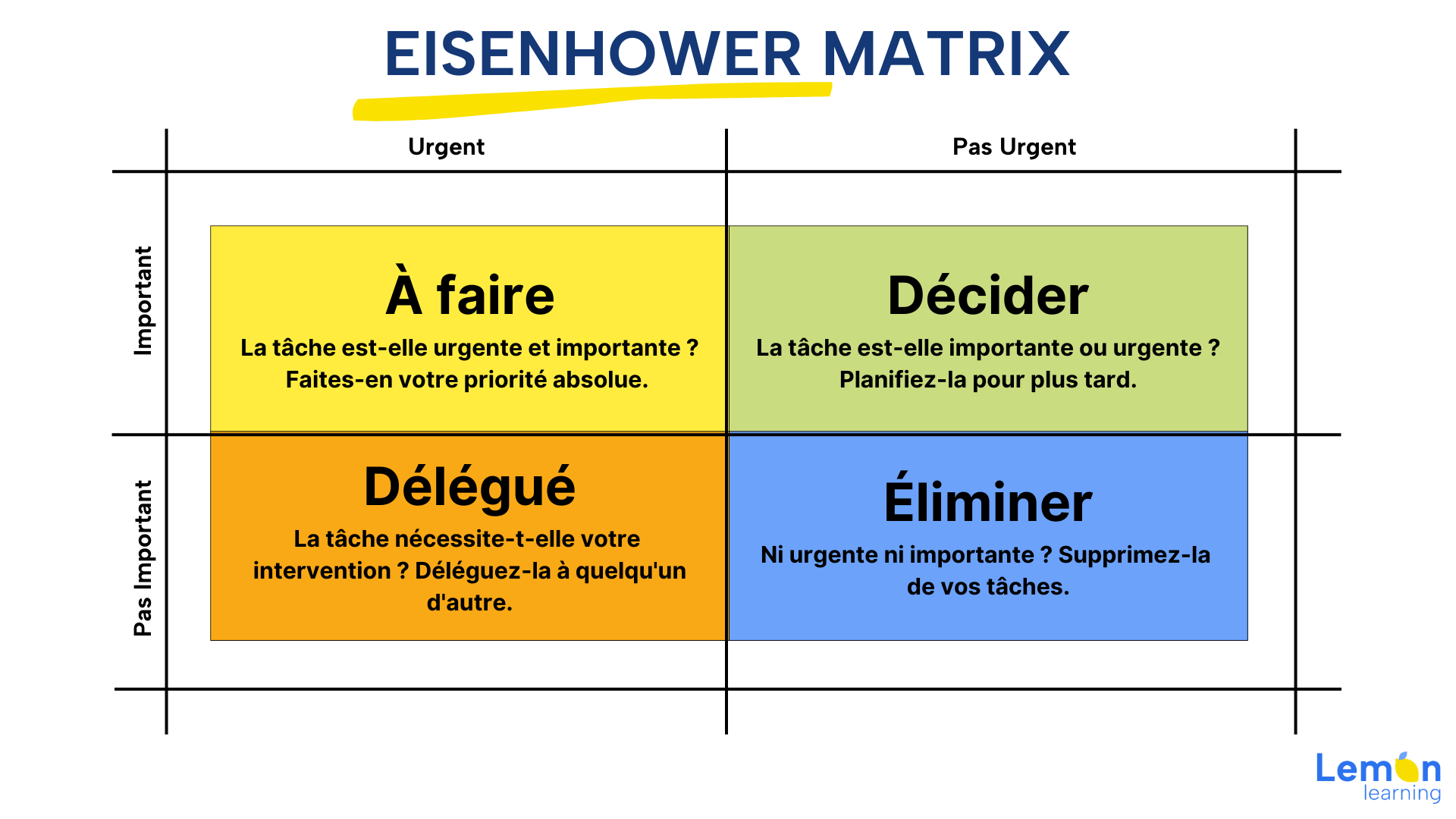
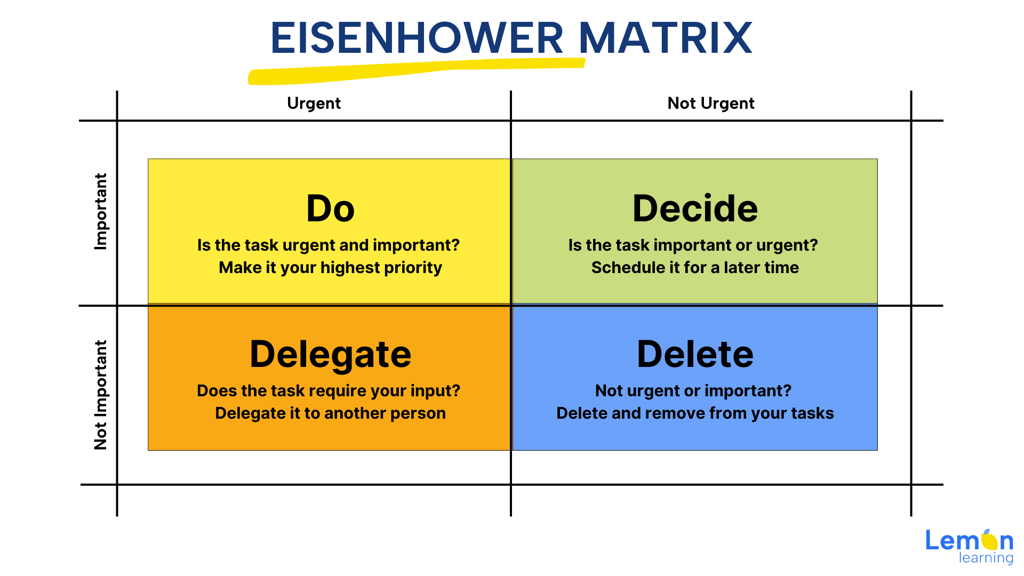
The Eisenhower Matrix, also called the Urgent-Important Matrix or the Eisenhower Decision Matrix, is a two-by-two grid that classifies tasks on two axes: urgency (does this need attention right now?) and importance (does this contribute to long-term goals?). The intersection of those two axes produces four distinct action categories.
The tool is named after Dwight D. Eisenhower, the 34th President of the United States and a five-star general who served as Supreme Commander of the Allied Forces in Europe during World War II. Eisenhower was widely studied for his ability to sustain high-quality decision-making under extreme pressure over long periods. The matrix itself was formalized as a management framework based on his philosophy and is described in detail in a peer-reviewed analysis of Eisenhower's management beliefs published in PMC. Author Stephen Covey later popularized the model in The 7 Habits of Highly Effective People, which introduced it to a mainstream business audience.
So why is it called the Eisenhower Matrix? Because the underlying philosophy traces directly to a principle Eisenhower articulated: that the most urgent decisions are rarely the most important ones, and the most important work is rarely urgent. That insight is the entire foundation of the framework.
What are the four quadrants of the Eisenhower Matrix?
The matrix is built on a simple grid. The vertical axis represents urgency; the horizontal axis represents importance. Each quadrant carries a default action.
Quadrant 1: Urgent and important (Do)
Tasks in Quadrant 1 are both pressing and consequential. They demand your personal attention right now. Examples include a critical system outage, a regulatory deadline, or a client escalation that will cause measurable harm if unaddressed. Because these tasks arrive with built-in stress, it is tempting to let Quadrant 1 consume your entire schedule. The goal is to handle these tasks promptly and then actively work to reduce how many land here in the future, usually by doing more planning in Quadrant 2.
Quadrant 2: Important but not urgent (Schedule)
Quadrant 2 is where the highest long-term value lives. Strategic planning, professional development, relationship building, process improvement, and preventive maintenance all belong here. Because these tasks carry no immediate deadline pressure, they are perpetually at risk of being crowded out by the noise of Quadrants 1 and 3. Protecting time for Quadrant 2 work is the primary discipline the matrix trains you to develop. According to the University of Central Florida's academic success resources, completing Quadrant 2 tasks before they become urgent is the key to reducing stress and improving output quality.
Quadrant 3: Urgent but not important (Delegate)
These tasks feel pressing but do not advance your core objectives. Certain meeting requests, routine administrative tasks, and some incoming messages often fall here. The recommended action is delegation. If someone else on the team can handle the task without a meaningful loss of quality, assign it to them. Delegation here is not avoidance; it is accurate role assignment. It also creates development opportunities for colleagues who benefit from taking on new responsibilities.
For individuals working solo, the practical alternative is to batch these tasks and handle them in a single time block, or apply the 2-minute rule: if the task takes two minutes or less, complete it immediately rather than letting it accumulate.
Quadrant 4: Not urgent and not important (Eliminate)
Tasks in Quadrant 4 consume time without generating meaningful returns. Excessive social browsing during work hours, redundant reports nobody reads, and low-value meetings with no agenda typically land here. The recommended action is elimination. Removing these tasks from your workflow is not laziness; it is how you reclaim hours for Quadrants 1 and 2.
What does the Eisenhower Matrix help you do?
The matrix solves a specific problem: the tendency to confuse urgency with importance. Tasks that feel urgent trigger an emotional response that makes them feel important, even when they are not. The matrix breaks that reflex by forcing an explicit, two-part evaluation of every task before you act on it.
Consistent use of the framework produces several concrete outcomes:
Fewer missed strategic deadlines, because Quadrant 2 work gets protected time before it becomes a crisis.
Cleaner delegation, because Quadrant 3 tasks are identified early and assigned intentionally rather than dropped or over-managed.
Lower cognitive overload, because Quadrant 4 tasks are eliminated rather than added to an already long list.
Improved decision speed, because the two-question evaluation (urgent? important?) is fast and repeatable.
These benefits extend directly to organizational change initiatives. When a team is navigating a software rollout or a restructuring, the matrix helps leaders distinguish between genuinely urgent implementation blockers and routine noise. For teams managing digital adoption, prioritizing the right training and support tasks early in a rollout significantly affects how quickly employees reach competence. Lemon Learning's learning and development solution is designed to support exactly that kind of structured prioritization in enterprise training programs.
The matrix also pairs well with other prioritization frameworks. Teams evaluating a backlog of product or project features, for example, often use complementary approaches to score and rank work. The RICE scoring model for prioritizing product features and the MoSCoW method for feature and project prioritization both address the ranking problem from a different angle and work well alongside the Eisenhower Matrix.
How do you use the Eisenhower Matrix effectively?
Using the matrix is straightforward. The challenge is building consistent habits around it. The following practices make implementation more reliable.
Start with a complete task inventory
Before sorting anything, write down every task you are currently tracking. Trying to build the matrix from memory while simultaneously evaluating each item introduces bias. A complete list, captured first, gives you an honest picture of your actual workload.
Evaluate each task with exactly two questions
For each item on your list, ask: Is this urgent (does it have a real, near-term consequence if delayed)? Is this important (does it contribute to a meaningful goal)? The answers place the task in a quadrant. Resist the temptation to place every task in Quadrant 1. If everything is urgent and important, the matrix cannot do its job.
Limit the number of tasks per quadrant
A common practical guideline is to cap each quadrant at roughly ten tasks. If Quadrant 1 contains twenty items, that is a signal that either the evaluation criteria are too loose or the workload itself needs to be renegotiated. A matrix that is too full in every quadrant provides no real guidance.
Use a template or dedicated tool
An Eisenhower Matrix template can be as simple as a paper grid or a shared spreadsheet. Several project management applications include built-in Eisenhower Matrix views. When choosing an Eisenhower Matrix app or tool, the key criteria are speed of entry and visibility. If sorting a task into the matrix takes longer than doing the task itself, the tool is adding friction rather than reducing it.
Keep personal and professional lists separate
Personal urgency and importance criteria rarely map onto professional ones. Mixing both contexts in a single matrix makes it harder to evaluate each task accurately. Two separate matrices, reviewed at different times of day, produce cleaner outputs.
Review and reset regularly
Urgency and importance are not fixed properties. A task that sits safely in Quadrant 2 on Monday can shift into Quadrant 1 by Thursday. A weekly review of the matrix, lasting no more than fifteen minutes, keeps the classification current and prevents the quadrants from becoming stale.
What are the limitations of the Eisenhower Matrix?
The matrix is not a complete productivity system. It is a sorting and prioritization tool, and like any simplified model, it has boundaries.
The most common limitation is the difficulty of honestly distinguishing urgency from importance. Many tasks feel urgent because of social pressure, habit, or proximity, not because of genuine consequences. Without that distinction, the matrix is populated with cognitive biases rather than accurate evaluations.
A second limitation is that the model is static within each review cycle. Complex projects involve interdependencies, and the importance of one task can change depending on the status of another. The matrix does not capture those relationships on its own.
A third limitation applies to senior roles with large teams. The delegation mechanism in Quadrant 3 assumes there are people to delegate to, bandwidth to absorb the work, and clear enough task definitions to hand off. In lean teams or solo roles, that assumption breaks down, and the batching or elimination approach becomes more relevant.
Finally, the matrix addresses what to prioritize, not how to execute the work. It should be combined with scheduling methods, deep-work practices, or project management tools to translate prioritization decisions into completed outputs.
Used with those limitations in mind, the Eisenhower Matrix remains one of the most durable and accessible prioritization frameworks available, and a reliable starting point for anyone working to take control of their time and attention.
FAQ
Frequently asked questions
What is the Eisenhower Matrix?+
The Eisenhower Matrix is a prioritization and time-management tool that sorts tasks into four quadrants based on two criteria: urgency and importance. Quadrant 1 holds tasks that are both urgent and important (do now). Quadrant 2 holds tasks that are important but not urgent (schedule). Quadrant 3 holds tasks that are urgent but not important (delegate). Quadrant 4 holds tasks that are neither urgent nor important (eliminate). The goal is to spend more time in Quadrant 2, where strategic, high-value work lives.
What is the 80/20 rule in the Eisenhower Matrix?+
The 80/20 rule, also known as the Pareto Principle, complements the Eisenhower Matrix by suggesting that roughly 80 percent of your results come from 20 percent of your tasks. When applied to the matrix, it reinforces the importance of identifying and protecting time for the high-impact activities that typically sit in Quadrant 2, rather than letting urgent but low-value tasks in Quadrants 3 and 4 dominate your schedule.
What is the 2-minute rule in the Eisenhower Matrix?+
The 2-minute rule is a practical guideline often applied to Quadrant 3 tasks (urgent but not important). If a task will take two minutes or less to complete, do it immediately rather than delegating or scheduling it. This prevents a backlog of tiny tasks from cluttering your matrix and slowing down your workflow.
Is the Eisenhower Matrix hard to learn?+
No. The Eisenhower Matrix is widely regarded as one of the simplest productivity frameworks available. It requires only a two-by-two grid and two questions for each task: Is this urgent? Is this important? Most people can start applying it within minutes. The main challenge is building the discipline to assess tasks honestly and consistently, particularly when distinguishing between genuinely important work and tasks that only feel urgent.
Learn what a RACI matrix is, what each letter stands for, how it works in project management, and how to build one that clarifies every role on your...