Comparison
The best Userlane alternatives for 2026
Userlane is a capable digital adoption platform with strong Microsoft ecosystem integration and a clean deployment model. But its guidance-first focus, opaque pricing, tiered support and narrower content library make it a poor fit for organisations that need a broader adoption programme, deeper change management support or transparent costs from the start. Here is an honest, side-by-side look at the strongest Userlane alternatives and how to choose.
Why look beyond Userlane?
The best Userlane alternatives, in one line each
Userlane's Microsoft focus and tiered support structure are real constraints for many organisations. If included support, broader governance, transparent pricing or a wider application footprint matter more, these are the strongest alternatives to weigh.
- Lemon Learning. Best for European enterprises that need a fully supported, easy-to-deploy DAP covering the full adoption lifecycle, with transparent pricing, included support and EU data sovereignty.
- Whatfix. Best for large enterprises that need agentic AI, simulation-based training and governed content operations across complex, multi-application environments.
- WalkMe. Best for large enterprises with dedicated digital adoption teams and deep customisation needs, though roadmap investment now flows toward SAP priorities following its 2024 acquisition.
- Apty. Best for compliance-heavy enterprises where adoption needs to extend into workflow enforcement, data validation and process accuracy at the field level.
- Userpilot. Best for mid-market SaaS product teams that want onboarding, feature adoption and product analytics in a single, accessible tool.
What to look for in a Userlane alternative
DAP evaluations that start with feature checklists often end with the wrong choice. Before comparing platforms, get clear on the decisions that actually move the needle.
How the Userlane alternatives compare
Lemon Learning
Our pickBest suited to: European enterprises that need a fully supported, easy-to-deploy DAP covering the full adoption lifecycle, from onboarding and change management through to long-term governance, with transparent pricing and support included.
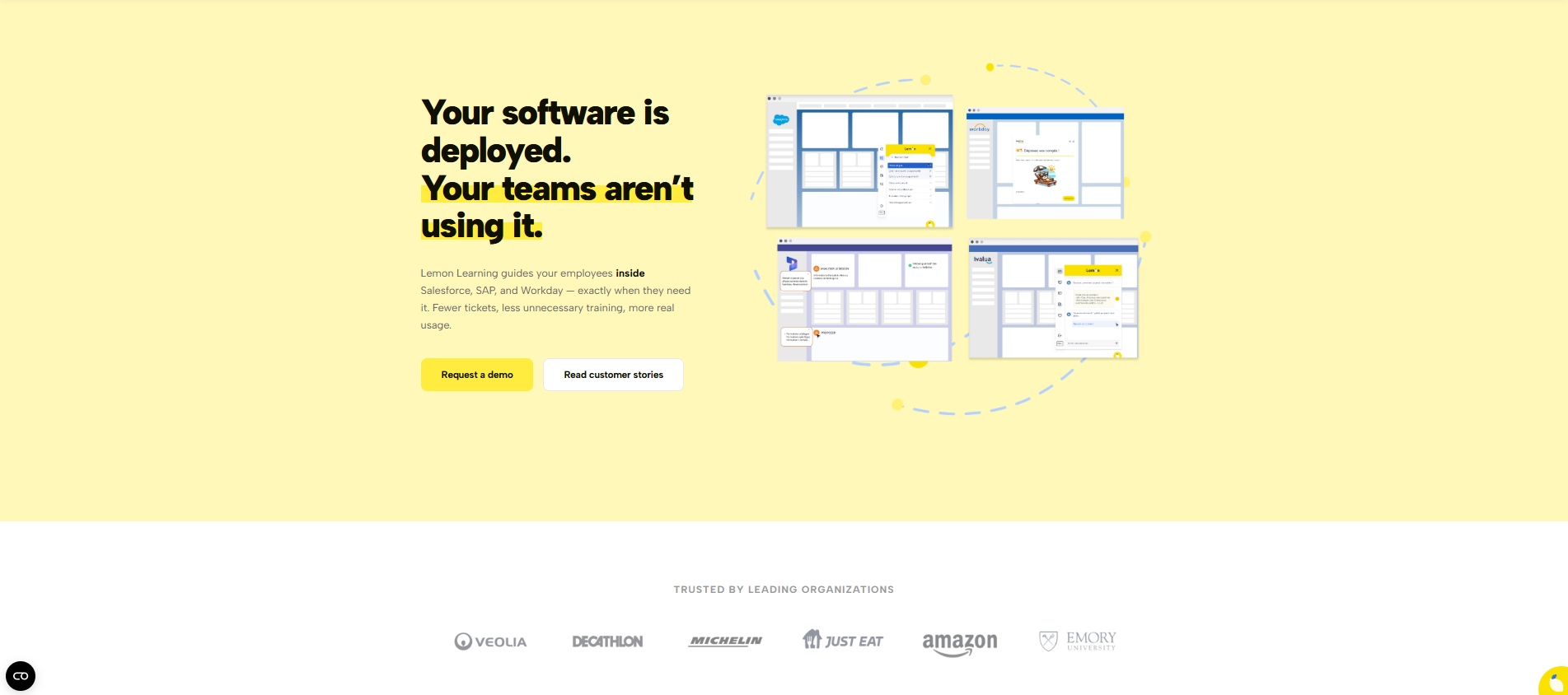
Lemon Learning is a European DAP referenced in the Gartner Market Guide for Digital Adoption Platforms (September 2025), with over 200 enterprise customers worldwide including BNP Paribas, Decathlon, Veolia, Schneider Electric and the French National Gendarmerie. Where Userlane is optimised for Microsoft-heavy environments and measures adoption through the HEART framework, Lemon Learning covers the full adoption lifecycle across any enterprise application stack, with support, governance and AI content creation included in the licence and no Microsoft dependency required.
What makes it different from Userlane
For organisations evaluating both platforms, our Lemon Learning vs Userlane comparison breaks down deployment, support, guidance depth, AI capabilities and pricing side by side.
- Support included, not tiered. Every licence includes unlimited local support with a dedicated project manager, pedagogical engineer and technical manager. Userlane structures support in paid tiers, meaning cost increases as your programme grows.
- Stack-agnostic. Lemon Learning deploys across SAP, Salesforce, Microsoft 365, Workday and in-house tools with equal depth. Its value does not depend on any single vendor ecosystem.
- Transparent pricing. Unlike Userlane's custom-only model, Lemon Learning offers published per-tool and corporate annual licensing, making it straightforward to benchmark and build a business case before entering a sales conversation.
- Governance built in. Lemon Governance monitors software usage across tools, prevents Shadow IT and manages content at scale, taking the platform well beyond HEART-level outcome measurement into long-term programme management.
- EU-sovereign by default. Hosted in Europe and GDPR-compliant by design, consistent with Userlane's Munich base. No configuration required and no legal verification needed for European procurement teams.
AI capabilities in 2026
- AI Assistant. The AI Assistant resolves user questions in natural language inside the application and launches the right guide automatically, cutting support ticket volume at scale.
- AI Guide Creator. The AI guide creation tool generates structured, step-by-step in-app guides from a simple text prompt, with automated translation across 35+ languages.
Limitations to consider
Lemon Learning is built for internal employee adoption across enterprise applications. If your estate is entirely Microsoft 365 and you specifically need Copilot-integrated agentic guidance as the primary use case, Userlane's dedicated Microsoft partnership may give it an edge in that narrow context.
Whatfix
Best suited to: Large enterprises that need agentic AI, simulation-based training and governed content operations across complex, multi-application environments.
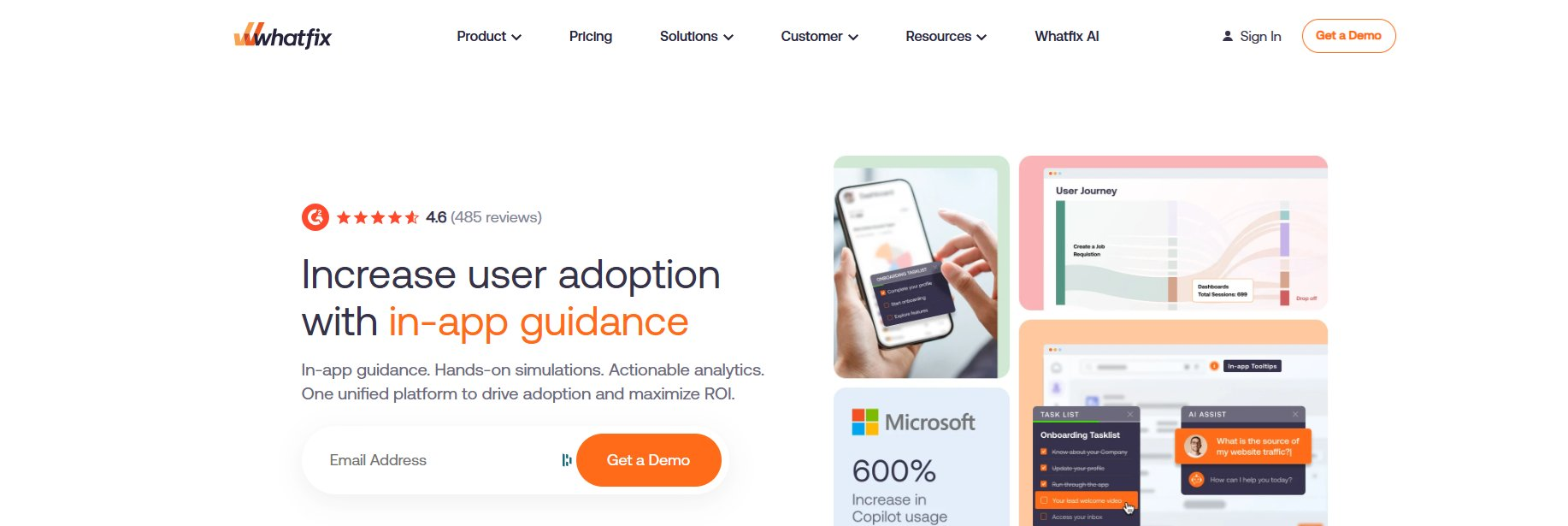
Whatfix is an enterprise-grade DAP that operates as a suite of three products: the core DAP for in-app guidance, Product Analytics for behaviour tracking, and Mirror for simulation-based training. Where Userlane focuses on guidance and HEART measurement, Whatfix goes deeper on agentic AI and the operational governance of content across complex, multi-application estates.
Where it excels
Its agentic AI suite, comprising an Authoring Agent, a Guidance Agent and an Insights Agent, is among the most developed in the category. Mirror's simulation training capability, allowing employees to practise workflows in safe pre-production environments, is a differentiator neither Userlane nor most alternatives offer.
Where it falls short
Cost and complexity. Entry-level contracts typically start around $24,000 annually, with larger deployments running $40,000 to $70,000 or more. Product Analytics and Mirror are sold separately, so the full suite carries a significant price premium over Userlane and Lemon Learning.
Compared to Lemon Learning
Lemon Learning reaches production in days and includes support in the licence. Whatfix is the right choice when simulation training or the full agentic AI suite are essential; outside those requirements, the complexity and cost premium are difficult to justify.
WalkMe
Best suited to: Large enterprises with dedicated digital adoption teams, substantial budgets and a strong SAP presence in their technology estate.
WalkMe is one of the longest-established DAPs, founded in 2011 and acquired by SAP in September 2024. Like Userlane, it targets enterprise employee adoption, but it operates at a different scale and price point, with deep customisation, dedicated implementation requirements and a roadmap that now answers to SAP's priorities.
Where it excels
Depth of customisation, a long enterprise track record, and deep native integration across the SAP ecosystem including SuccessFactors, Ariba, Concur and S/4HANA. For organisations already committed to SAP infrastructure, it is now a tightly embedded option.
Where it falls short
For non-SAP organisations, product investment and AI development now flow toward SAP's roadmap. Implementations require dedicated engineers and multi-week configuration. Average contract values sit around $78,817 per year, with support billed separately. Compared with Userlane, the barrier to entry is significantly higher.
Compared to Lemon Learning
Lemon Learning reaches production in days with support included and an independent roadmap. WalkMe requires dedicated engineers and months to deploy, with support billed on top and a product direction shaped by SAP rather than a diverse customer base.
Apty
Best suited to: Compliance-heavy enterprises where adoption must extend into workflow enforcement, data validation and process accuracy at the field level.
Apty takes a different approach from Userlane: where Userlane focuses on guidance and outcome measurement, Apty focuses on process compliance and data accuracy. Its Apty PULSE diagnostic, Apty OneX GenAI copilot and data validation capabilities are built for regulated industries where correct workflow execution is as important as adoption itself.
Where it excels
Live adoption diagnostics across the technology stack via Apty PULSE; data validation that flags incorrect or incomplete inputs during task completion; and cross-application workflow guidance via Apty OneX. For regulated industries where audit trails and process accuracy are non-negotiable, these capabilities are genuinely differentiated.
Where it falls short
Its compliance-first orientation is a strength in specific contexts but a limitation in broader change management programmes. It is US-based, which introduces GDPR and data residency concerns for European organisations. Pricing is custom with no published rates.
Compared to Lemon Learning
Where compliance, audit trails and workflow enforcement are the primary requirement, Apty merits serious evaluation. Where the brief is broader adoption velocity, change management and included support across a mixed application estate, Lemon Learning is the stronger fit.
Userpilot
Best suited to: Mid-market SaaS product and growth teams that want onboarding, feature adoption and product analytics in a single, accessible tool.
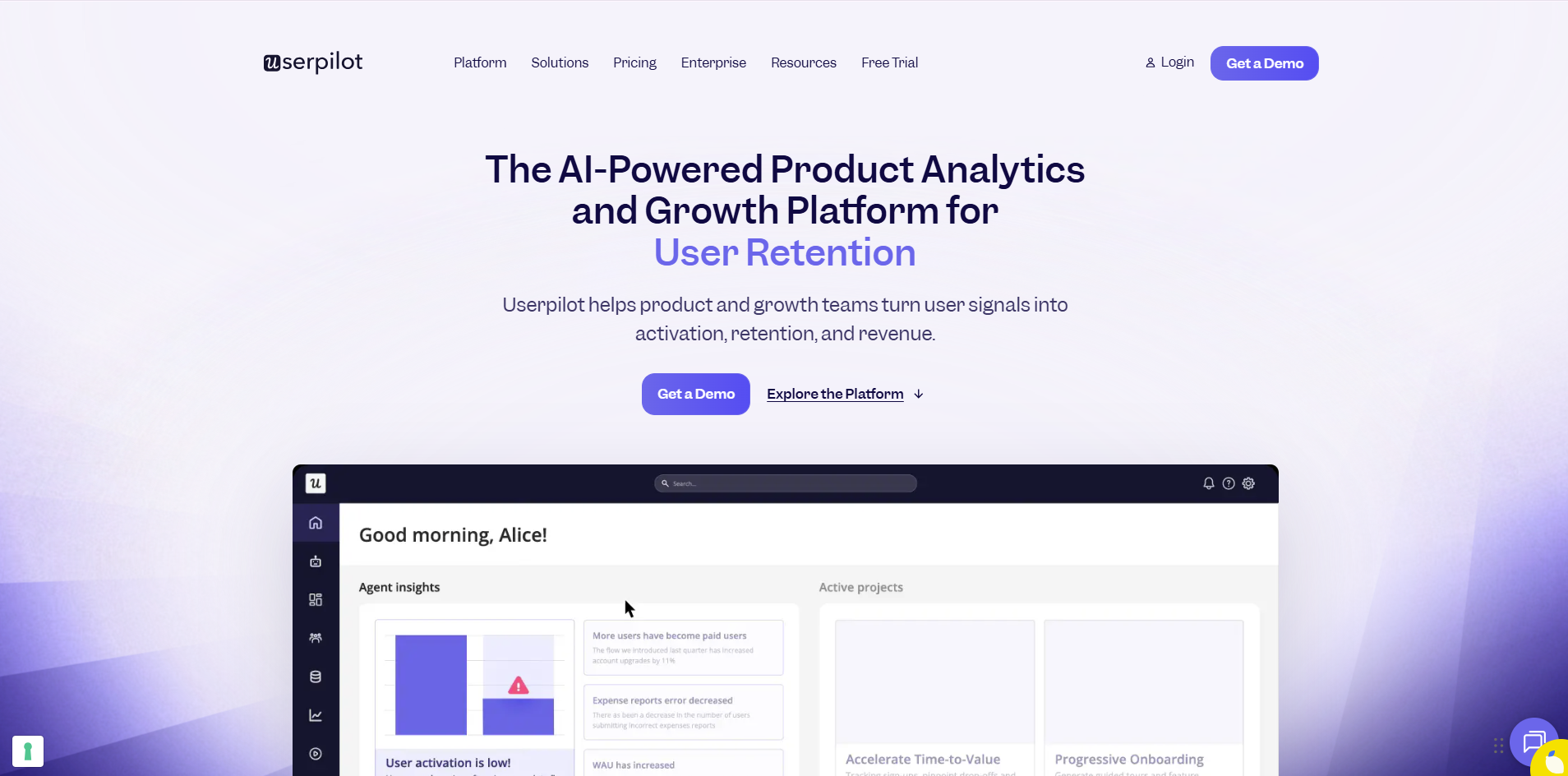
Userpilot sits at the opposite end of the market from Userlane: lightweight, no-code, and focused on customer-facing SaaS onboarding rather than enterprise employee adoption. For teams evaluating Userlane that have concluded its enterprise orientation and custom pricing are overkill for a simpler product onboarding brief, Userpilot offers an accessible alternative with built-in analytics.
Where it excels
No-code flows, tooltips, modals and checklists; behaviour-driven segmentation and targeting; and built-in product analytics covering funnels, cohorts, feature engagement and NPS, included in the core product. Starter pricing is published from $249 per month, making it easy to evaluate before a sales conversation.
Where it falls short
It is built for customer-facing SaaS and product-led growth, not internal enterprise employee adoption. It has no equivalent to Userlane's HEART framework, enterprise governance or Microsoft ecosystem depth, and does not target the regulated-sector or change management use cases that bring most organisations to evaluate Userlane in the first place.
Compared to Lemon Learning
Userpilot is the right choice for fast, no-code customer onboarding on a SaaS product. Lemon Learning is the right choice for internal employee adoption, included support and governance at enterprise scale.
The questions that actually decide it
The platforms above all have the fundamentals. For a team evaluating or leaving Userlane, the right fit comes down to a handful of questions.
Userlane's Microsoft 365 Copilot integration is its strongest differentiator. If your stack runs primarily on Salesforce, SAP, Workday or custom tools, a platform with a broader application footprint, such as Lemon Learning, will serve you better without the Microsoft dependency.
If you need a dedicated team covering project management, pedagogical engineering and technical delivery without additional cost, Lemon Learning's included support is structurally different from Userlane's paid tiers and most alternatives in this field.
If monitoring usage across your full software portfolio, preventing Shadow IT and managing content at scale are part of your brief, Lemon Learning's governance layer goes meaningfully further than Userlane's HEART framework.
Userlane does not publish pricing. If transparent costs are important for building an internal business case, Lemon Learning's published pricing and Userpilot's public tiers both make the evaluation process significantly faster.
If simulation-based training is essential, Whatfix leads. If strict process compliance and data validation are the core brief, Apty merits evaluation. For most other enterprise adoption programmes, see the full best digital adoption platforms guide.
A two-person team guided Salesforce adoption across a university and retired the PDFs
[Add approved quote from Emory case study here]

Userlane alternatives, common questions.
What is the best Userlane alternative? +
It depends on your stack and priorities. For European enterprises that need included support, transparent pricing, a broader application footprint and full-lifecycle governance, Lemon Learning is the strongest fit. For agentic AI and simulation training, Whatfix leads. For compliance-heavy industries, Apty. For mid-market SaaS onboarding, Userpilot. Our best digital adoption platforms guide compares them in depth.
Why choose a Userlane alternative? +
Userlane is a strong fit for Microsoft-heavy enterprise environments that benefit from its Copilot integration. Teams look elsewhere when their stack is mixed, when they need support included rather than tiered, when transparent pricing matters for internal approval, or when they need deeper governance capabilities beyond outcome measurement.
How much does Userlane cost? +
Userlane does not publish pricing. All contracts are custom, making it difficult to benchmark before entering a sales process. Lemon Learning offers transparent per-tool and corporate annual licensing with unlimited local support included, and no implementation fees.
Is Userlane only for Microsoft environments? +
No, Userlane works across a range of enterprise applications. But its strongest differentiator, an AI Assistant integrated with Microsoft 365 Copilot, is specifically valuable for Microsoft-heavy estates. Organisations running primarily on Salesforce, SAP or Workday may find a platform without that specific dependency, such as Lemon Learning, a more natural fit.
Is there a GDPR-compliant Userlane alternative? +
Yes. Both Userlane and Lemon Learning are European and GDPR-compliant by design. Lemon Learning is EU-hosted by default with no US data-residency exposure, making it a direct like-for-like alternative on data sovereignty while going further on included support and transparent pricing.
Compare them on your own stack.
In 30 minutes we will run Lemon Learning on the actual tools you are evaluating, whether it is Salesforce, SAP, Workday or an in-house application. No generic walkthrough, just a tailored demo relevant to you.
Book a demo