The Burke-Litwin Change Model: A Practical Guide for Organizational Leaders
Learn how the Burke-Litwin causal model of organizational performance and change works, what its 12 factors are, and how to apply it to drive effective
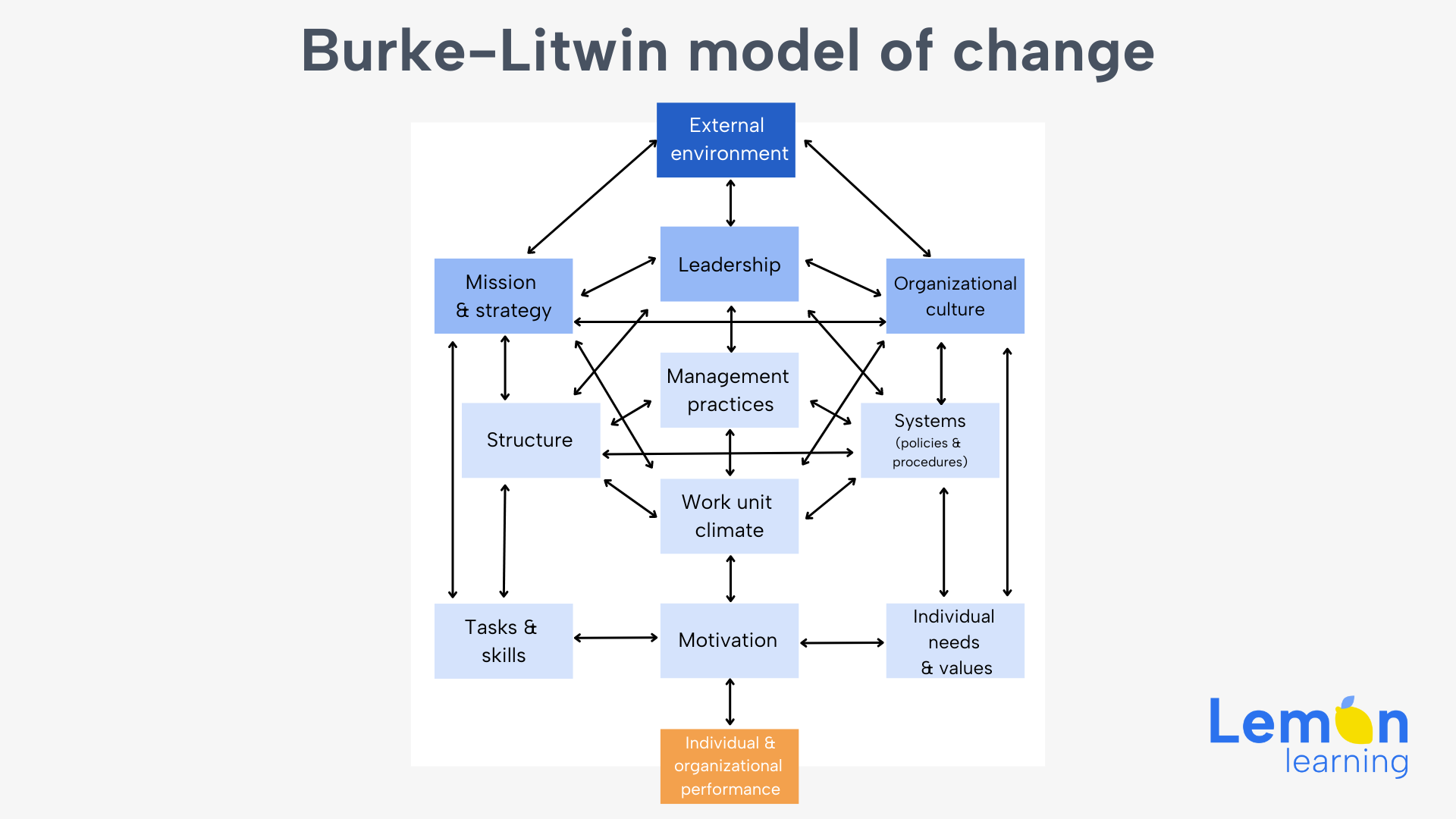
The Burke-Litwin model of organizational change is a causal framework that identifies 12 interdependent factors shaping how and why organizations change, and maps the direction of influence between them. Developed by W. Warner Burke and George H. Litwin and first published in 1992 in the Journal of Management, it remains one of the most cited diagnostic tools in organizational development. This guide explains the model's structure, its 12 factors, the distinction between transformational and transactional change, and how to apply it systematically to a real change initiative.
What is the Burke-Litwin Model?
The Burke-Litwin model, formally titled "A Causal Model of Organizational Performance and Change," is a systems-based diagnostic framework for understanding organizational change and performance. Unlike simpler change models that treat an organization as a linear sequence of steps, Burke and Litwin constructed a causal map: a set of 12 factors arranged so that changes in upstream factors (such as external environment or leadership) flow downward and influence downstream factors (such as work climate or motivation), ultimately affecting individual and organizational performance.
The model was designed to do two things simultaneously: explain how organizations currently perform, and predict how deliberate change interventions will ripple through the system. That dual purpose makes it particularly useful for leaders who want to anticipate second-order consequences before they launch a transformation program.
The framework is also notable for distinguishing between two types of change: transformational change, which alters the fundamental character of an organization, and transactional change, which modifies day-to-day operations without reshaping core identity. This distinction has direct practical implications for where leaders should focus their attention and resources.
What Are the 12 Factors of the Burke-Litwin Model?
The model groups its 12 factors into three categories: transformational factors, transactional factors, and a performance factor. Each factor both influences and is influenced by the others, but the general direction of causality runs top-to-bottom in the standard diagram.
Transformational Factors
Transformational factors sit at the top of the model. A significant shift in any of these typically triggers change across the entire organization. Burke and Litwin specifically linked transformational change to external pressures: market disruptions, regulatory shifts, or major competitive threats that force an organization to reconsider its fundamental direction.
Factor
Definition
Example trigger
External Environment
All outside forces acting on the organization: market conditions, regulation, technology, competition, and societal trends
A new regulation requiring data privacy compliance
Mission and Strategy
The organization's declared purpose and the plan for achieving it; what leaders believe the organization exists to do and how it will compete
A strategic pivot from product sales to subscription services
Leadership
The behavior and values demonstrated by senior executives; the tone set at the top that others observe and emulate
A new CEO with a different management philosophy
Organizational Culture
The shared values, beliefs, norms, and behaviors that characterize how things are done in the organization, often described as "the way we do things here"
Shifting from a hierarchical to a collaborative decision-making culture
Because these four factors are deeply embedded, changing them requires sustained effort. Leadership behavior and organizational culture, in particular, are slow to shift and can undermine a change initiative if left unaddressed while other factors are reformed.
Transactional Factors
Transactional factors govern the everyday workings of the organization. They sit below the transformational layer and are influenced by it. Changes here can be made without necessarily transforming the organization's fundamental character, though they must remain aligned with the transformational factors above them to be sustainable.
Factor
Definition
Practical implication
Structure
The formal arrangement of roles, reporting lines, and authority within the organization
A matrix structure may slow decision-making if it conflicts with an agile strategy
Management Practices
The behaviors managers exhibit when implementing strategy: how they plan, organize, communicate, and develop people
Managers who hoard information block the openness a new collaborative culture requires
Systems and Policies
Formal rules, processes, procedures, and technology platforms that support day-to-day operations
Legacy software that does not support new workflows must be replaced or supplemented
Work Climate
The collective perceptions employees hold about their work environment: psychological safety, fairness, support, and clarity of expectations
A climate of fear suppresses the feedback loops a learning organization needs
Task Requirements and Individual Skills
The competencies, knowledge, and behaviors that specific roles demand, matched against what employees actually possess
A digital transformation initiative fails if employees lack the skills to use new tools
Individual Needs and Values
The personal motivations, preferences, and core values each employee brings to the organization
Employees whose personal values conflict with a new mission are unlikely to sustain changed behaviors
Motivation
The aroused behavioral tendencies that direct, energize, and sustain goal-directed effort; influenced by both individual needs and organizational conditions
Unreinforced effort after a major restructuring leads to disengagement
The Performance Factor
Individual and Organizational Performance sits at the base of the model and represents the measurable output of all 12 factors working together. This includes financial results, customer satisfaction, employee productivity, quality outcomes, and any other metric the organization uses to define success. Crucially, performance data also feeds back upward through the model: poor results signal that something in the causal chain requires attention.
What Is the Difference Between Transformational and Transactional Change?
One of the Burke-Litwin model's most important contributions to change management thinking is its explicit distinction between two fundamentally different types of change.
Transformational change is driven primarily by the external environment and is required when an organization must alter its mission, strategy, culture, or leadership approach to survive or grow. It is deep, systemic, and carries a high risk of failure if underestimated. The organization after transformational change looks and behaves differently in its most basic characteristics.
Transactional change involves modifications to structure, management practices, systems, climate, tasks, skills, or motivation. It tends to be more bounded and manageable, although it still requires careful planning. Transactional change typically occurs more frequently and in response to internal pressures or operational improvements rather than existential external threats.
The practical value of this distinction is that it guides resource allocation. Leaders who treat a genuinely transformational challenge (such as a culture overhaul or a mission redefinition) with only transactional tools (such as a new org chart or a revised performance review system) will find that surface-level changes fail to take hold. Conversely, leaders who mobilize the organization for full-scale transformation when only a process adjustment is needed create unnecessary disruption.
"Permanent change is not a sequence of projects. It does not work, because it is not about moving from state A to state B; with permanent change there is no state A and state B."
How Does the Causal Logic of the Model Work?
The Burke-Litwin model is not just a list of 12 factors: it is a causal map. Arrows in the original diagram show that change flows generally from the top (external environment) downward toward performance, but the model also acknowledges feedback loops. An organization does not simply receive external pressure and adapt; its performance outcomes and cultural responses loop back to influence how it reads and responds to the environment.
The key causal chains worth understanding are:
External Environment to Mission and Strategy: Shifts in market conditions, technology, or regulation are the most common reason organizations revisit their strategic direction. Without this link, strategy can become disconnected from reality.
Leadership to Organizational Culture: What leaders consistently model, reward, and tolerate defines culture far more than any written values statement. A leadership change is therefore one of the fastest ways to begin a cultural shift, though culture itself is slow to follow.
Culture and Structure to Management Practices: Even technically competent managers will behave in ways that are constrained or enabled by the cultural norms and structural incentives around them. Changing management practices in isolation, without addressing the culture that produces them, tends to be ineffective.
Systems and Policies to Task Requirements: Technology platforms, HR processes, and operational procedures define what employees are expected to do and how. When systems are misaligned with strategy, employees cannot perform effectively regardless of their skill or motivation.
Work Climate to Motivation: An environment perceived as fair, safe, and well-resourced generates higher motivation. Leaders who invest in climate improvement often see motivation and discretionary effort improve without changing pay or role design.
Motivation to Performance: Sustained effort directed at the right tasks, in the right conditions, produces the outcomes the organization needs. Motivation is therefore the proximate driver of performance, with all other factors acting through it.
Understanding these chains allows leaders to identify the highest-leverage intervention points rather than attempting to change everything at once.
How Do You Apply the Burke-Litwin Model to an Actual Change Initiative?
Applying the Burke-Litwin model of organizational change is a four-phase diagnostic and planning process. Each phase builds on the previous one and is designed to produce a fact-based, stakeholder-grounded action plan.
Phase 1: Diagnose All 12 Factors
Begin by collecting factual data on each of the 12 factors as they currently exist in your organization. Do not rely on assumptions or single sources. Triangulate using multiple methods: structured interviews with decision-makers and frontline employees, surveys measuring work climate and motivation, document analysis of strategy papers and policy manuals, and observation of management behaviors in practice.
For each factor, answer two questions: What is the current state? What is the desired state after the change initiative is complete? The gap between the two answers defines the scope of the work needed for that factor.
Phase 2: Map the Causal Links Relevant to Your Initiative
Not all 12 factors will be equally central to every change initiative. Once you have diagnostic data, map which factors are most directly affected by the change you are planning and which will be impacted as secondary or tertiary consequences. This prevents tunnel vision and allows you to anticipate resistance or failure before it occurs.
For example, a digital transformation program will immediately affect systems and policies and task requirements and individual skills, but it will also affect work climate (if employees feel unprepared or surveilled), management practices (if managers do not know how to coach new tools), and motivation (if early difficulties are not supported). Mapping these links in advance leads to a more complete intervention design.
Phase 3: Prioritize Transformational or Transactional Action
Based on your causal map, determine whether your initiative primarily requires transformational or transactional change. If the external environment has fundamentally shifted and your mission, strategy, leadership, or culture must change, treat this as a transformational initiative and allocate resources accordingly. If you are improving a process, restructuring a team, or updating a system, you are in transactional territory and can apply more targeted tools.
A critical pitfall is misclassifying the level of change required. Many initiatives that fail do so because leaders apply transactional solutions (new software, a revised org chart) to what is fundamentally a transformational problem (a culture that rewards the status quo). A thorough diagnostic in Phase 1 usually reveals the true nature of the challenge.
Phase 4: Build and Execute a Structured Action Plan
With diagnosis and mapping complete, develop an action plan that includes specific objectives for each affected factor, clear owners, timelines, and measurable success indicators. A few principles strengthen execution:
Stakeholder involvement: Engage employees, managers, and senior leaders from the beginning, not just as recipients of the change but as co-designers. The Burke-Litwin model's systemic logic is itself a useful communication tool: showing people how their role connects to the broader change increases buy-in.
Sequencing: Address transformational factors before transactional ones where possible. Restructuring without cultural alignment, or deploying new technology without leadership commitment, typically produces resistance or superficial adoption.
Communication throughout: Monitor how employees at every level respond to each phase and adjust messaging accordingly. Silence creates anxiety; transparent, frequent communication about what is changing and why reduces it.
Review cycles: External conditions can shift during a long change initiative. Build in regular reassessments of the external environment factor to ensure your strategy remains valid.
Supporting technology adoption: When new digital tools are part of the initiative, ensuring employees can actually use them is essential. Platforms designed for change management support can embed guidance directly in the tools employees use, reducing the skill gap identified in the task requirements factor.
For a broader framework on structuring the end-to-end process, the guide to a successful change management process provides complementary steps that work alongside the Burke-Litwin diagnostic approach.
What Are the Strengths and Limitations of the Burke-Litwin Model?
No single framework is suited to every situation. Understanding where the Burke-Litwin model excels and where it has limitations helps you apply it with appropriate judgment.
Strengths
Systemic view: By mapping causal relationships rather than listing independent variables, the model reveals how change in one area ripples into others. This prevents the common failure mode of solving one problem while inadvertently creating another.
Diagnostic depth: The 12-factor structure gives change leaders a comprehensive checklist that is still manageable. It is detailed enough to surface hidden obstacles but not so granular that it becomes paralytic.
Transformational vs. transactional clarity: This distinction is the model's most practically useful contribution. It helps leaders calibrate the scale of intervention needed rather than defaulting to either under- or over-engineering the response.
Empirical grounding: The original 1992 paper by Burke and Litwin was published in the peer-reviewed Journal of Management and has accumulated thousands of academic citations, giving practitioners confidence that the model's structure reflects real organizational dynamics.
Feedback loop recognition: By acknowledging that performance data feeds back into the model, Burke and Litwin built in an inherent review mechanism, encouraging leaders to treat change as an ongoing diagnostic cycle rather than a one-time project.
Limitations
Complexity: For small organizations or simple change initiatives, 12 factors and their causal links may represent more analytical overhead than the initiative justifies. Simpler models may be more practical in those contexts.
Data demands: The diagnostic phase requires genuine investment in data collection across all levels of the organization. Leaders who skip this step and apply the model based on assumptions will produce an action plan that reflects those assumptions rather than organizational reality.
Change velocity: In fast-moving environments, a comprehensive Burke-Litwin diagnosis can take longer than the time available before external conditions shift again. In those situations, the model may be more useful as a retrospective sense-making tool or as a partial scan of the highest-priority factors.
Measurement difficulty: Factors such as organizational culture, work climate, and individual motivation are real and consequential, but measuring them accurately requires skill in survey design and qualitative research. Organizations without that capability may measure these factors imprecisely.
How Does the Burke-Litwin Model Compare to Other Change Frameworks?
The Burke-Litwin model is one of several established frameworks for understanding organizational change. Situating it relative to others helps practitioners choose the right tool for the challenge at hand.
Framework
Primary focus
Key differentiator from Burke-Litwin
Burke-Litwin (1992)
Diagnosing causal factors of organizational performance and change
Individual-level psychological model; does not map organizational structure or external environment
Lewin's Force Field Analysis
Identifying driving and restraining forces for a specific change
Narrower scope; useful for a single decision but not for diagnosing whole-system dynamics
In practice, Burke-Litwin works best as the diagnostic foundation, with other models providing the execution methodology. For example, using Burke-Litwin to identify that culture and leadership are the primary obstacles to change, and then applying Kotter's steps to sequence the leadership engagement, is a common and effective combination. You can also explore the four main types of organizational change management to understand which category your initiative falls into before selecting a framework.
What Does the Burke-Litwin Model Look Like Applied to a Real Scenario?
Consider a mid-size financial services organization that is migrating its core operations onto a new cloud-based platform. The immediate instinct might be to treat this as a technology project: select the platform, migrate the data, train users, and go live. The Burke-Litwin model prompts a much richer analysis.
External Environment: Regulatory pressure on data security and competitor investment in cloud infrastructure are the primary external drivers. These are real and time-sensitive, which means the initiative cannot be postponed.
Mission and Strategy: The organization's stated strategy of operational efficiency and data-driven decision-making is directly supported by the migration. Leadership should communicate this alignment explicitly to give the change purpose beyond technical necessity.
Leadership: If senior leaders are not visibly using and endorsing the new platform, middle managers will treat adoption as optional. Leadership behavior must change alongside the technology.
Organizational Culture: If the culture has historically valued established processes and is risk-averse about new tools, the migration will face passive resistance. Cultural messaging about innovation as a core value, reinforced by early wins, is needed.
Structure: Reporting lines for the digital and operations teams may need temporary adjustment to support cross-functional collaboration during migration.
Management Practices: Managers need coaching on how to support their teams through the transition: how to handle questions, escalate technical issues, and model positive engagement with the new system.
Systems and Policies: Legacy workflows embedded in old software must be redesigned for the new platform. Policy documents and standard operating procedures must be updated in parallel with the technology rollout.
Work Climate: If employees feel that the migration is being done to them rather than with them, anxiety and disengagement will undermine adoption. Early involvement, pilot groups, and transparent communication about the timeline all improve climate.
Task Requirements and Individual Skills: A skills gap analysis is essential before go-live. Where gaps exist, targeted training must be delivered. Embedding guidance in the platform itself, rather than relying on classroom training alone, increases the speed and durability of skill acquisition.
Individual Needs and Values: Some employees will welcome the new tools as an efficiency gain. Others will fear job displacement or feel that years of expertise in the old system are being devalued. Both responses are legitimate and require different communication and support strategies.
Motivation: Recognition of early adopters, visible celebration of milestone achievements, and clear messaging that proficiency in the new platform is a valued and rewarded capability all sustain motivation through the inevitable difficulties of transition.
Performance: Define specific, measurable performance indicators for the migration: adoption rates, error rates, process cycle times, user confidence scores. Review these at regular intervals and use them to identify which upstream factors need further attention.
By working through all 12 factors rather than only the technical and training dimensions, the organization surfaces risks it would otherwise encounter only after go-live, when they are more expensive to address. Lemon Learning's digital adoption platform is designed to support exactly the skills and motivation factors the model identifies as critical: providing in-application guidance that meets employees where they work, rather than relying on training that is disconnected from the moment of need.
Key Recommendations for Applying the Burke-Litwin Model Effectively
Based on the model's structure and its use across organizational development practice, several recommendations stand out for leaders planning to apply it.
Do not skip the diagnostic phase. The quality of your action plan is entirely dependent on the quality of your diagnosis. Invest in data collection across all levels, including frontline employees who often hold the most accurate picture of how things actually work.
Prioritize transformational factors if they are implicated. It is tempting to start with the transactional factors because they feel more concrete and controllable. But if your diagnosis reveals that culture or leadership is misaligned with the desired change, addressing those factors must come first or in parallel.
Communicate the causal logic to stakeholders. Showing employees and managers how their role connects to the broader change, using the model's causal structure as a communication tool, increases understanding and reduces the anxiety that comes from feeling like a passive recipient of change imposed from above.
Build in feedback loops. The model treats performance data as an input back into the system. Schedule regular reviews where performance indicators are examined and traced back to the causal factors most likely responsible. This turns the model from a one-time diagnostic into an ongoing management discipline.
Use the right tools for each factor. Human performance, motivation, and skill development all have specific supporting disciplines and technologies. Match the intervention to the factor: culture work requires different methods than systems redesign or skills training.
For leaders who want to understand the broader organizational context in which the Burke-Litwin model operates, the overview of organizational change provides essential background on why organizations change and what determines success or failure across different types of initiatives.
FAQ
Frequently asked questions
What is the Burke-Litwin model of organizational change?+
The Burke-Litwin model, formally titled 'A Causal Model of Organizational Performance and Change' and published by W. Warner Burke and George H. Litwin in 1992, is a framework that identifies 12 interconnected factors influencing how and why organizations change. It distinguishes between transformational factors (driven by the external environment and producing deep, culture-wide change) and transactional factors (governing day-to-day operations), and shows how they causally link to individual and overall performance.
What are the 12 factors in the Burke-Litwin model?+
The 12 factors are: (1) External Environment, (2) Mission and Strategy, (3) Leadership, (4) Organizational Culture, (5) Structure, (6) Management Practices, (7) Systems and Policies, (8) Work Climate, (9) Task Requirements and Individual Skills, (10) Individual Needs and Values, (11) Motivation, and (12) Individual and Organizational Performance. The first four are transformational; factors five through eleven are transactional; performance is the outcome factor.
What is the difference between transformational and transactional change in the Burke-Litwin model?+
Transformational change involves the top four factors: external environment, mission and strategy, leadership, and organizational culture. Altering any of these creates organization-wide impact and is typically driven by external pressures such as market shifts or regulatory changes. Transactional change involves the lower-tier factors such as structure, management practices, systems, and work climate. These govern everyday interactions and can be adjusted without necessarily reshaping the entire organization.
How do you apply the Burke-Litwin model in practice?+
Applying the Burke-Litwin model involves four broad steps: (1) Map all 12 factors for your organization by collecting factual data from decision-makers. (2) Identify causal links and dependencies between factors to understand where change in one area will ripple into others. (3) Prioritize the factors most relevant to your planned change initiative. (4) Build an action plan that addresses both transformational and transactional factors, involves all stakeholders, and uses clear metrics to track progress. Regular reviews ensure the model remains aligned with evolving external conditions.
Learn what a RACI matrix is, what each letter stands for, how it works in project management, and how to build one that clarifies every role on your...