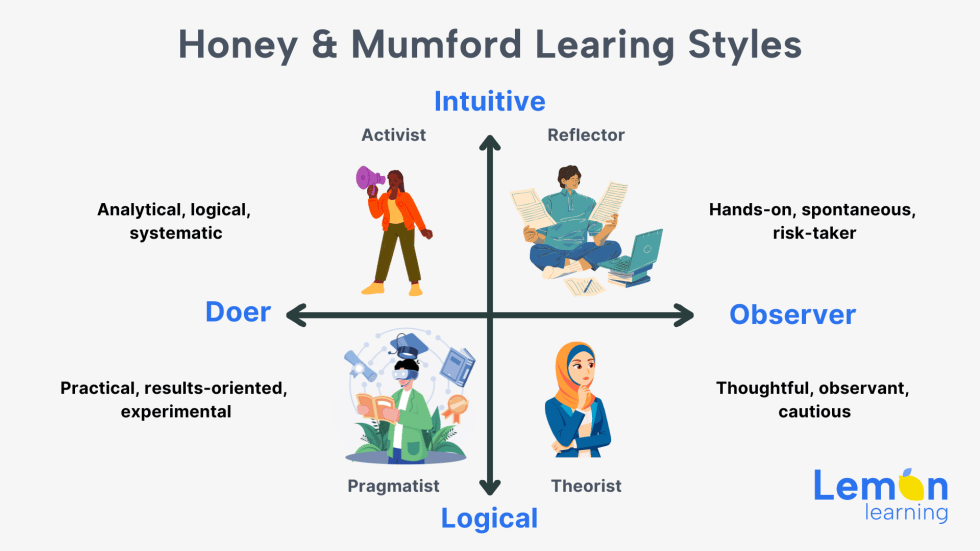
The Honey and Mumford learning styles model, developed by psychologists Peter Honey and Alan Mumford in 1986, identifies four distinct preferences that explain how individuals process and retain new information: Activist, Reflector, Theorist, and Pragmatist. Understanding which style applies to you, or to your team, allows educators and managers to design more effective, targeted learning experiences. This guide covers each of the four styles, how to identify your preference, and how to put the framework to practical use.
Where Does the Honey and Mumford Model Come From?
The Honey and Mumford model builds directly on the experiential learning work of David Kolb, whose four-stage learning cycle (Concrete Experience, Reflective Observation, Abstract Conceptualisation, Active Experimentation) was published in 1984. Honey and Mumford adapted Kolb's cycle to create a more practitioner-friendly tool aimed at managers and workplace trainers rather than academic researchers. Their Learning Styles Questionnaire (LSQ) was first published in 1986 and has since been used widely in corporate learning and development programmes and in higher education.
Each of the four Honey and Mumford styles broadly corresponds to a stage in Kolb's cycle, but the language and the self-assessment approach were redesigned to make the model easier to apply in organisational settings. For a deeper look at the underlying experiential theory, see this overview of Kolb's learning cycle and its workplace applications.
What Are the 4 Honey and Mumford Learning Styles?
The model categorises learners into four types. Most people show a strong preference for one or two styles rather than scoring equally across all four.
Activists
Activists learn best through direct, hands-on experience. They embrace new challenges enthusiastically, engage fully in the present moment, and are comfortable with ambiguity and the absence of step-by-step instructions. Risk-taking and experimentation come naturally to them.
Activists thrive in interactive and experiential environments such as role-plays, simulations, group problem-solving tasks, and competitive team activities. Their main development area is learning to pause, observe, and reflect before moving on, since the drive to act can sometimes mean they miss important lessons from what has just happened.
Reflectors
Reflectors prefer to stand back, gather information from multiple angles, and think carefully before drawing conclusions. They are comfortable with qualitative, even disorganised data, and they take time to absorb observations from their own experience and from watching others.
Reflectors work well in settings that allow independent research, small-group discussion at their own pace, and structured opportunities to review what has been learned. They can feel uncomfortable when forced to make fast decisions or speak without preparation, so activities that demand immediate responses without reflection time are less suited to this style.
Theorists
Theorists build understanding by connecting new information to existing frameworks, models, and logical systems. They seek the underlying principles behind what they observe and are motivated by analysis, systems thinking, and intellectual rigour. Abstract concepts and structured arguments are their preferred currency.
Theorists learn well through case studies with clear analytical frameworks, structured lectures, reading, and opportunities to question assumptions. They typically struggle with tasks that require intuitive or emotional judgement, or situations where the rules are unclear and ambiguity is high.
Pragmatists
Pragmatists are motivated by the practical relevance of what they are learning. They want to know how an idea or technique applies to real problems they face, and they learn best through concrete demonstrations, worked examples, coaching from an experienced practitioner, and problem-solving with real-world constraints.
Pragmatists can lose interest when learning feels too theoretical or disconnected from immediate application. Linking new concepts explicitly to job-relevant scenarios is the most effective way to engage them.
Summary of the 4 Honey and Mumford Learning Styles
Style
Core approach
Best suited to
Development need
Activist
Learn by doing, embrace challenges
Simulations, role-play, group tasks
Reflection and consolidation
Reflector
Observe, analyse, then conclude
Independent research, structured review
Acting decisively under time pressure
Theorist
Build models, seek logical principles
Analytical case studies, structured lectures
Tolerating ambiguity and intuitive tasks
Pragmatist
Apply learning to real problems
Worked examples, coaching, problem-solving
Engaging with theory for its own sake
What Is the Honey and Mumford Learning Styles Questionnaire?
The Honey and Mumford Learning Styles Questionnaire (LSQ) is the primary diagnostic tool associated with the model. In its standard form it contains 80 statements about behaviour and attitudes. Respondents mark each statement as either applying or not applying to them, without any time limit. The process typically takes 10 to 15 minutes to complete.
Once scored, the results indicate the relative strength of each of the four preferences. Honey and Mumford recommend that learners use their profile not as a fixed label but as a starting point for reflection: understanding a weaker preference is just as valuable as confirming a dominant one, because developing range across all four styles makes a person a more effective learner overall.
Peter Honey and Alan Mumford recommend that to maximise personal learning, each learner should understand their own learning style and actively seek out opportunities that both play to their strengths and stretch their less-developed preferences.
How Do You Identify Your Honey and Mumford Learning Style?
The most reliable method is to complete the formal LSQ. However, you can also develop a strong initial hypothesis by reflecting on the following questions about your own learning habits:
Do you prefer to jump straight into a new task before reading the instructions, or do you research thoroughly before starting?
Are you more energised by working things out in the moment, or by having time to think quietly before contributing?
Do you gravitate toward understanding the theory behind a process, or do you care mainly about whether it works in practice?
When given a new piece of software or tool at work, do you explore it by trial and error, read the manual, look for the underlying logic, or ask how colleagues are using it day-to-day?
Patterns in your answers will point toward one or more of the four styles. Most people find they have a primary style and a secondary one, with the remaining two being less natural but still accessible with conscious effort.
How Is the Honey and Mumford Model Applied in Practice?
The framework is useful wherever learning is being designed or managed, whether that is a classroom, a corporate training room, or a one-to-one coaching conversation.
Application in Education
Teachers and trainers who use the Honey and Mumford framework can design programmes that serve all four preferences within a single course. A well-balanced unit might include:
A live problem or challenge for Activists to engage with immediately
A structured review or discussion period that gives Reflectors time to process
A model or conceptual framework that satisfies Theorists' need for coherence
A practical case study or simulation that shows Pragmatists how the concept applies to real situations
When designing software training programmes, for example, instructors can pair exploratory sandbox exercises (for Activists) with detailed walkthroughs (for Theorists), reflective group debriefs (for Reflectors), and job-context scenarios (for Pragmatists). This variety increases engagement and improves knowledge retention across a mixed group.
Application in the Workplace
Managers and learning and development professionals who understand the four styles can tailor coaching, onboarding, and performance support to individual team members. Some practical examples:
Activists benefit from stretch assignments, cross-functional projects, and the chance to lead new initiatives.
Reflectors do their best thinking when given advance notice of discussion topics and time to prepare considered responses before a meeting.
Theorists respond well to access to research, structured frameworks, and opportunities to challenge assumptions in a safe environment.
Pragmatists are most engaged when training is anchored to the specific challenges they face in their role, with clear guidance on immediate application.
Understanding these preferences also supports more effective onboarding. When new employees understand their own learning style early, they can take greater ownership of their development and communicate more clearly with managers about the kind of support they need. For organisations managing broader workforce transitions, the model pairs naturally with structured approaches to learning and development programme design.
Application in Digital Learning Environments
The shift toward digital and hybrid working has made it more important than ever to design learning experiences that serve different preferences. A one-size-fits-all e-learning module will not engage all four styles equally. Effective digital learning design applies the same logic as classroom design: offer varied formats within a programme rather than relying on a single modality.
Lemon Learning's digital adoption platform supports this approach by delivering contextual, in-application guidance that can be surfaced at the moment a user needs it, rather than requiring them to leave their workflow and complete a separate training course. This on-demand format naturally accommodates Pragmatists and Activists, while structured guided tours and knowledge-base content serve Theorists and Reflectors.
What Are the Limitations of the Honey and Mumford Model?
The Honey and Mumford model is a widely used and practically valuable tool, but it is important to apply it with an understanding of its limitations.
First, learning styles are self-reported preferences, not fixed neurological traits. A person's preferred style can shift depending on the subject, the context, and their level of prior knowledge. Research in cognitive and educational psychology has found limited evidence that matching teaching methods to self-reported learning styles produces better outcomes than simply using varied, well-designed instruction for everyone.
Second, placing learners into one of four categories risks oversimplification. Most individuals draw on multiple styles depending on the task, and labelling someone as "a Reflector" can inadvertently discourage them from developing other approaches.
Third, the LSQ relies on honest self-assessment. Results can be influenced by how a person wishes to see themselves rather than how they actually behave when learning.
Used thoughtfully, the model is best treated as a reflective prompt and a framework for discussion, not a definitive classification system. For a broader view of how the Honey and Mumford model compares with other frameworks, see this overview of essential learning styles models.
How Does the Honey and Mumford Model Relate to Other Learning Theories?
As noted above, the model is an adaptation of Kolb's experiential learning cycle. The four Honey and Mumford styles map approximately as follows:
Honey and Mumford styles mapped to Kolb's learning cycle stages
Honey and Mumford Style
Corresponding Kolb Stage
Activist
Concrete Experience
Reflector
Reflective Observation
Theorist
Abstract Conceptualisation
Pragmatist
Active Experimentation
The key difference is that Kolb describes a cycle through which all learners should ideally pass, while Honey and Mumford focus on the stage at which an individual is most comfortable, treating that comfort as a starting point for self-development rather than a ceiling.
Other related frameworks include Neil Fleming's VARK (Visual, Aural, Read/Write, Kinaesthetic) model, which focuses on sensory modality preferences, and Howard Gardner's theory of multiple intelligences, which takes a broader view of cognitive strengths. Each framework offers a different lens; no single model captures the full complexity of how people learn.
FAQ
Frequently asked questions
What are the 4 learning styles of Honey and Mumford?+
Peter Honey and Alan Mumford identify four learning styles: Activists (who learn through hands-on experience and new challenges), Reflectors (who observe and analyse before acting), Theorists (who connect ideas through logic and abstract models), and Pragmatists (who focus on the practical application of knowledge). Most people show a preference for one or two of these styles.
Is Honey and Mumford still relevant today?+
The Honey and Mumford model remains widely used in workplace training and higher education because it offers a practical, accessible framework for tailoring learning to individuals. However, researchers note that learning-style theories in general lack robust empirical support from controlled studies, and the model is best used as a reflective tool rather than a fixed label for any learner.
Are there criticisms of the Honey and Mumford model?+
Yes. Critics point out that learning-style categories can oversimplify how people learn, that individuals rarely fit neatly into one style, and that the scientific evidence for matching teaching methods to self-reported styles is limited. The model is nonetheless valued as a starting point for encouraging self-reflection about learning preferences.
What is the Honey and Mumford Learning Styles Questionnaire?+
The Honey and Mumford Learning Styles Questionnaire (LSQ) is a self-assessment tool, typically containing 80 statements, that helps individuals identify their dominant learning preference among the four styles. Respondents mark each statement as applying or not applying to them, and their scores indicate whether they lean toward Activist, Reflector, Theorist, or Pragmatist learning.
Learn what the Eisenhower Matrix is, how its four quadrants work, and how to use this proven prioritization tool to manage tasks more effectively at...