Kurt Lewin's Change Model: A Practical Guide to the 3 Stages
Learn how Kurt Lewin's three-stage change model, Unfreeze, Change, and Refreeze, helps organizations manage transformation and reduce resistance to change.
Kurt Lewin's change model is a three-stage framework, Unfreeze, Change, and Refreeze, that helps organizations plan and sustain transformation while reducing employee resistance. Developed by psychologist Kurt Lewin in the 1940s, it remains one of the most widely cited models in change management.
Who was Kurt Lewin?
Kurt Lewin was a German-American social psychologist whose work on group dynamics shaped modern organizational theory. He introduced the concept of Force Field Analysis, which frames change as a balance between driving forces (pressures pushing for change) and restraining forces (resistance to it). His three-stage model uses the metaphor of an ice cube: you melt it, reshape it, then refreeze it in its new form.
What are the three stages of Lewin's change model?
Stage
Core objective
Key actions
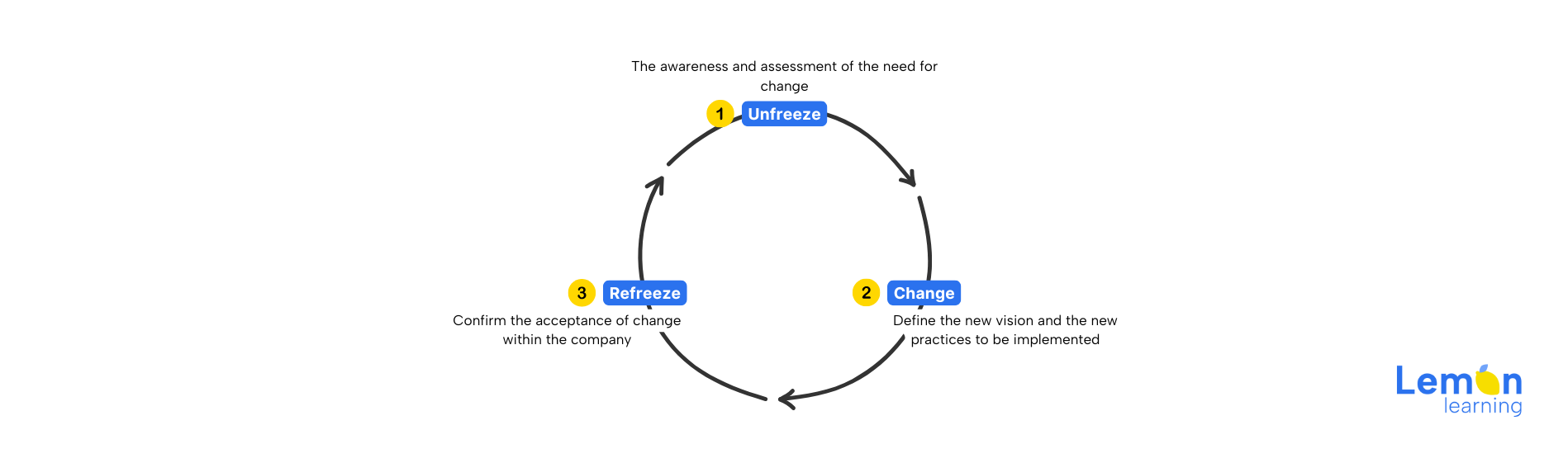
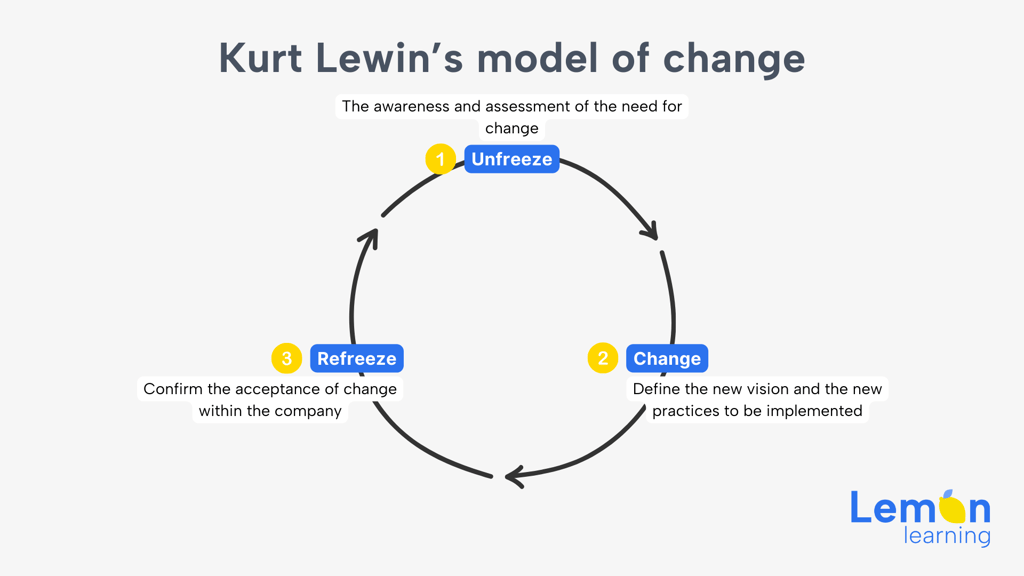
1. Unfreeze
Build awareness of the need for change
Communicate the rationale, reduce resistance, assess current behaviors
2. Change
Implement new behaviors and processes
Define the new vision, support employees, gather feedback
3. Refreeze
Embed the change into culture and habits
Reinforce new practices, align with company culture, confirm acceptance
Stage 1: Unfreeze
The Unfreeze stage builds awareness that the current state must change. Leaders analyze existing behaviors, communicate the reasons for change clearly, and work to lower resistance among employees. Using data and transparent communication at this stage makes the next phase significantly smoother.
Stage 2: Change
The Change stage is where new practices are introduced. Change agents are essential here: they guide teams through uncertainty, facilitate feedback sessions, and keep everyone focused on the shared goal. Regular check-ins help maintain momentum and address concerns before they escalate.
Stage 3: Refreeze
The Refreeze stage makes the change permanent by anchoring new behaviors to the organizational culture. New processes should be documented, reinforced through internal communication, and tied to individual accountability so that progress is not lost over time. For organizations managing software rollouts, a change management solution can accelerate this embedding process.
Why does Lewin's model still matter?
Lewin's model is effective precisely because of its clarity. As a 2021 review in PMC notes, it remains a foundational reference in organizational change literature. Teams looking to explore complementary approaches can review a broader set of change management frameworks before selecting the best fit for their context.
Frequently asked questions about Lewin's change model
What is the difference between Lewin and Kotter change model?
Lewin's model uses three broad stages; Kotter's model uses eight sequential steps with a stronger emphasis on leadership and urgency. Lewin suits simpler transitions; Kotter is often preferred for complex, large-scale change.
Is Lewin's change model too simple?
Its linear structure can be a limitation in fast-moving or highly complex environments. That said, its simplicity makes it accessible and easy to communicate, which is an advantage when introducing change concepts to a broad employee base.
What is Stage 2 of Lewin's change model?
Stage 2 is the Change (or Movement) stage, where new behaviors and processes are actively implemented with the support of change agents and ongoing employee communication.
What is a real-life example of Lewin's change model?
A software migration is a clear example: Unfreeze by explaining why the old system is inadequate, Change by training staff on the new platform, and Refreeze by embedding the new workflows into standard procedures.
FAQ
Frequently asked questions
What is the difference between Lewin and Kotter change model?+
Lewin's model condenses organizational change into three broad stages: Unfreeze, Change, and Refreeze. Kotter's model breaks the process into eight sequential steps and places greater emphasis on leadership, coalition-building, and sustaining urgency. Lewin's framework is simpler and better suited to straightforward transitions, while Kotter's is often preferred for large-scale or complex transformations.
Is Lewin's change model too simple?+
Critics argue that Lewin's three-stage model is too linear and does not fully reflect the complexity of real-world organizational change. However, its simplicity is also its strength: it gives teams a clear, accessible framework that is easy to communicate and apply, making it a solid starting point before layering on more detailed methodologies.
What is Stage 2 of Lewin's change model?+
Stage 2 is the Change stage, also called the Movement stage. During this phase, the organization implements new behaviors, processes, and practices. Change agents play a central role in communicating the new vision, gathering employee feedback, and maintaining momentum toward the desired outcome.
What is a real-life example of Lewin's change model?+
A common real-life application is a company migrating to new software. In the Unfreeze stage, leadership communicates why the old system is insufficient. In the Change stage, employees are trained on the new platform and supported through the transition. In the Refreeze stage, the new workflows are embedded into standard operating procedures and daily habits, making the change permanent.