Different Learning Styles: 8 Essential Models Every Trainer Should Know
Explore 8 key learning style models - VARK, Kolb, Honey & Mumford, Gardner, and more - to design training programs that match how your learners actually
Learning style models are frameworks that describe the different ways individuals prefer to receive, process, and retain information. Understanding the main models - from the VARK (Visual, Auditory, Reading/Writing, Kinesthetic) framework to Kolb's experiential cycle - helps trainers and learning and development professionals design programs that meet learners where they are. This guide covers eight essential models, explains what each one says, and shows how to apply them in workplace training.
It is worth noting that the scientific status of learning styles remains debated. A widely cited 2017 review published in Frontiers in Psychology found limited evidence that matching instruction to a learner's stated style consistently improves outcomes. The models below are best used as diagnostic tools to increase training variety, not as rigid categories that lock learners into a single track.
1. What Is the VARK Model?
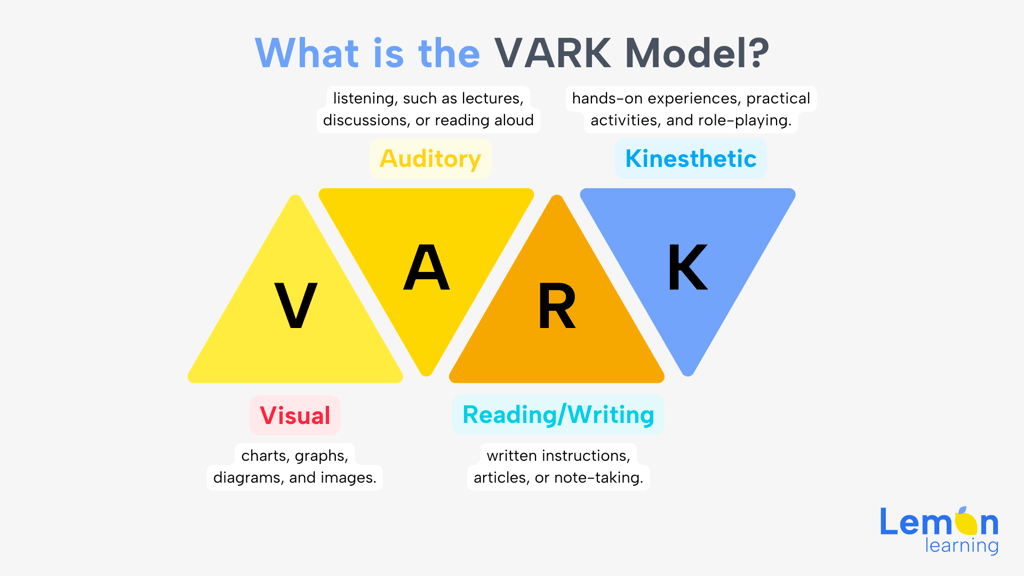
The VARK learning style model was developed by Neil Fleming and identifies four primary learning preferences: Visual, Auditory, Reading/Writing, and Kinesthetic. It is one of the most widely used frameworks in both education and corporate training.
Visual learners: Prefer charts, graphs, diagrams, and images to understand information.
Auditory learners: Learn best through listening - lectures, discussions, podcasts, or reading aloud.
Reading/Writing learners: Prefer written instructions, articles, reports, and note-taking.
Kinesthetic learners: Thrive on hands-on experiences, practical exercises, and role-playing scenarios.
Aligning training content with these preferences increases engagement. A product walkthrough for a kinesthetic learner works better as a guided simulation than a slide deck.
2. What Is Kolb's Learning Cycle?
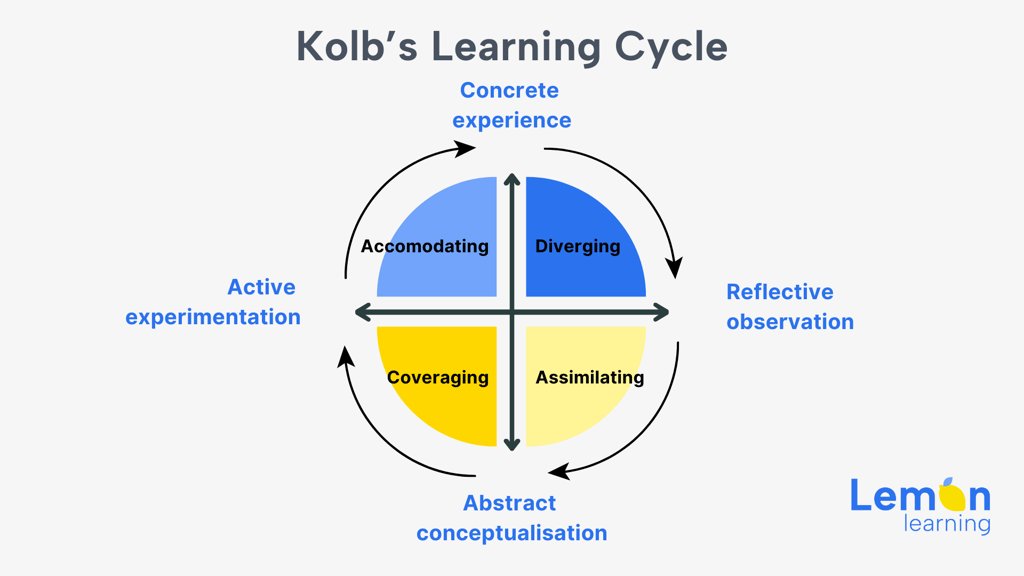
Kolb's Learning Cycle, developed by David Kolb, frames learning as a continuous four-phase process rather than a fixed style. Learners move through each stage, though they may have a preferred entry point.
Concrete experience: Engaging directly in a new task or situation.
Reflective observation: Stepping back to observe and review the experience.
Abstract conceptualization: Drawing conclusions and forming general principles.
Active experimentation: Applying those principles to new situations.
Strong in theory-building; less focused on practice
Converger
Abstract conceptualization + Active experimentation
Practical problem-solving and application
Accommodator
Concrete experience + Active experimentation
Hands-on, adaptive, learns by doing
3. What Are the Honey and Mumford Learning Styles?
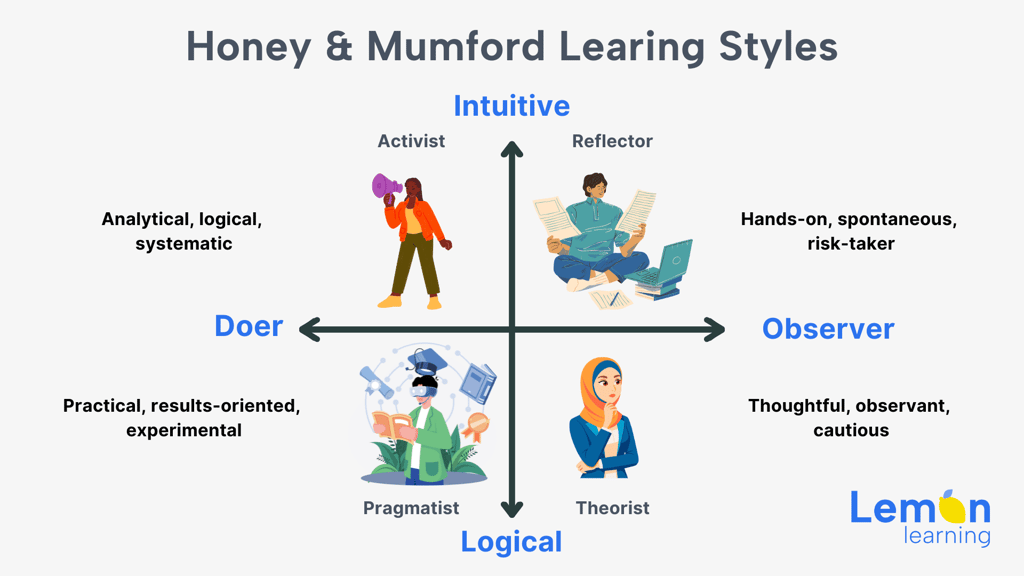
Peter Honey and Alan Mumford adapted Kolb's framework into a practical model built specifically for workplace contexts. Their model describes four learner types that training designers can directly target.
Activists: Enthusiastically dive into new experiences and challenges; learn best through action and variety.
Reflectors: Prefer to observe, gather data, and analyze before reaching conclusions.
Theorists: Analytical and systematic; like to synthesize information into logical frameworks.
Pragmatists: Focus on practical application and solving real-world problems quickly.
The Felder-Silverman Learning Style Model (FSLSM), developed by Richard Felder and Linda Silverman, describes learning preferences across four independent dimensions rather than as fixed types. This makes it particularly useful for higher education and technical training.
Dimension
One End
Other End
Processing
Active (group work, trial and error)
Reflective (individual thinking)
Perception
Sensing (concrete, practical facts)
Intuitive (abstract, innovative ideas)
Input
Visual (diagrams, charts)
Verbal (written or spoken text)
Understanding
Sequential (step-by-step logic)
Global (big picture first)
Because each dimension is a spectrum, instructors can use the FSLSM to build courses that address multiple positions simultaneously rather than designing separate tracks.
5. What Are Gardner's Multiple Intelligences?
Howard Gardner's Theory of Multiple Intelligences, introduced in 1983, argues that intelligence is not a single general capacity but a set of distinct abilities. Gardner identified eight intelligences:
Linguistic: Sensitivity to spoken and written language.
Logical-mathematical: Ability to analyze problems logically and carry out mathematical operations.
Spatial: Capacity to think in three dimensions and visualize.
Musical: Skill in the performance, composition, and appreciation of musical patterns.
Bodily-kinesthetic: Expertise in using one's body to solve problems or create products.
Interpersonal: Ability to understand and interact effectively with others.
Intrapersonal: Capacity for self-understanding and self-reflection.
Naturalistic: Ability to recognize and categorize natural objects and patterns.
In training design, Gardner's framework supports a holistic approach: a curriculum that incorporates storytelling, visual mapping, group discussion, and practical tasks is more likely to reach a diverse audience than one that relies on a single format.
6. What Are Gregorc's Learning Styles?
Anthony Gregorc's Mind Styles Model describes how individuals perceive and order information. It combines two perceptual qualities (concrete vs. abstract) with two ordering abilities (sequential vs. random) to produce four styles:
Concrete sequential: Prefers structured, step-by-step, practical methods with clear outcomes.
Abstract sequential: Excels in theoretical analysis and independent research.
Concrete random: Thrives on hands-on experimentation and intuitive problem-solving.
Abstract random: Values flexibility, emotional connections, and holistic understanding.
Gregorc's framework is used in professional coaching and team-building contexts to help individuals understand their natural cognitive tendencies and collaborate more effectively with people who process information differently.
7. What Is the Dunn and Dunn Model?
The Dunn and Dunn Learning Style Model, developed by Rita Dunn and Kenneth Dunn, is one of the most comprehensive frameworks available. It maps learning preferences across five environmental and personal dimensions:
Environmental: Lighting, noise levels, temperature, and physical setting.
Emotional: Motivation, persistence, responsibility, and structure preferences.
Sociological: Whether a learner works best alone, in pairs, in groups, or with an authority figure.
Physiological: Time of day, need for mobility, and sensory input preferences.
Psychological: Analytical versus global cognitive processing styles.
Because it addresses environmental and emotional variables alongside cognitive ones, the Dunn and Dunn model is particularly relevant when designing hybrid or remote training programs, where learners control more of their own environment.
8. What Is the VAK Approach?
The VAK (Visual-Auditory-Kinesthetic) model is a simplified predecessor to the VARK framework. It categorizes learners into three sensory preferences:
Visual learners: Absorb information most effectively through images, video, and spatial displays.
Auditory learners: Excel when content is delivered orally through lectures, conversations, or audio.
Kinesthetic learners: Benefit most from touch, movement, and hands-on practice.
The VAK approach is often criticized for being too broad. Its value lies in its simplicity: it offers a quick starting framework for trainers who are new to learning style theory and need a practical entry point before exploring more granular models.
How Do You Apply Learning Style Models in Real Training Programs?
No single model gives the complete picture. Effective training programs use multiple models as complementary lenses rather than competing theories. A practical approach is to:
Use VARK or VAK to audit whether current content formats cover all sensory preferences.
Apply Kolb's cycle to ensure training moves from experience through reflection to application.
Use Honey and Mumford profiles to sequence activities that serve both reflectors and activists.
Reference Dunn and Dunn when designing flexible, self-paced digital learning environments.
For organizations rolling out software or new digital tools, understanding how Lemon Learning supports learning and development teams in delivering in-app, context-sensitive guidance can help bridge the gap between a learner's preferred style and the demands of real-time software adoption.
Learning style models are not a guarantee of outcomes, but they are a structured way to introduce variety, reduce friction, and increase the relevance of training content for the full range of people in any team.
FAQ
Frequently asked questions
What are the 8 different types of learning styles?+
The eight learning styles most commonly referenced in training and education come from multiple models. They include: Visual (VARK/VAK), Auditory (VARK/VAK), Reading/Writing (VARK), Kinesthetic (VARK/VAK), and the four Honey and Mumford styles - Activist, Reflector, Theorist, and Pragmatist. Gardner's Multiple Intelligences framework separately identifies eight distinct intelligences - Linguistic, Logical-mathematical, Spatial, Musical, Bodily-kinesthetic, Interpersonal, Intrapersonal, and Naturalistic - which are often mapped to learning preferences.
What are the 8 types of learning?+
The eight types of learning most cited in instructional design literature are: visual, auditory, reading/writing, kinesthetic (from the VARK model), experiential (Kolb), collaborative, independent, and reflective learning. Different frameworks prioritize different categories, so the exact list varies by model and context.
What are the 8 types of teaching methods?+
Eight commonly used teaching methods include: direct instruction, collaborative/group learning, inquiry-based learning, problem-based learning, experiential learning, differentiated instruction, blended learning, and flipped classroom. The most effective method depends on the subject matter and the learning style profiles of the audience.
What are the 8 generative learning strategies?+
Generative learning strategies are active techniques that help learners build meaning from new information. Eight widely cited strategies are: summarizing, mapping (concept maps), drawing/diagramming, imagining, self-testing, elaborative interrogation, self-explanation, and teaching others (the protege effect). These strategies are distinct from learning style models but complement them in instructional design.
Discover how the Kirkpatrick Model's four levels - Reaction, Learning, Behavior, and Results - help you measure training effectiveness and prove ROI...