The RASCI Matrix: A Complete Guide for Project Teams
Learn what the RASCI matrix is, how each role works, and how to build one for your project. Includes a comparison with RACI, step-by-step setup, and a FAQ.
The RASCI matrix is a responsibility assignment framework that maps five roles (Responsible, Accountable, Supportive, Consulted, and Informed) to every task in a project, so every stakeholder knows exactly what is expected of them. It is a direct extension of the widely used RACI matrix, adding a dedicated Support role for teams that need active collaboration layers between the task owner and subject-matter advisors.
What is the RASCI Matrix?
The RASCI matrix is a project management tool that visually maps stakeholder roles to each task or deliverable in a project. Its purpose is to eliminate ambiguity, prevent duplicated effort, and ensure that no task is left without a clear owner. Each cell in the grid receives one of five role designations, giving every participant a precise reference point throughout the project lifecycle.
The framework belongs to the broader family of RAM (Responsibility Assignment Matrix) tools. According to the responsibility assignment matrix article on Wikipedia, these matrices are standard instruments in project management for linking project roles to the work breakdown structure.
How Do the Five RASCI Roles Work in Practice?
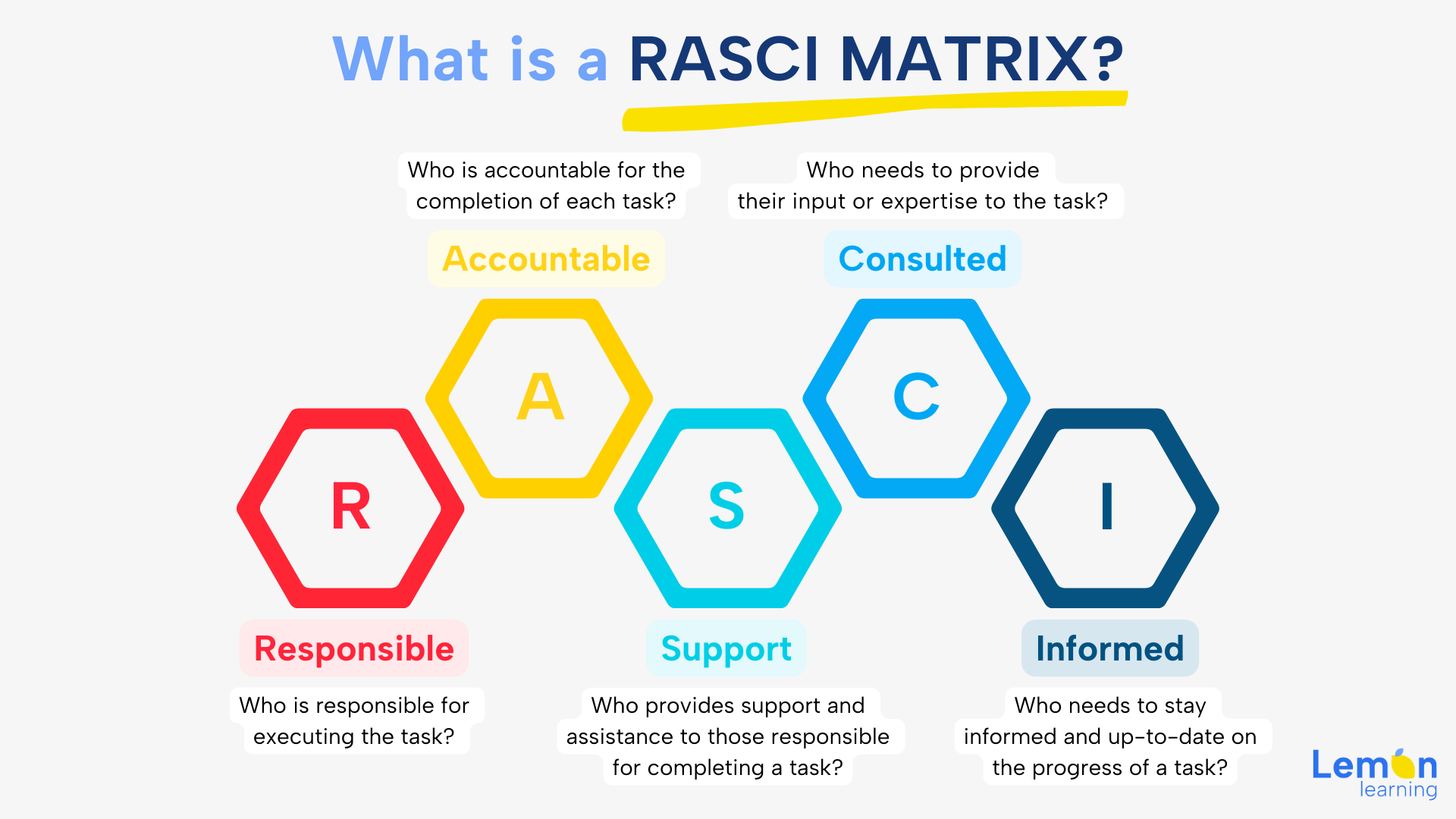
Each letter in RASCI describes a distinct level of involvement. Assigning the right role to the right person is the core skill in building a useful matrix.
Responsible
The Responsible party is the individual or group that performs the work. Multiple people can share this designation for a single task, but over-assigning it dilutes accountability. In practice, keep the number of Responsible parties as small as the task genuinely requires.
Accountable
The Accountable person holds final decision-making authority and ownership of the outcome. Only one person should be Accountable per task. This is the individual who answers if something goes wrong and who signs off on completion.
Supportive
The Supportive role is what distinguishes RASCI from RACI. Supportive team members actively assist the Responsible party by providing resources, doing preparatory work, or stepping in to unblock progress. They are more hands-on than a Consulted party but do not own the task outcome.
Consulted
Consulted individuals are subject-matter experts whose input is sought before or during task execution. Communication with them is two-way: the task owner asks questions, and the Consulted party provides guidance. They are not doing the work; they are advising on it.
Informed
Informed stakeholders receive updates on progress and outcomes. Communication with them is one-way. They need awareness of the project status because of their position as stakeholders, but they do not contribute to execution decisions.
Role
Level of Involvement
Can There Be Multiple?
Communication Direction
Responsible
Executes the work
Yes, but keep it lean
Two-way with Accountable
Accountable
Final authority and ownership
No - exactly one per task
Two-way with Responsible
Supportive
Actively assists Responsible
Yes
Two-way with Responsible
Consulted
Provides expert advice
Yes
Two-way with Responsible
Informed
Receives status updates
Yes
One-way (receives only)
How Does RASCI Differ from RACI?
RASCI and RACI serve the same core purpose, but they are not identical. The critical structural difference is the addition of the Support (S) role in RASCI.
In a standard RACI framework, a stakeholder either owns the work, advises on it, or is kept in the loop. There is no formal designation for someone who rolls up their sleeves to help the Responsible party without owning the outcome. RASCI fills that gap. The Support role is particularly valuable in cross-functional projects where specialists from other departments contribute effort without taking ownership.
Both matrices also serve as diagnostic tools. Running through the grid helps project managers spot:
Orphaned tasks with no Responsible or Accountable person assigned.
Overloaded stakeholders who carry too many Responsible or Accountable designations.
Inflated Informed lists that create communication noise without adding value.
What Are the Main Advantages of the RASCI Approach?
The primary advantage of RASCI is role clarity at scale. When teams grow beyond a handful of people, informal role expectations break down. A completed RASCI matrix gives every participant a single reference document that answers the question "what is my job here?" for each task.
Additional benefits include:
Reduced decision paralysis. Because only one person is Accountable per task, there is never ambiguity about who makes the final call.
Better workload visibility. Scanning the matrix column by column shows whether any individual is carrying a disproportionate number of Responsible or Accountable assignments.
Improved cross-functional collaboration. The Support role formally acknowledges contributors who would otherwise operate in an informal gray area, giving them a recognized place in the project structure.
Conflict prevention. Many team conflicts stem from overlapping or unclear responsibilities. A well-built matrix surfaces those overlaps before they create friction.
Onboarding efficiency. New team members can review the matrix to understand the project structure without requiring lengthy briefings from their manager.
These benefits directly support broader organizational goals. For teams implementing new systems or processes, pairing a RASCI matrix with a structured change management approach helps ensure that role assignments are understood and acted on, not just documented.
How to Build a RASCI Matrix Step by Step
Building a RASCI matrix requires five sequential steps. Work through them in order to avoid backtracking once the grid is populated.
Step 1: Define the project scope and deliverables
Before creating the matrix, agree on what the project covers. List all major deliverables and break them into discrete tasks or sub-tasks. The left column of the matrix will hold these tasks, so they need to be specific enough to assign a meaningful role.
Step 2: Identify all stakeholders
List every person or role involved in the project across the top row of the matrix. Use role titles rather than personal names where possible; this makes the matrix reusable if personnel change during the project.
Step 3: Assign RASCI designations
Work through each task row and assign R, A, S, C, or I to each stakeholder column. Apply these rules as you go:
Every task must have exactly one A (Accountable).
Every task must have at least one R (Responsible).
S, C, and I are optional but should be assigned wherever they genuinely apply.
A single person can hold both R and A on the same task, but this should be intentional, not a default.
Step 4: Review and validate with the team
Share the draft matrix with all stakeholders and invite corrections. This step often surfaces disagreements about ownership that are better resolved on paper than mid-project. Color-coding each letter (for example, red for A, blue for R) makes the grid easier to scan during review.
Step 5: Communicate and maintain the matrix
Once finalized, make the matrix accessible to everyone on the project. Store it in a shared location and assign someone to update it when scope, personnel, or responsibilities change. A RASCI matrix that is not maintained becomes a source of confusion rather than clarity.
What Are the Challenges of Using a RASCI Matrix and How Can They Be Solved?
Like any project management tool, the RASCI matrix has limitations. Recognizing them in advance makes it easier to manage them.
Complexity in large projects
A matrix for a project with dozens of tasks and many stakeholders can become difficult to read and maintain. The solution is to work at the right level of granularity: use high-level task groupings in the main matrix and create separate sub-matrices for particularly complex workstreams.
Resistance from team members
Some team members may be unfamiliar with the framework or skeptical of its value. Address this by involving key stakeholders in the creation process rather than presenting a completed matrix for sign-off. Participation increases understanding and buy-in.
Role overlap and conflict
When responsibilities genuinely overlap between two people, the matrix can expose tensions rather than resolve them. Use the review step (Step 4 above) as a structured conversation to clarify boundaries before they become conflicts. If two people both believe they are Accountable for the same task, that is a project governance issue that needs resolving at the leadership level.
Rigidity in fast-moving environments
In agile or rapidly changing projects, the matrix can become outdated quickly. Build a review cadence into the project schedule, for example a brief matrix audit at each sprint retrospective or milestone review, to keep it current.
Over-populating the Informed column
It is tempting to mark senior stakeholders as Informed on every task. This creates communication overload and signals that the matrix has not been thought through carefully. Only assign I where an individual genuinely needs the information to fulfill their role.
RASCI Matrix Example
The following example shows how RASCI designations might be applied across a simplified software rollout project. Stakeholder titles are illustrative.
Task
Project Manager
IT Lead
HR Manager
Department Head
Executive Sponsor
Define project scope
A
R
C
C
I
Configure software environment
I
A/R
I
I
I
Develop training materials
C
S
A/R
C
I
Deliver end-user training
I
S
A
R
I
Post-launch review
A
R
R
C
I
Notice that in "Deliver end-user training," the IT Lead carries an S designation. They are not running the sessions (that is the Department Head's Responsible role), nor do they own the outcome (the HR Manager is Accountable), but they actively support delivery by providing technical assistance. This is the Support role doing exactly what it is designed to do.
For guidance on building the visual representation of this grid, the RACI diagram guide covers diagramming principles that apply equally to RASCI.
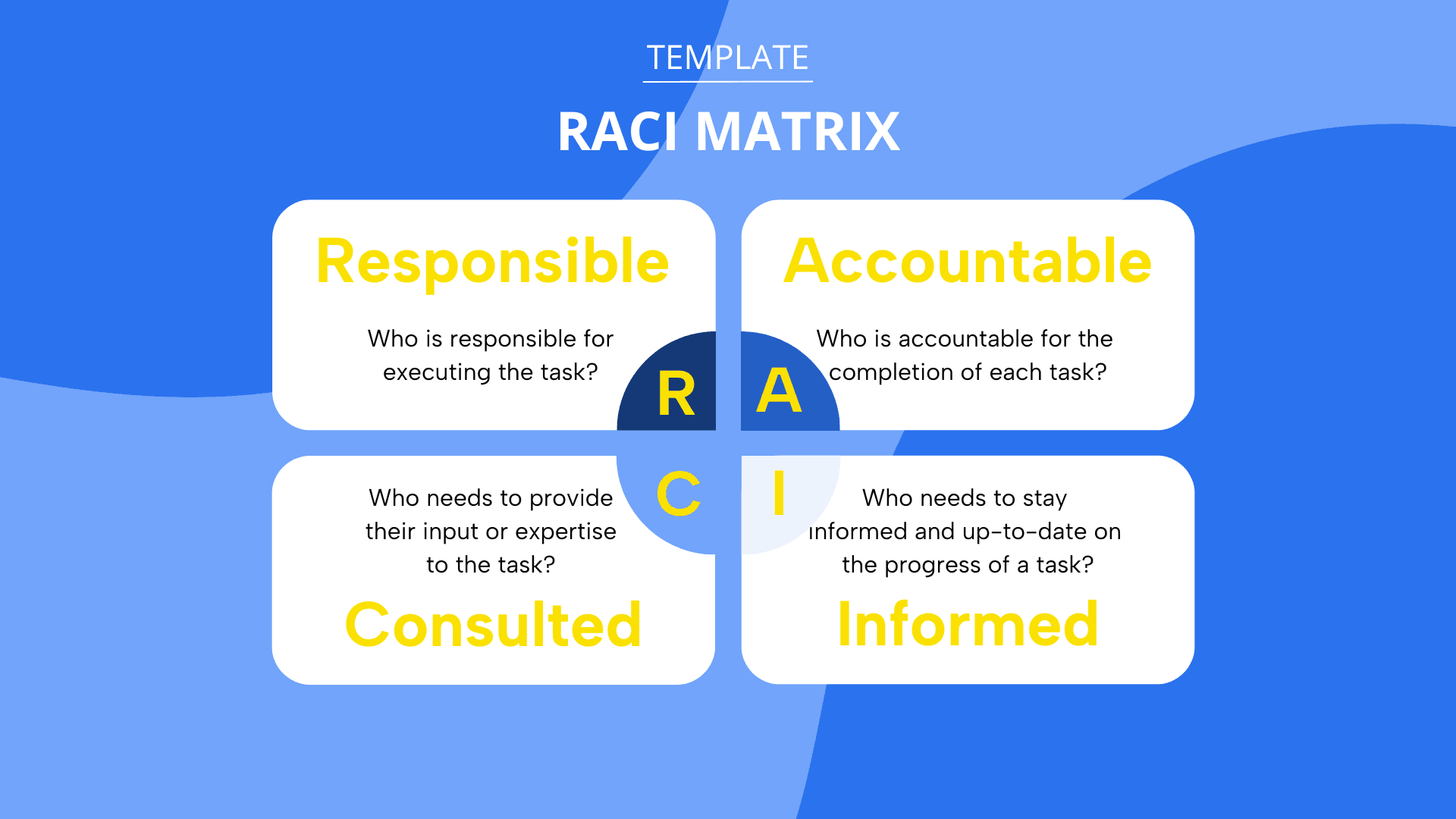
Click the image to receive your template
Frequently Asked Questions
What does RASCI stand for?
RASCI stands for Responsible, Accountable, Supportive, Consulted, and Informed. Each letter represents a distinct role assigned to stakeholders for every task or deliverable in a project.
Is RASCI better than RACI?
Neither framework is universally superior. RASCI is better suited to larger or more complex projects where an active support layer is needed between the task owner and subject-matter advisors. RACI is simpler and works well for smaller teams or straightforward projects where the extra role would add unnecessary overhead. The right choice depends on project complexity and team size.
What is the difference between R and A in RASCI?
Responsible refers to the person or people who perform the work on a given task. Accountable is the single individual who holds final authority and ownership over the outcome. There can be multiple people marked Responsible on one task, but only one person should be Accountable. If no one is Accountable, there is no clear decision-maker; if too many people are Accountable, decisions stall.
What is the difference between RACI and DACI?
RACI (Responsible, Accountable, Consulted, Informed) focuses on assigning work and managing stakeholder communication across a project. DACI (Driver, Approver, Contributor, Informed) is a decision-making framework that clarifies who drives a specific decision, who approves it, who contributes input, and who is simply kept informed. DACI is preferred when the primary goal is structuring decisions rather than assigning ongoing task ownership. The two frameworks can complement each other: RACI for project execution, DACI for key decision points within the same project.
Lemon Learning helps organizations put role clarity into practice. When teams understand their responsibilities, adopting new tools and processes becomes significantly more straightforward. Learn how the Lemon Learning change management solution supports project teams through structured onboarding and in-app guidance.
FAQ
Frequently asked questions
What does RASCI stand for?+
RASCI stands for Responsible, Accountable, Supportive, Consulted, and Informed. Each letter represents a distinct role assigned to stakeholders for every task or deliverable in a project.
Is RASCI better than RACI?+
Neither framework is universally superior. RASCI is better suited to larger, more complex projects where an active support layer is needed alongside the responsible party. RACI is simpler and works well for smaller teams or straightforward projects where the extra role would add unnecessary overhead.
What is the difference between R and A in RASCI?+
In RASCI, Responsible refers to the person or persons who carry out the work on a task. Accountable (sometimes called the decision-maker or project owner) is the single individual who has final authority and ownership over the outcome. There can be multiple people marked Responsible, but only one person should be Accountable per task.
What is the difference between RACI and DACI?+
RACI (Responsible, Accountable, Consulted, Informed) focuses on task execution and stakeholder communication. DACI (Driver, Approver, Contributor, Informed) is a decision-making framework designed to clarify who drives a decision, who approves it, who contributes input, and who is simply informed. DACI is preferred when the primary goal is structuring decisions rather than assigning work.