What Is a RACI Matrix? A Complete Guide for Project Teams
Learn what a RACI matrix is, what each letter stands for, how it works in project management, and how to build one that clarifies every role on your team.
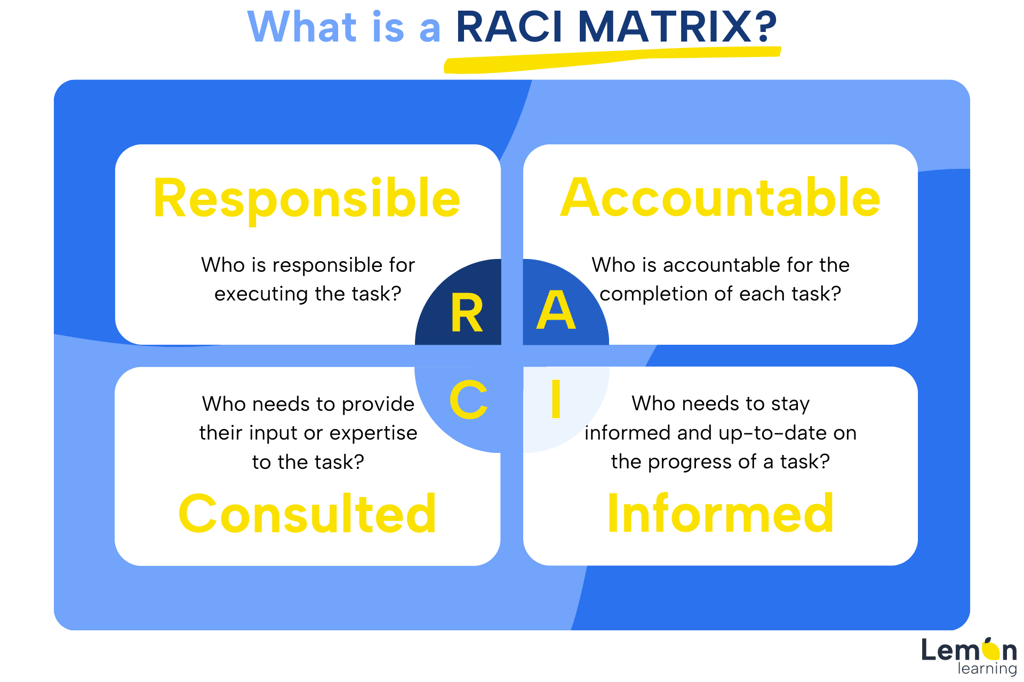
A RACI matrix is a responsibility assignment chart used in project management to map every task, milestone, or key decision to the people involved in it. The acronym RACI stands for Responsible, Accountable, Consulted, and Informed. Each person on the project team receives one of these four designations for each task, so everyone knows exactly what is expected of them. For a deeper look at how the chart is structured visually, see our guide to building a RACI diagram.
What is a RACI matrix?
A RACI matrix is a project management tool that clarifies task ownership by defining each team member's role in completing a task or reaching a decision. It takes the form of a grid: tasks or deliverables are listed on one axis, and the people or roles involved in the project are listed on the other. Each cell in the grid contains one of the four RACI letters to show how that person relates to that task.
The formal name for this tool is a RAM (Responsibility Assignment Matrix) or, more specifically, a linear responsibility chart. The RACI version is the most widely adopted because its four categories cover the full spectrum of involvement without becoming overly complex.
The core purpose of the matrix is to prevent two of the most common project failures: tasks that no one owns, and tasks that too many people try to own at the same time. By making roles explicit and visible, the matrix keeps communication clean and decision-making fast.
What do the four RACI components mean?
Each letter in RACI defines a distinct type of involvement. Understanding the difference between the four is essential to using the matrix correctly.
Responsible (R)
The Responsible person or group is the one who performs the actual work. They execute the task and produce the deliverable. There can be more than one Responsible party for a single task when the work is shared, but the boundaries of each person's contribution should be clear.
Accountable (A)
The Accountable person is the single owner who has final authority over the task and is answerable for its outcome. This is the person who approves the work before it is considered done. The golden rule of RACI is that every task must have exactly one Accountable designation. Assigning more than one creates competing authority and defeats the purpose of the matrix. The Accountable role is often held by a project manager, team lead, or executive sponsor.
Consulted (C)
Consulted individuals are subject-matter experts or stakeholders whose input is sought before a decision is made or a task is completed. Communication with Consulted parties is two-way: they provide information, review work, or give feedback. They do not make final decisions, but their expertise shapes the outcome. A legal or compliance officer, a technical architect, or a department head are common examples of Consulted roles.
Informed (I)
Informed individuals are kept up to date on progress and outcomes but are not actively involved in completing the work. Communication with Informed parties is one-way. They may be senior leaders, end users, or other departments affected by the project's results. Keeping them informed prevents surprises and ensures alignment without pulling them into the day-to-day work.
Summary of the four RACI roles
Letter
Role
Communication direction
Typical example
R
Responsible
Executes the work
Developer, analyst, content writer
A
Accountable
Approves and owns outcome
Project manager, team lead
C
Consulted
Two-way input before completion
Legal counsel, technical architect
I
Informed
One-way update after completion
Executive sponsor, end users
What does a RACI matrix look like in practice?
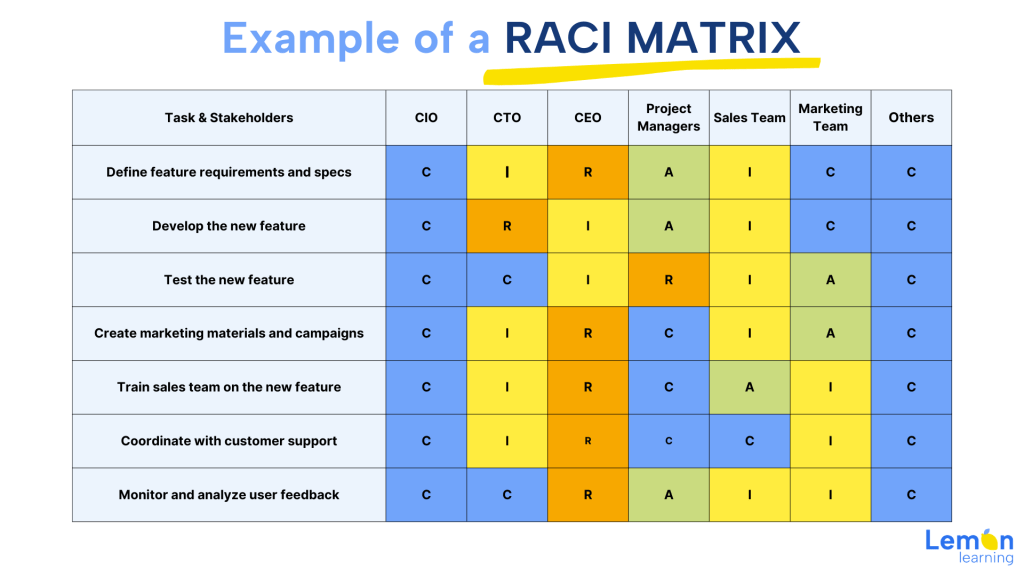
A practical RACI matrix becomes clear with a real-world scenario. The example below shows how a SaaS technology company might assign roles for launching a new product feature, involving a CIO (Chief Information Officer), CTO (Chief Technology Officer), CEO (Chief Executive Officer), project managers, the sales team, the marketing team, and broader stakeholders.
In this scenario, consider the task of defining the feature's technical requirements. The engineering team members are Responsible because they do the technical specification work. The CTO is Accountable because they own the technical roadmap and must approve the requirements before development begins. The CIO is Consulted because the feature must align with broader IT infrastructure decisions. The CEO and sales team are Informed so they can plan their launch and customer communications accordingly.
Now consider the task of preparing customer-facing marketing materials. The marketing team is Responsible. The CMO (Chief Marketing Officer) is Accountable. The sales team is Consulted because they speak with customers daily and understand messaging needs. The CTO is Informed so they can flag any technical claims that need adjusting.
This structure makes it immediately clear who must act, who must approve, who to ask for input, and who simply needs an update, for every item on the project plan.
RACI matrix in a website redesign project
Another common example is a marketing department leading a website overhaul. The web development team is Responsible for building pages. The marketing director is Accountable for the final product. The company's IT architect is Consulted on CRM (Customer Relationship Management) system integration requirements. The project sponsor and executive leadership are Informed of milestones and launch dates. In some cases, particularly on smaller teams, the Accountable and Responsible roles may be held by the same person for certain tasks, which the matrix should reflect explicitly.
What are the advantages of using a RACI matrix?
The main benefit of a RACI matrix is role clarity: every participant knows precisely what is expected of them for every task, which reduces miscommunication and wasted effort. Beyond that core benefit, the matrix delivers several practical advantages throughout the project lifecycle.
Eliminates duplication and gaps
One of the most frequent planning errors in project management is having multiple people performing the same task without coordination, or having a critical task that no one has been assigned to cover. A completed RACI matrix makes both problems visible immediately. If a column in the matrix is empty, a task has no owner. If multiple people hold the Accountable designation for the same task, the matrix signals a structural problem that must be resolved before work begins.
Improves communication efficiency
The matrix defines exactly who needs to be included in meetings, reviews, and status updates, and who does not. Teams that use a RACI chart report fewer unnecessary meetings because the Informed column is handled through structured updates rather than all-hands discussions. This is especially valuable in cross-functional projects where departments have different rhythms and priorities.
Reduces conflict and delays
Role ambiguity is a leading cause of project delays and interpersonal conflict. When two people both believe they are the decision-maker on a task, approvals stall and tensions rise. The RACI matrix prevents this by establishing a single Accountable person before conflict has a chance to develop.
Supports onboarding and team transitions
When a new team member joins a project mid-stream, or when someone leaves and their responsibilities must be redistributed, the RACI matrix serves as an immediate orientation document. New contributors can see their entire scope of involvement at a glance, rather than learning through trial and error.
Scales across project types and industries
The RACI matrix is used in IT, marketing, construction, healthcare, finance, human resources, and organizational change programs. Its simplicity makes it applicable wherever a group of people must coordinate on a defined set of tasks. Whether the project runs for two weeks or two years, the same four-letter framework applies.
Strengthens stakeholder management
By explicitly identifying who is Consulted and Informed, the matrix forces project teams to think through their stakeholder landscape early. This reduces the risk of key voices being overlooked during planning and prevents last-minute objections from stakeholders who should have been involved earlier.
How do you build a RACI matrix step by step?
Building a RACI matrix takes focused preparation but follows a repeatable process. The steps below apply whether you are using a spreadsheet, a project management platform, or a dedicated collaboration tool.
Step 1: List all project tasks and deliverables
Begin by documenting every task, milestone, and key decision in the project. Work from your project plan or work breakdown structure if one already exists. Be specific: "conduct user testing" is more useful than "testing." Each row in the matrix will correspond to one task, so the more complete this list, the more useful the finished matrix will be.
Include not just execution tasks but also decisions (approving a budget, signing off on a design), communications (notifying stakeholders of a milestone), and review steps (quality assurance sign-off). These are often the steps where role ambiguity causes the most problems.
Step 2: Identify all roles and stakeholders
List every role, team, or individual involved in the project across the top of the matrix. Use role titles rather than personal names where possible, because people change but roles tend to persist. Common roles include project manager, product owner, technical lead, department head, legal counsel, executive sponsor, and end-user representative.
Avoid listing every employee in the organization. The matrix should include only those with a genuine stake in at least one task. A matrix with too many columns becomes unwieldy and loses its communicative value.
Step 3: Assign RACI designations for each task
Go through each task row and assign R, A, C, or I to each role. Apply these rules consistently:
Every task must have at least one R and exactly one A.
The A and R roles may be held by the same person on a given task, but this should be a deliberate choice, not an oversight.
C designations should be limited to those who genuinely add value through input. Over-consulting slows decisions and creates bottlenecks.
I designations should cover anyone who will be meaningfully affected by or needs to act on the outcome of a task.
Step 4: Review and validate with the team
Share the draft matrix with all listed stakeholders before treating it as final. This review step is critical. It surfaces disagreements about authority, uncovers gaps where no one has been assigned, and gets explicit buy-in from everyone named. A RACI matrix that has not been reviewed and agreed upon is just a document; one that the team has validated becomes a binding operating agreement for the project.
During the review, watch for patterns that signal structural problems:
Any person with an A on every task: this may indicate a bottleneck or an over-controlling authority structure.
Any role with nothing but I designations: this person may not need to be on the matrix at all, or they may be underutilized.
Any task with more than one A: this must be resolved before the project moves forward.
Step 5: Keep the matrix current
A RACI matrix is a living document. As projects evolve, tasks are added or removed, people change roles, and new stakeholders emerge. Assign responsibility for maintaining the matrix to the project manager and establish a regular review cadence, particularly at the start of each new project phase.
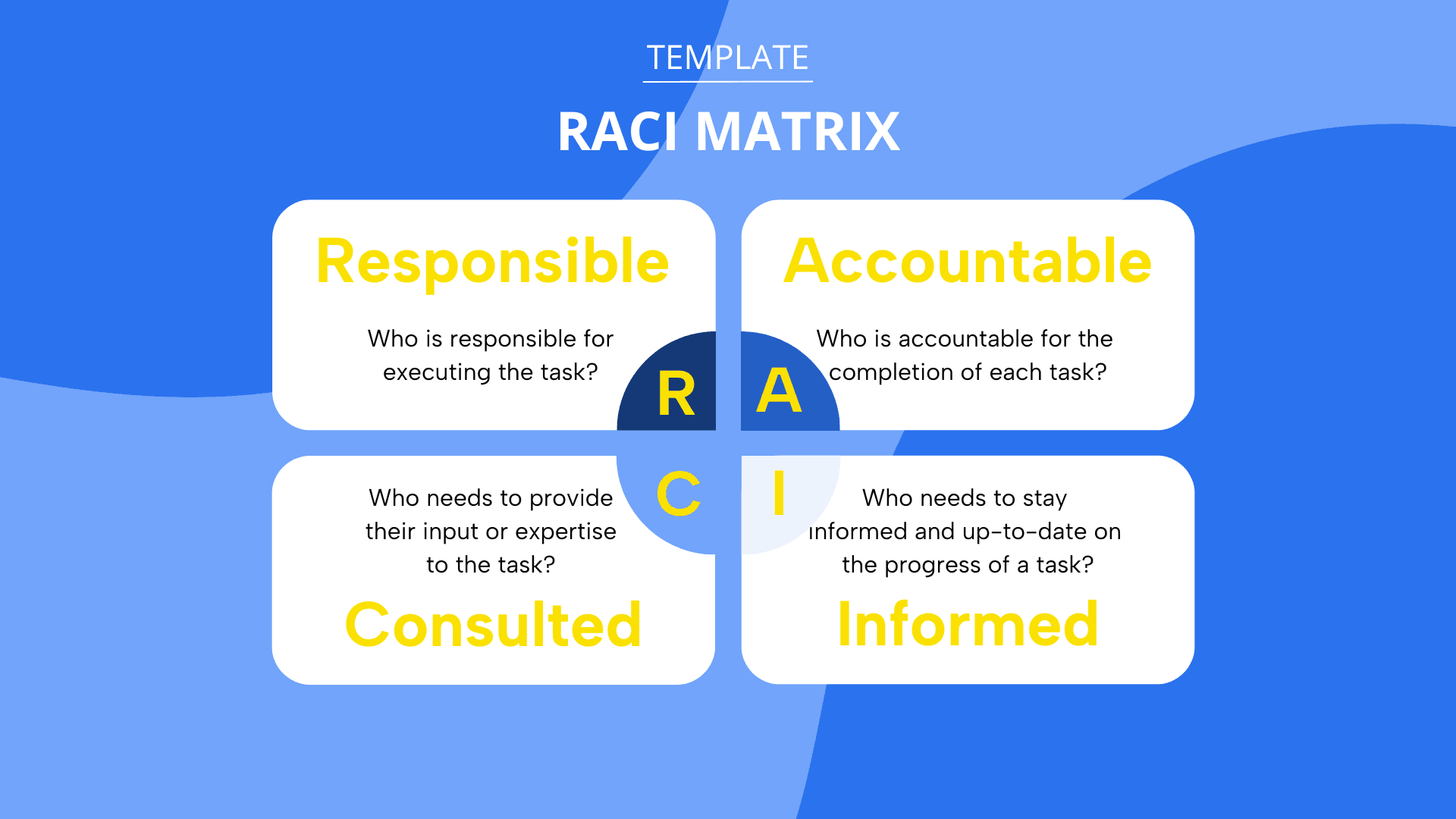
Download our free RACI matrix template to get started:
What are the most common RACI mistakes to avoid?
Even experienced project managers make the same recurring errors when building a RACI matrix. Knowing these pitfalls in advance makes it much easier to produce a matrix that genuinely helps the team.
Assigning multiple Accountable owners
This is the most damaging mistake. When two people share Accountable status for a task, neither feels sole ownership. Decisions get deferred, blame gets distributed, and the task either stalls or produces a diluted result. Every task needs exactly one person who is answerable for it.
Confusing Responsible with Accountable
These two roles are frequently conflated, especially when a senior person both does the work and owns the outcome. The distinction matters because it defines escalation paths. If work is not progressing, the Responsible party is the one who needs to act. If the Accountable person is not satisfied with the output, they are the one who can redirect or reject it. When the roles are blurred, these conversations become harder to have.
Over-consulting stakeholders
Marking too many people as Consulted creates consultation fatigue and slows every decision point. Reserve the C designation for people whose input is genuinely required for the task to proceed correctly. If someone's opinion would be nice to have but is not necessary, they belong in the I column or may not need to appear at all.
Building the matrix without stakeholder input
A RACI matrix created in isolation by a project manager and handed to the team as a fait accompli often generates resistance. People who disagree with their designations, or who feel the matrix misrepresents how work actually happens, will ignore it. Build the matrix collaboratively and use the validation step as a genuine opportunity to surface and resolve disagreements.
Letting the matrix go stale
A matrix that was accurate at project kick-off but has not been updated since is misleading. Outdated RACI charts create the same role confusion they were designed to prevent. Treat the matrix as a live document and review it whenever the team structure or project scope changes significantly.
How does RACI compare to related frameworks?
RACI is the most widely used responsibility assignment framework, but it is not the only one. Several variants address specific limitations of the core model.
RASCI
RASCI (Responsible, Accountable, Supportive, Consulted, Informed) adds a fifth designation: Supportive (S). The Supportive role covers people who provide resources or assistance to the Responsible party without being fully Responsible themselves. This distinction is useful in large organizations where one team does the work but depends heavily on another team for tools, data, or logistical support. For a full comparison of the two models, see our article on the key differences between RASCI and RACI.
DACI
DACI (Driver, Approver, Contributor, Informed) reframes the model around decision-making rather than task execution. The Driver is the person who pushes a decision forward, the Approver is the final authority, Contributors provide input, and Informed parties are notified. DACI is popular in product management and agile environments where the emphasis is on who drives decisions rather than who performs work.
RACI-VS
RACI-VS adds Verifier (V) and Signatory (S) roles, which are useful in highly regulated industries such as pharmaceuticals or aerospace where formal verification and legal sign-off are required as distinct steps separate from approval.
The right framework depends on your organization's size, industry, and the nature of the projects you run. For most teams starting out, the standard RACI model provides enough structure without adding unnecessary complexity.
How does a RACI matrix support change management?
A RACI matrix is particularly valuable during organizational change initiatives, where unclear ownership is one of the most common reasons transformations stall or fail. When a company is rolling out a new technology platform, restructuring a department, or implementing a new process, the number of people who need to be involved, consulted, or kept informed multiplies quickly.
In a change management context, the matrix helps answer several critical questions before the initiative launches: Who is responsible for training employees on the new system? Who must approve the communication plan? Which department heads need to be consulted on the rollout timeline? Which end users need to be informed of go-live dates?
"Change management's goal is to ensure end users adopt the new solution."
By mapping these responsibilities explicitly, a RACI chart helps change managers ensure that adoption activities are owned by identifiable people, that no critical communication falls through the gaps, and that senior sponsors understand their role in the change without being drawn into operational details.
For organizations undergoing digital transformation, tools like Lemon Learning's change management solution complement the structural clarity of a RACI matrix by providing in-application guidance that supports end users at the moment of need, reinforcing the accountability structure the matrix defines.
Understanding how a RACI matrix integrates with broader change planning frameworks can strengthen any transformation program. For a practical overview of the process, see our guide to running a successful change management process.
Key takeaways
A RACI matrix is one of the most practical tools available to project managers and change leaders because it addresses a problem that every team faces: ambiguity about who is responsible for what. By assigning one of four clear designations to every person for every task, the matrix transforms an abstract project plan into an actionable operating agreement.
The core principles to remember are straightforward:
Every task must have at least one Responsible person who performs the work.
Every task must have exactly one Accountable person who owns the outcome.
Consulted parties provide two-way input before completion; Informed parties receive one-way updates afterward.
The matrix must be validated with the team before it goes into effect and updated whenever the project scope or team composition changes.
Used consistently, a RACI matrix reduces conflict, accelerates decisions, and gives every team member a clear and agreed-upon understanding of their role. It takes a modest investment of time at the planning stage and pays dividends across the entire project lifecycle.
FAQ
Frequently asked questions
What is the golden rule of RACI?+
The golden rule of RACI is that every task must have exactly one Accountable (A) person. Assigning more than one Accountable role to a single task creates confusion over who has final ownership and undermines the matrix's core purpose of eliminating ambiguity.
What are the four components of RACI?+
The four components are: Responsible (the person or group who performs the work), Accountable (the single owner who is answerable for the outcome), Consulted (subject-matter experts whose input is sought before decisions are made), and Informed (stakeholders who are kept up to date on progress but are not actively involved in execution).
Is RACI outdated?+
RACI is not considered outdated. It remains one of the most widely used responsibility-assignment frameworks in project management. Critics note it can become bureaucratic on large, fast-moving projects, which is why variants such as RASCI and DACI have emerged to address specific gaps. The core model, however, is still recommended by leading project management bodies and practitioners.
What is the main benefit of making a RACI chart?+
The main benefit is role clarity. A RACI chart eliminates overlap and gaps in responsibility by giving every team member a precise understanding of their involvement in each task or decision. This reduces miscommunication, prevents duplicated effort, and helps projects stay on schedule.