The PDCA Cycle (Deming Wheel): Plan, Do, Check, Act
The PDCA cycle, also called the Deming wheel, is a four-step method for continuous improvement: Plan, Do, Check, Act. Learn each step and when to use it.
The PDCA cycle, also known as the Deming wheel or Deming cycle, is a four-step method for continuous improvement: Plan, Do, Check, Act. Introduced by William Edwards Deming in 1950 (building on the work of Walter Shewhart), it gives any organization a simple, repeatable loop for testing a change, measuring the result, and improving from it. It is widely used as a quality-focused change management method, and it works at any scale, from a single workflow to a company-wide transformation. Here are the four steps of the PDCA cycle and when to use them.
What is the PDCA cycle (Deming wheel)?
The PDCA cycle is a framework for optimizing how an organization works and for driving continuous improvement. According to the American Society for Quality, it is a four-step model for carrying out change. It lets team leaders and managers improve operations using internal expertise, starting from what already exists and refining it step by step. The method rewards patience and consistency more than big-bang reinvention.
The cycle is a loop, not a one-off project. Teams run through the four phases again and again, and each pass produces new insight that feeds the next. Its reach goes beyond internal processes: the same loop can improve tasks, services, marketing approaches, and products. A startup launching a new offer and a large enterprise refining operations can both use it to make measured, reversible improvements.
Why the PDCA cycle works
The PDCA cycle has endured for over seventy years because of three qualities:
It lowers risk. Changes are tested on a small scale before a full rollout, so mistakes are cheap and reversible instead of company-wide.
It is evidence-based. The Check step forces a comparison against a baseline, so decisions rest on data rather than opinion.
It compounds. Because each Act feeds the next Plan, improvements accumulate over time instead of fading after a single project.
The 4 steps of the PDCA cycle
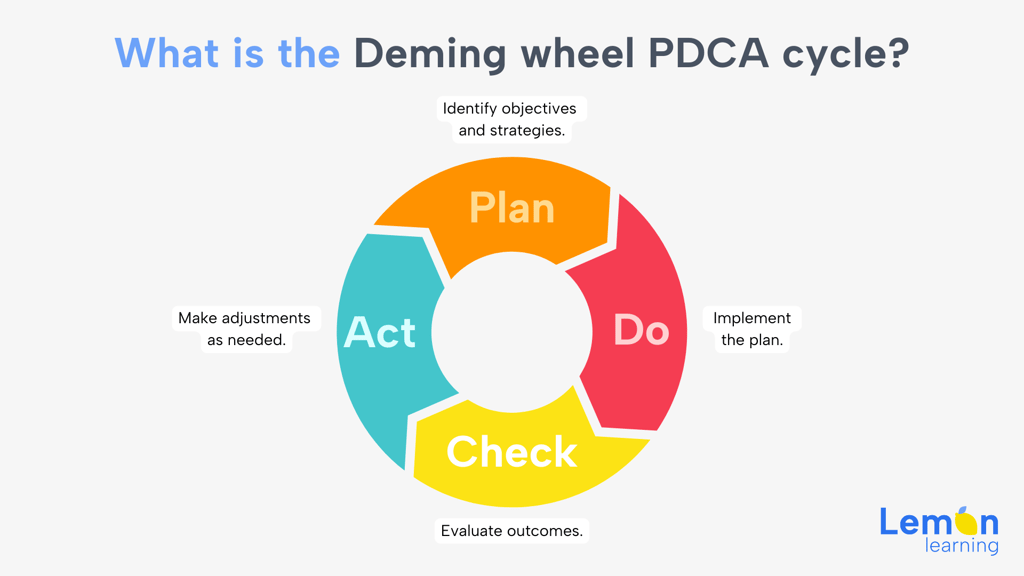
The PDCA cycle has four steps, run in sequence: Plan, Do, Check, Act. Skipping a step undermines the result. Teams repeat the loop until the outcome is satisfactory.
1. Plan
The Plan step is the foundation of the cycle, and it should not be rushed. Here you identify the problem to solve, analyze the current situation, and plan the work. Pinpoint the services and people the change will affect and define the objective. Structured tools such as the 5 Ws (Who, What, Where, When, Why) and the Ishikawa (fishbone) diagram help frame the problem and its root causes. Finish the Plan step by choosing the solution to test and the way you will implement it.
2. Do
In the Do step, you carry out the plan, ideally on a small scale first. Put the chosen solution into action, specify what each person must do, and communicate the expected outcome. Set deadlines for each action and check that resources are sufficient. Document any problems and adjustments as you go, and note the root causes of issues so you can address them in the next steps.
3. Check
In the Check step, you assess the gap between the expected outcome and the actual result. Measure the effectiveness of everything defined during planning. This is the step that turns activity into learning: without an honest Check, the cycle cannot improve anything. Compare data against the baseline you captured in the Plan step.
4. Act
In the Act step, you act on what the Check revealed. If the result is positive, adopt the tested solution and standardize it as the new way of working. If it is negative, adjust and run the loop again with what you learned. Either way, the cycle does not stop: each Act feeds a new Plan, which is what makes the Deming wheel a model of continuous improvement rather than a one-time fix.
PDCA cycle example
Imagine a support team facing a spike in tickets after a new tool goes live. Plan: they hypothesize that most tickets come from three confusing steps and plan in-app guidance for those steps. Do: they pilot the guidance with one department. Check: ticket volume on those steps drops by a measurable amount versus the baseline. Act: they roll the guidance out to every department and start a new cycle on the next pain point. The improvement is small, measured, and repeatable, which is exactly the point of the model.
When to use the PDCA cycle
The PDCA cycle gives a structured, low-risk way to manage processes, make improvements, and navigate change. It fits many situations:
Implementing change. Piloting a change on a small scale before a broad rollout surfaces issues early and improves adoption. When the change involves new software, pairing PDCA with in-app adoption guidance helps the "Do" step land, because employees are guided through the new tool at the moment they use it rather than in a one-off training.
Improving business processes. Regular evaluation and adjustment based on feedback lead to more efficient operations.
Launching new products. Testing, gathering market feedback, and refining improves the odds of a successful launch.
Defining and refining workflows. For repetitive tasks, the loop keeps processes clear and efficient over time.
Making data-driven decisions. Starting from a hypothesis, testing it, and analyzing results keeps decisions grounded in evidence.
Migrating to new systems. The loop provides a step-by-step roadmap that reduces downtime and supports a smoother digital adoption of the new system.
PDCA vs Kaizen, Six Sigma, and Lean
PDCA is often confused with related improvement approaches, but they operate at different levels: Kaizen is the philosophy, Lean and Six Sigma are broader systems, and PDCA is the simple loop many of them run on.
Method
What it is
Relationship to PDCA
Kaizen
A philosophy of ongoing, incremental improvement
PDCA is one of the engines that makes Kaizen happen
Lean
A system focused on removing waste
Frequently uses PDCA to test and confirm each improvement
Six Sigma
Reduces variation through its own DMAIC cycle (Define, Measure, Analyze, Improve, Control)
Heavier and more statistical; many teams start with PDCA first
In short, PDCA is the common, lightweight loop underneath much of the continuous improvement world.
FAQ
Frequently asked questions about the PDCA cycle
Who created the PDCA cycle?+
The PDCA cycle was popularized by William Edwards Deming in 1950, who based it on the earlier work of Walter Shewhart. This is why it is also called the Deming wheel or Deming cycle.
Is PDCA the same as Kaizen?+
No. Kaizen is a broader philosophy of continuous, incremental improvement, while PDCA is a specific four-step method often used to put Kaizen into practice.
Is PDCA part of Six Sigma?+
They are related but distinct. Six Sigma uses its own DMAIC cycle to reduce variation. PDCA is simpler and more general, and teams often use it before or alongside Six Sigma.
Is the PDCA cycle still relevant today?+
Yes. Its simplicity is why it endures: any team can use it to test a change safely, measure the result, and improve, which is especially valuable during software rollouts and digital transformation.
Learn what the RASCI matrix is, how each role works, and how to build one for your project. Includes a comparison with RACI, step-by-step setup, and...