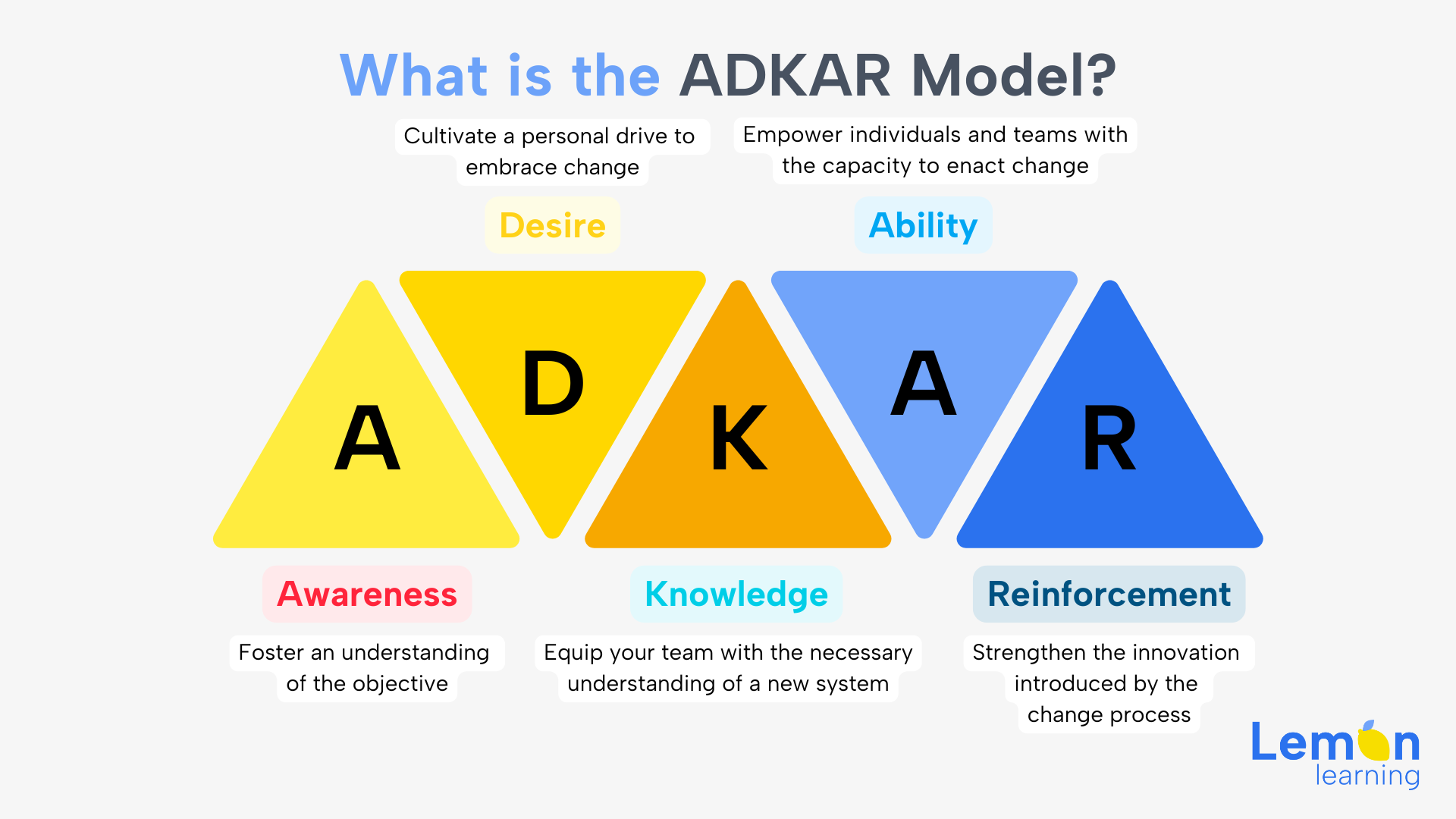
The ADKAR (Awareness, Desire, Knowledge, Ability, Reinforcement) model is a structured, individual-focused change management framework created by Prosci that guides people through five sequential stages. Organizational change only succeeds when each person affected makes a successful transition, so the model diagnoses and resolves barriers at the personal level before change can take hold across a team or an entire company.
What is the ADKAR model and where does it come from?
The ADKAR model is an outcome-oriented change management framework developed by Prosci, a research-based change management organization. The model is built on the premise that organizational change is the sum of individual changes. If any single stage is incomplete for a given person, the overall change initiative hits a barrier point at that individual.
The five building blocks of the Prosci ADKAR model are:
Stage
What it means
Primary lever
Awareness
Understanding why the change is necessary
Communication
Desire
Personal motivation to support and participate in the change
Leadership, incentives
Knowledge
Knowing how to change - the skills and information required
Training, coaching
Ability
Demonstrated capacity to implement the change in practice
Practice, feedback
Reinforcement
Sustaining the change and preventing regression to old habits
Recognition, follow-up
Why use the ADKAR change model over other frameworks?
The ADKAR model of change management stands out because it pinpoints exactly where a change is breaking down for a specific individual, rather than treating the organization as a uniform block. Most change initiatives stall not because the strategy is wrong, but because individual people are stuck at one of the five stages.
Key advantages include:
Targeted diagnosis: A manager can identify whether an employee lacks awareness, desire, or ability, then apply the right intervention rather than a generic one.
Reduced resistance: By addressing the root cause of each person's resistance to organizational change, the model prevents blockages from spreading across teams.
Scalable from individual to organization: Once each person moves through all five stages, individual progress aggregates into measurable organizational change.
"Every technological change must be accompanied, often step by step. Teams sometimes told me, a year and a half later: I finally understand why you changed that six months ago."
When should you apply the ADKAR methodology?
The ADKAR change management model is most valuable when a change requires people to actually work differently, not just when a process is updated on paper. It is the primary tool for the project manager, business leader, and change agent responsible for guiding teams through transitions.
Common use cases include:
Rolling out new enterprise software, SaaS platforms, or digital tools
Restructuring teams or reporting lines
Introducing new compliance or regulatory requirements
Scaling a new process across multiple departments
The model also helps identify where a live initiative is already struggling. If employees have been trained but are not changing their behavior, the barrier is likely at the Ability or Reinforcement stage rather than the Knowledge stage. This distinction prevents teams from repeating training that will not resolve the actual problem. For a broader view of how this fits into a structured program, see the guide to a successful change management process.
How do you apply the ADKAR model step by step?
Applying the ADKAR model means moving each individual through all five stages in sequence. Skipping a stage creates a gap that will surface later as resistance, low adoption, or regression to old behaviors.
Awareness and Desire: building the will to change
Start by communicating the business reason for the change clearly and honestly. Employees who understand why a change is happening are far more likely to develop the desire to support it. For individuals who remain reluctant, the direct manager must address personal motivations and concerns one to one. Addressing resistance to change at this early stage is far less costly than attempting to correct it after rollout.
Knowledge and Ability: building the skill to change
Once employees want to change, they need to know how. Structured training, coaching sessions, and job aids deliver the Knowledge component. The Ability stage then requires practice - employees need real opportunities to apply new skills in context, on the actual tools or processes involved. The gap between knowing and doing is often wider than anticipated, and patience at this stage pays off in sustained adoption.
Reinforcement: making the change last
Reinforcement is the most frequently neglected stage of the ADKAR change model. Recognizing progress, conducting follow-up audits, and correcting drift back to old habits are all essential to locking in the change. Lemon Learning's change management solution supports this stage by delivering in-application guidance that reinforces new workflows at the moment of use, reducing the need for repeated retraining and sustaining long-term employee development.
The ADKAR model for change management provides a clear, actionable structure for any change initiative. By identifying and resolving the specific stage where each individual is stuck, change leaders can move from initiative launch to sustained adoption with far greater consistency and confidence.
FAQ
FAQ
Frequently asked questions
What is the ADKAR model?+
The ADKAR model is a goal-oriented change management framework developed by Prosci. It guides individuals through change using five sequential building blocks: Awareness, Desire, Knowledge, Ability, and Reinforcement. Because organizational change only succeeds when each person affected makes a successful transition, the model targets individual behavior before scaling to the group.
What are the 5 steps of ADKAR?+
The five steps are: (1) Awareness - understanding why change is needed; (2) Desire - motivation to support and participate in the change; (3) Knowledge - knowing how to change, gained through training or coaching; (4) Ability - the demonstrated skill to implement the change in practice; and (5) Reinforcement - actions that sustain the change and prevent regression to old habits.
How does the ADKAR model differ from Kurt Lewin's 3-step model?+
Kurt Lewin's 3-step model (Unfreeze, Change, Refreeze) operates at the organizational level, describing change as a broad process of destabilizing the status quo, moving to a new state, and stabilizing it. The ADKAR model operates at the individual level, diagnosing exactly where a specific person is struggling in their personal change journey and providing targeted interventions at each stage.
What are the 5 C's of change management?+
The 5 C's of change management are commonly listed as: Clarity (a clear vision of what is changing and why), Communication (consistent messaging to all stakeholders), Commitment (leadership and employee buy-in), Coaching (support to build skills and confidence), and Consistency (reinforcing new behaviors over time). While not a single standardized framework like ADKAR, the 5 C's are frequently used as a complementary checklist alongside structured models.