Glossary
Learning by doing
Learning by Doing is a training method that promotes practical hands-on experiences (instructional, learning while working).
Discover Kolb's Experiential Learning Cycle: the 4 stages (concrete experience to active experimentation), the 4 learning styles, and how to apply the

Kolb's Learning Cycle is a four-stage model that describes how people acquire, process, and retain knowledge through experience. Developed by David A. Kolb and published in his 1984 book Experiential Learning: Experience as the Source of Learning and Development, the model argues that durable learning comes not from passive instruction but from a continuous loop of experiencing, reflecting, thinking, and acting. This guide covers every stage of the cycle, the four associated learning styles, real-world applications, and the model's known limitations, giving training designers and L&D (Learning and Development) professionals everything they need to put the theory into practice.
Kolb's Learning Cycle, also called the Kolb Experiential Learning Cycle or Kolb's Reflective Cycle, is an iterative framework proposing that knowledge is built through the transformation of concrete experience. The model places the learner at the center of the process: rather than simply receiving information, the learner actively engages with it, reflects on what happened, forms abstract conclusions, and then tests those conclusions through new action.
The theoretical roots of Kolb's model draw on the work of earlier learning theorists, including John Dewey, who championed learning by doing, Jean Piaget, who described cognitive development through active engagement with the environment, and Kurt Lewin, whose action-research cycle influenced the cyclical structure. Kolb synthesized these influences into a single, coherent model that has since become one of the most widely cited frameworks in adult education and organizational training.
At its core, Kolb's theory rests on two axes of learning:
The intersection of these two dimensions produces the four learning styles discussed later in this article. Crucially, Kolb's model treats learning as a cycle rather than a linear sequence: a learner can enter the cycle at any point, but effective learning requires moving through all four stages.
The four stages of Kolb's Experiential Learning Cycle are Concrete Experience, Reflective Observation, Abstract Conceptualization, and Active Experimentation. Each stage builds on the previous one, and the cycle repeats as the learner gains deeper mastery over time.
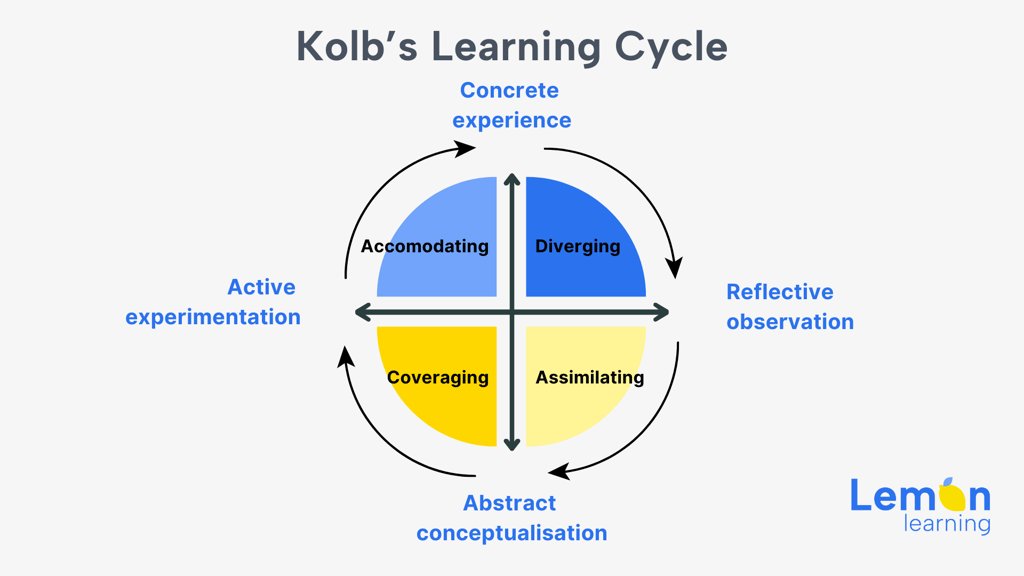
Concrete Experience is the starting point in which the learner is directly involved in a new situation or revisits an existing experience from a fresh angle. The emphasis is on doing and feeling rather than thinking analytically. The learner is fully immersed, responding to events as they unfold.
Examples in a training context include:
The quality of this initial experience matters because the material gathered here feeds every subsequent stage. If the experience is too abstract or disconnected from the learner's real context, the reflection that follows will lack grounding.
In the Reflective Observation stage, the learner steps back from the activity and reviews it from multiple angles. The focus shifts from doing to watching and wondering. Key questions at this stage include: What happened? What did I notice? What went well or poorly? How did others respond?
This is the stage most closely associated with Kolb's Reflective Cycle in practice. Learners may write in a learning journal, participate in a debriefing discussion, or simply sit with their observations before moving on. In corporate training, peer review sessions and after-action reviews serve this function well.
Reflective Observation is sometimes the most neglected stage in fast-paced workplace training, yet research consistently shows that reflection is central to transferring experience into lasting knowledge. Skipping this stage typically means the learner moves straight to action without understanding what they actually learned.
Abstract Conceptualization is where the learner uses analytical and cognitive skills to draw conclusions from the reflected experience. Rather than remaining at the level of "what happened to me," the learner asks "what does this mean in a broader sense?" They identify patterns, form theories, and connect their personal experience to established models or principles.
In a training program, this stage might involve:
Abstract Conceptualization is the intellectual engine of Kolb's cycle. It is here that the learner moves beyond personal anecdote and builds transferable knowledge that can be applied in new situations.
Active Experimentation closes the loop. Armed with new conceptual understanding, the learner applies their conclusions to real or simulated situations, testing hypotheses and planning next actions. This stage is oriented toward doing with intention: unlike the relatively open-ended Concrete Experience stage, Active Experimentation involves deliberate testing of specific ideas.
Examples include:
After Active Experimentation, the cycle begins again: the outcomes of deliberate testing become the new Concrete Experience, and the learner refines their understanding through another pass around the cycle. This iterative, layered quality is what makes the model particularly effective for complex skill development.
Beyond the four stages, Kolb identified four learning styles that emerge from a learner's preferred position on the two axes of the cycle. These styles describe habitual ways of approaching new information. Most people show a dominant style, although all learners are capable of using all four approaches.
The four styles map onto the cycle as follows:
| Learning Style | Dominant Stages | Preferred Approach | Typical Strengths |
|---|---|---|---|
| Diverging | Concrete Experience + Reflective Observation | Feeling and watching | Imagination, empathy, generating ideas |
| Assimilating | Abstract Conceptualization + Reflective Observation | Watching and thinking | Logical analysis, building theoretical models |
| Converging | Abstract Conceptualization + Active Experimentation | Thinking and doing | Problem-solving, applying ideas technically |
| Accommodating | Concrete Experience + Active Experimentation | Doing and feeling | Taking risks, adapting plans, working collaboratively |
Divergers approach learning by observing experiences from many angles and generating ideas through imagination and feeling. They are comfortable with ambiguity and tend to excel in brainstorming, group work, and activities that involve understanding other people's perspectives. Divergers often gravitate toward roles in the arts, counseling, or human resources. In training, they benefit from open-ended discussions, case studies, and collaborative exercises that allow for creative exploration before any single answer is proposed.
Assimilators are most comfortable in the upper half of the cycle, combining reflection with abstract thinking. They prefer logical precision, organized information, and the opportunity to develop coherent theoretical frameworks. They are less interested in direct personal experience and more interested in whether a theory is logically sound. Assimilators tend to perform well in scientific, academic, and data-intensive roles. Training formats that suit them include structured readings, lectures, research tasks, and independent study modules.
Convergers combine abstract thinking with active testing. They prefer practical applications of ideas and are particularly strong at finding a single best answer to a well-defined problem. Technical and engineering professions often attract converging learners. In training, they respond well to simulations, technical problem sets, and activities where they can apply a concept to a concrete scenario and evaluate the outcome systematically.
Accommodators learn through hands-on action and direct experience, relying on gut instinct and the input of others when analysis falls short. They are adaptive, willing to take risks, and tend to thrive when things change rapidly. Accommodating learners are often found in marketing, sales, and project management roles. They benefit from action-learning projects, trial-and-error exercises, and team-based challenges where progress is visible quickly.
Understanding these four styles is valuable for instructional design professionals building blended learning programs because it helps ensure that course activities do not systematically favor one kind of learner while leaving others underserved.
Kolb's Experiential Learning Cycle is applied in practice by designing learning activities that guide participants through all four stages in sequence, either within a single session or across a longer program.
Below are concrete examples of how the cycle maps onto common training formats:
| Kolb Stage | Classroom Activity | Workplace / L&D Activity |
|---|---|---|
| Concrete Experience | Role-play, group exercise, field trip | Job shadowing, live software practice, simulation |
| Reflective Observation | Class discussion, learning journal | After-action review, peer debrief, survey |
| Abstract Conceptualization | Lecture, assigned reading, concept mapping | Short e-learning module, model walkthrough, coaching |
| Active Experimentation | Project assignment, practical test | On-the-job task, knowledge check, prototype build |
The most common mistake in applying Kolb's model is front-loading conceptual instruction before the learner has had any relevant experience to reflect on. When abstract content arrives first, it has no experiential hook to attach to. Reversing the order, starting with a concrete activity before introducing the theory, consistently produces stronger engagement and retention.
In personal development settings, individuals can use Kolb's cycle informally by deliberately seeking out new experiences, setting aside time for structured reflection (a journal, a conversation with a mentor), identifying the generalizable lesson, and committing to a specific change in behavior before repeating the cycle.
In workplace learning, Kolb's model is especially relevant because most professional skills are tacit: they are learned through practice, not through reading a manual. The cycle provides a structural rationale for replacing purely passive training formats with blended or action-oriented programs.
Specific workplace applications include:
Kolb's cycle also pairs well with other frameworks used in organizational learning. The Kirkpatrick Evaluation Model, for instance, assesses training at four levels (reaction, learning, behavior, and results), and each of Kolb's stages can be mapped to evidence collected at one of those levels. Similarly, practitioners interested in social dimensions of learning may want to compare Kolb's individual-centered model with Albert Bandura's Social Learning Theory, which foregrounds observation of others and self-efficacy as drivers of behavior change.
One practical consideration is timing. As Elder Mathias, CIO at Aftral, noted on the CIO Pioneers podcast:
"It took three or four months, and we had to make sure the training happened before go-live but not too far before, so people would not forget. Inevitably there were difficulties at launch: people had forgotten how to perform a given operation."
This observation directly reflects the Active Experimentation stage: if too much time elapses between acquiring conceptual knowledge and applying it, the cycle stalls. Embedding just-in-time guidance within the work environment, rather than relying solely on pre-go-live classroom training, addresses exactly this gap.
Kolb's Learning Cycle is widely used, but it has attracted substantive academic criticism that practitioners should be aware of.
1. Overemphasis on individual experience. Scholars including David Boud and Rosemary Keogh have argued that Kolb's model underestimates the role of social and cultural context in learning. Knowledge is often co-constructed with others rather than generated by a single learner moving through private stages.
2. The learning styles concept lacks robust empirical support. While the four-stage cycle has attracted considerable support, the idea that individuals have stable, fixed learning styles has been challenged by researchers in educational psychology. The consensus in cognitive science is that adapting instruction to a learner's alleged fixed style does not reliably improve outcomes. Practitioners are better served by offering varied activity types that cycle through all four stages for all learners, rather than routing individuals into style-specific tracks.
3. Cultural assumptions. Critics have noted that the model reflects Western, individualist assumptions about the primacy of personal experience and independent reasoning, which may not translate equally across all cultural learning contexts.
4. Difficulty creating the right initial experience. Designing a Concrete Experience that is genuinely relevant, safe enough for a learning environment, and sufficiently complex to generate meaningful reflection is demanding. In highly specialized or high-risk domains, simulating a realistic first experience may be logistically difficult.
5. The cycle is not strictly sequential. In practice, learners rarely move through the four stages in neat order. Real learning is messier, often involving recursive loops, skipped stages, or simultaneous processing at multiple levels.
These criticisms do not invalidate the model's practical utility. They do suggest that Kolb's cycle is most effective when used as a design heuristic rather than a rigid prescription, and when supplemented by awareness of social learning dynamics and individual variation beyond style labels.
Kolb's Experiential Learning Cycle remains one of the most influential and practically applicable models in adult learning and organizational training. Here is a concise overview of what the model says and what practitioners should take from it:
For organizations looking to put these principles into operation across digital tools and software rollouts, the Lemon Learning Learning and Development solution provides in-application guidance that mirrors Kolb's cycle: learners engage with real tasks, receive contextual prompts that support reflection and conceptualization, and are guided through active practice without leaving the flow of work.
Kolb's learning cycle theory, formally called Experiential Learning Theory (ELT), was introduced by David Kolb in 1984. It proposes that learning is a four-stage cyclical process driven by experience: Concrete Experience, Reflective Observation, Abstract Conceptualization, and Active Experimentation. The core idea is that knowledge is created through the transformation of experience, and that learners must move through all four stages to fully consolidate new skills and understanding.
The standard academic citation is: Kolb, D. A. (1984). Experiential Learning: Experience as the Source of Learning and Development. Prentice-Hall, Englewood Cliffs, NJ. In APA 7th edition format this appears as: Kolb, D. A. (1984). Experiential learning: Experience as the source of learning and development. Prentice-Hall.
Kolb identified four learning styles that arise from combinations of the cycle's stages: Diverging (feeling and watching), Assimilating (watching and thinking), Converging (thinking and doing), and Accommodating (doing and feeling). Each style reflects a preferred way of taking in and processing new information, and individuals typically show a dominant preference for one style.
To apply Kolb's theory, design activities that move learners through all four stages. Start with a hands-on task or simulation (Concrete Experience), then prompt reflection through discussion or journaling (Reflective Observation), introduce underlying concepts or models (Abstract Conceptualization), and finish with a practical exercise or project where learners test new ideas (Active Experimentation). In a workplace context, this can include role-plays, after-action reviews, short e-learning modules, and on-the-job practice assignments.
Learning by Doing is a training method that promotes practical hands-on experiences (instructional, learning while working).
Explore 8 key learning style models - VARK, Kolb, Honey & Mumford, Gardner, and more - to design training programs that match how your learners...
Discover how Bloom Creative Learning and Lemon Learning enhance software training with a fresh approach, by delivering user-centric e-learning...