SaaS Onboarding: How a Digital Adoption Platform Turns New Users into Confident Adopters
Learn what SaaS onboarding means, why it drives software adoption, and how a Digital Adoption Platform improves onboarding for every SaaS tool you deploy.
SaaS onboarding is the structured process of guiding users through a Software-as-a-Service (SaaS) application from the moment of first login, so they reach productive use as quickly as possible. It applies to both external customers adopting your product and internal employees using a newly deployed business tool. A digital adoption platform is currently one of the most effective ways to deliver that guidance at scale, because it embeds interactive help directly inside every SaaS application your organization runs.
What Does SaaS Onboarding Mean and Why Does It Matter?
SaaS onboarding is the set of guided experiences, content, and processes that help users understand and adopt a SaaS application. The goal is not just to show users where buttons are; it is to accelerate the moment users realize the tool solves a real problem for them, a milestone often called time to value.
Effective SaaS onboarding is relevant in three recurring scenarios:
The arrival of new employees who must use existing business software from day one
The deployment of a new SaaS tool across the organization
Training on major updates, new features, or process changes within an existing tool
The objectives are consistent across all three: help users handle the application correctly, increase retention and continued use, and communicate the tool's value quickly enough that users do not disengage.
Without deliberate onboarding, users abandon software. Abandoned software means the business goals that justified the purchase, whether cost reduction, process standardization, or better collaboration, are never realized.
Why Is SaaS Popular, and Why Does Adoption Still Fail?
SaaS is popular because it removes infrastructure overhead, accelerates deployment, and standardizes processes across organizations. As Jean-Severin Lerre, DSI (Chief Information Officer) at INSEE, noted on the CIO Pioneers podcast:
"One advantage I see in SaaS is that it standardises things. A traditional business function says mine is very different, whereas in SaaS mode they see the most widely used standard way of doing things, and that lets them challenge their own practices."
Jean-Severin Lerre, DSI, INSEE, on the Lemon Learning CIO Pioneers podcast
Yet fast deployment does not guarantee fast adoption. Research consistently shows that a significant share of licensed SaaS applications go unused because organizations do not invest equally in onboarding. The tool arrives; the guidance does not. This is the core problem a DAP (Digital Adoption Platform) is built to solve.
What Does a DAP Do for SaaS Onboarding?
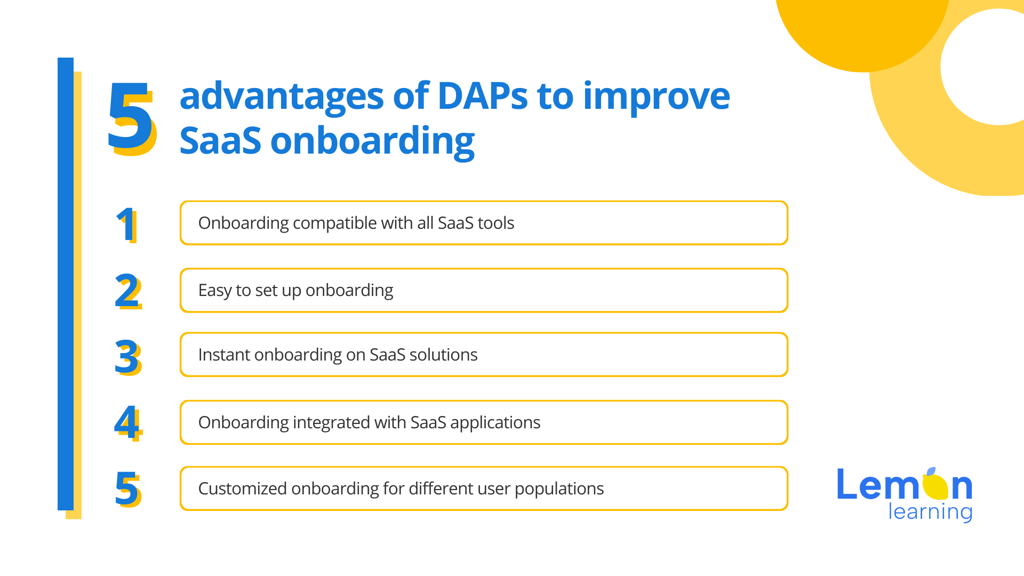
A DAP is a software layer that sits on top of any web-based application and delivers contextual, interactive guidance to users while they work. Instead of sending employees to a separate training portal or a thick manual, a DAP surfaces the right help at the right moment, inside the tool itself. Below are the five practical advantages that make a DAP the strongest choice for SaaS onboarding.
A DAP is not built for a single application. One platform covers the full range of SaaS tools a typical organization runs:
Application Category
Examples
ERP (Enterprise Resource Planning)
SAP, Oracle, Infor
CRM (Customer Relationship Management)
Salesforce, Microsoft Dynamics
HRIS (Human Resource Information System)
Workday, SuccessFactors
E-Procurement
Coupa, SAP Ariba
Digital Workplace
Microsoft 365, Google Workspace
Internal custom tools
Any web-based application
This breadth means your team manages one onboarding platform rather than a patchwork of tool-specific training programs.
Simple to Set Up
Implementation is designed to be lightweight for IT teams. A DAP integrates with your existing SaaS applications through a browser extension or a single line of code. The content-authoring interface allows trainers or HR teams to build walkthroughs, tooltips, and checklists directly from within the live application, without developer support. This dramatically reduces the time between deploying a new tool and having guided onboarding content ready for users.
Guidance Delivered Inside the Application
Users do not need to leave their workflow to find help. A DAP overlays onboarding content directly on the SaaS interface, so guidance appears precisely when a user encounters a new screen or a complex task. This in-app model removes the friction of switching between the tool and a separate training resource, which is one of the most common reasons onboarding content goes ignored.
Real-Time, Instant Onboarding
Because help is embedded and always available, users are supported from the very first login. They do not have to wait for a scheduled training session or remember instructions delivered weeks before go-live. The result is faster software adoption and a measurably shorter time to value. Users can also return to onboarding content on demand whenever they face an unfamiliar task, making continuous learning a natural part of daily work rather than a separate event.
Personalized Journeys by User Population
Not every user needs the same guidance. A DAP lets you configure onboarding flows by role, department, or skill level. Practical examples by tool type include:
E-Procurement: Separate onboarding flows for buyer and supplier users, each focused on the tasks relevant to that role
CRM adoption: Tailored walkthroughs for sales teams versus marketing teams, reflecting their different daily workflows
HRIS onboarding: Differentiated guidance for HR administrators managing records and for employees accessing self-service features
Personalization reduces cognitive overload by showing users only what they need, when they need it.
How Does Customer Onboarding with a DAP Work?
Customer onboarding with a DAP follows the same in-app logic as internal employee onboarding, but the audience is external. When a new customer logs into your SaaS product for the first time, the DAP layer can present a guided product tour, highlight key features, and surface contextual tips at moments of likely confusion. This reduces the volume of support tickets generated by new users, shortens the time before a customer experiences the product's core value, and improves retention rates.
For SaaS vendors, embedding a DAP into the product also means onboarding content can be updated centrally whenever the interface changes, without rebuilding a separate help center or re-recording video tutorials.
How Does Employee Onboarding with a DAP Differ?
Employee onboarding with a DAP addresses an internal challenge: when a new hire joins or an existing employee moves to a new role, they typically face multiple SaaS applications at once. A DAP covers every tool in the digital workplace from a single platform, so the onboarding experience is consistent regardless of which application the employee opens. This is especially valuable during large-scale software deployments, where training all staff through traditional sessions is slow, expensive, and quickly forgotten.
Common onboarding training mistakes in enterprise settings, such as scheduling classroom sessions too far before go-live or providing generic content that does not match a user's role, are directly addressed by the just-in-time, role-specific approach a DAP enables.
What Are the Best DAP Platforms for SaaS Onboarding?
When evaluating the best DAP for SaaS onboarding, the key criteria are: compatibility with your existing SaaS stack, ease of content authoring for non-technical teams, the ability to segment users by role, analytics that show where users drop off or struggle, and the vendor's track record in your industry.
For a structured comparison of leading options, the best digital adoption platforms guide reviews the market in detail. Lemon Learning is a DAP built specifically for enterprise SaaS environments, covering all major ERP, CRM, HRIS, and digital workplace tools through a single overlay platform.
One frequently asked question is how Lemon Learning compares to tools like Nexthink. The distinction matters: Nexthink is primarily a digital employee experience (DEX) monitoring and IT analytics platform, focused on detecting issues across endpoints and networks. Lemon Learning is focused on in-application guidance and onboarding, making the two tools complementary rather than direct competitors in most enterprise architectures.
For organizations evaluating SaaS onboarding software more broadly, the State of SaaS Onboarding research from Cloud Coach provides useful benchmark data on how onboarding quality connects to retention and implementation outcomes.
Request a Lemon Learning demo
FAQ
Frequently asked questions
What is onboarding in SaaS?+
SaaS onboarding is the structured process of guiding new users through a Software-as-a-Service application so they quickly understand its value and core workflows. It typically includes in-app walkthroughs, tooltips, tutorials, and contextual help content, and it applies to both external customers adopting a product and internal employees using a newly deployed business tool.
What are the 4 phases of onboarding?+
The four commonly recognised phases of onboarding are: (1) Welcome and orientation, where users are introduced to the product and its purpose; (2) Activation, where users complete a key action that demonstrates the product's core value; (3) Habit formation, where repeated use is encouraged through guidance and nudges; and (4) Expansion, where users discover advanced features or additional use cases that deepen engagement.
Is SaaS being replaced by AI?+
SaaS is not being replaced by AI. Instead, AI capabilities are being embedded into existing SaaS products to automate tasks, personalise experiences, and surface insights. Most analysts describe the trend as AI-augmented SaaS rather than a wholesale replacement. The subscription delivery model that defines SaaS remains the dominant way business software is deployed and purchased.
What are the top 5 SaaS companies?+
Consistently cited among the largest SaaS companies by revenue are Microsoft (Microsoft 365 and Azure), Salesforce, ServiceNow, Adobe, and SAP. Rankings shift with each financial quarter, so checking the latest analyst reports gives the most current picture.
Poor user adoption undermines IT procurement systems. Learn how digital adoption platforms like Lemon Learning improve onboarding, reduce errors, and...