Discover the VARK learning style model, its four types (Visual, Auditory, Reading/Writing, Kinesthetic), how to identify your style, and why it matters
The VARK (Visual, Auditory, Reading/Writing, Kinesthetic) learning style model is a framework that categorizes how individuals prefer to receive and process information. Developed by New Zealand educator Neil Fleming, it gives learners and trainers a shared vocabulary for personalizing instruction. It is one of several learning styles models used in professional and academic settings, each offering a different lens on how people absorb new knowledge.
What Is the VARK Model?
The VARK model is a classification system that groups learners by their preferred sensory channel for taking in information. Neil Fleming introduced it in 1987 after observing that students in his classes responded very differently to the same instructional materials. He noticed that some learners retained information best through diagrams and charts, others through listening, others through text, and others through direct experience.
To make the model practical, Fleming designed a questionnaire that presents real-world scenarios and asks respondents how they would prefer to handle each one. The pattern of answers reveals a dominant style or, in many cases, a multimodal preference, meaning the individual draws on more than one style depending on context. The official questionnaire is available at vark-learn.com, the home of the VARK model.
Why Does Knowing Your VARK Learning Style Matter?
Knowing your VARK learning style helps you select study strategies and training resources that align with how you naturally process information, which can make learning faster and less frustrating. For organizations, it gives Learning and Development (L&D) teams a starting point for designing more inclusive training programs.
Practical benefits include:
Employees can choose formats that suit them, such as video walkthroughs, written guides, or hands-on practice scenarios, rather than struggling with a single delivery method.
Trainers can identify gaps in their course materials when one or more VARK styles are underserved.
Managers can use VARK results to support onboarding conversations and individual development planning.
Teams that understand their own and each other's preferences tend to collaborate more effectively on knowledge-sharing tasks.
Knowing your style does not mean you can only learn one way. Most people have more than one strong preference, and the goal of using VARK is to expand your toolkit, not to limit it. Embedding continuous learning as a business strategy works best when both individuals and organizations treat learning preferences as a guide rather than a fixed constraint.
What Are the Four VARK Learning Styles?
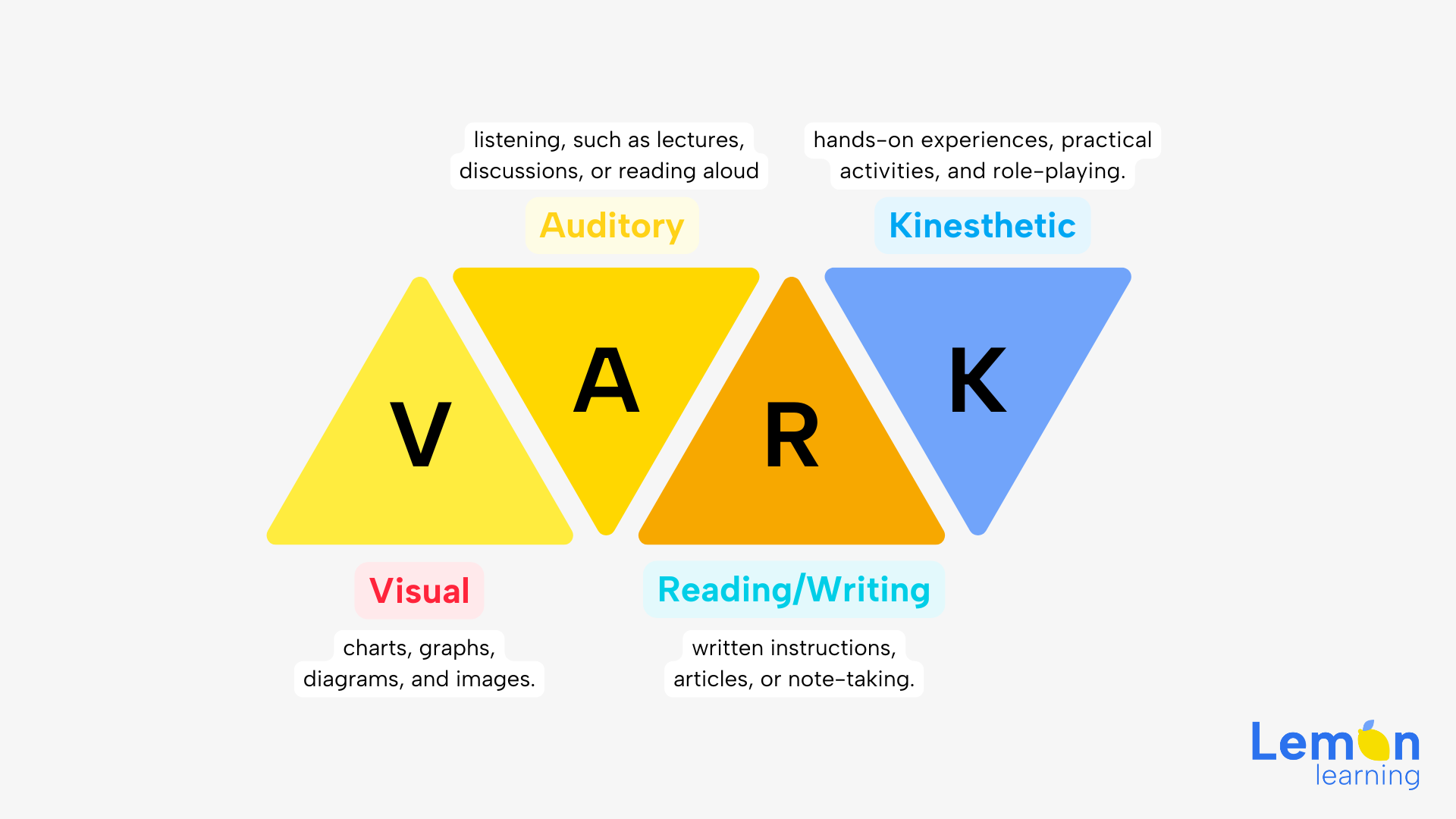
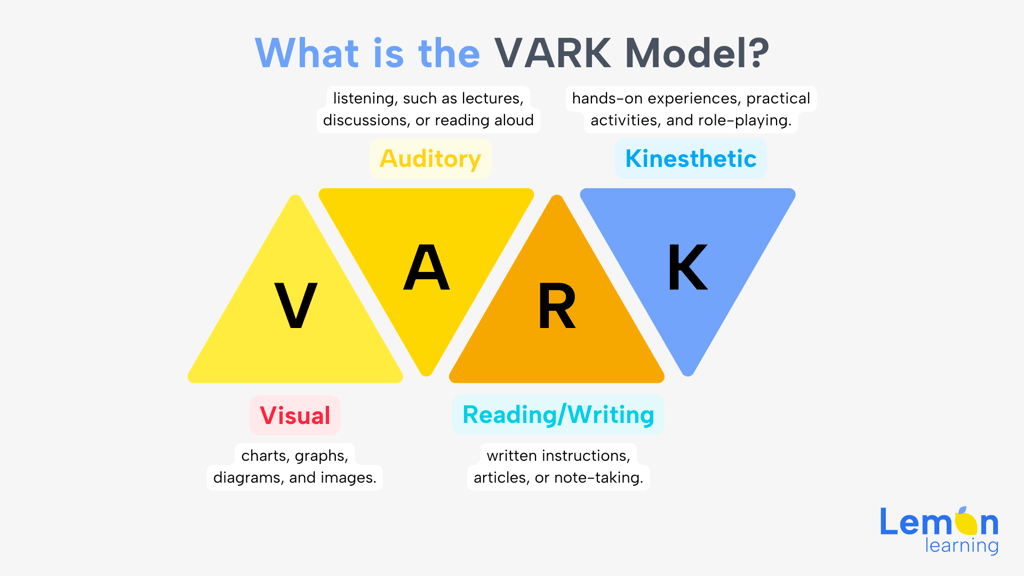
The VARK model identifies four distinct learning styles. The table below summarizes each style, its core characteristics, and the types of resources that tend to work best for it.
Lectures, podcasts, group discussions, audio recordings
Reading/Writing (R/W)
Written words, whether reading or producing them
Reports, textbooks, written instructions, note-taking, lists
Kinesthetic (K)
Experience, practice, and real-world application
Simulations, role-play, case studies, fieldwork, hands-on demos
Visual Learning (V)
Visual learners process information most effectively when it is represented graphically or spatially. This does not mean they simply prefer pictures; rather, they benefit from layouts, hierarchies, and spatial arrangements that show how concepts relate to one another. Charts, flowcharts, diagrams, and annotated slides all support this style. Color-coded notes and concept maps help visual learners organize and retain complex information. In corporate training, short explainer videos and dashboard screenshots often resonate strongly with this group.
Auditory Learning (A)
Auditory learners absorb information best when it is spoken or discussed. They tend to retain more from a live presentation or recorded lecture than from reading the same content on a page. Group discussions, question-and-answer sessions, and verbal explanations all support this style. In a workplace context, auditory learners often benefit from team debriefs, mentoring conversations, and recorded walkthroughs with narration. Reading key points aloud or explaining a concept to a colleague are also effective self-study strategies for this group.
Reading/Writing Learning (R/W)
Learners with a Reading/Writing preference process information most effectively through written text, whether they are reading it or producing it themselves. They are comfortable with dense written materials such as policy documents, user manuals, and research reports. Highlighting passages, rewriting notes in their own words, and creating structured lists are all strategies that deepen comprehension for this style. In training programs, providing written summaries, glossaries, and follow-up reading materials serves R/W learners well.
Kinesthetic Learning (K)
Kinesthetic learners, sometimes called tactile learners, learn best through concrete experience and direct application. Abstract explanations tend to engage them less until they can connect the concept to a real scenario. Simulations, case studies drawn from actual situations, role-playing exercises, and supervised practice are all highly effective for this style. In software training, for example, kinesthetic learners benefit most from guided hands-on walkthroughs rather than passive video demonstrations. A digital adoption platform that delivers in-application, step-by-step guidance directly inside enterprise software is a practical tool for supporting kinesthetic learners in workplace technology onboarding.
How Can Trainers Adapt Instruction to VARK Styles?
Trainers and L&D professionals can use VARK as a design checklist to ensure their programs serve the full range of learner preferences. The following approach is practical for most corporate settings:
Assess before designing. Administer the VARK questionnaire or a short informal survey at the start of a program to understand the distribution of preferences in the group.
Build multimodal content. For each key learning objective, provide at least two format options, for example a short video and a written summary, so learners can choose the channel that works best for them.
Mix delivery methods. Combine synchronous discussion (auditory), written documentation (R/W), visual job aids (visual), and practice activities or simulations (kinesthetic) within a single course rather than relying on one format throughout.
Create a safe environment for feedback. Encourage learners to tell trainers when a format is not working for them, and respond with alternative resources rather than treating the original format as the only option.
Review and iterate. After each training cycle, check completion rates and assessment results across different content formats to identify which styles may be underserved.
This multimodal approach also aligns with broader best practices in instructional design. Understanding how VARK connects to experiential learning frameworks can deepen a trainer's toolkit; Kolb's learning cycle offers a complementary model that emphasizes reflection and active experimentation alongside concrete experience. For teams navigating large-scale technology rollouts, connecting learning design to established change management models can also improve adoption outcomes.
What Are the Limitations of the VARK Model?
The VARK model is widely used, but it is important to understand where its evidence base is strong and where it is not.
Limited evidence for "meshing." The idea that learners perform best when instruction is matched exactly to their stated style, sometimes called the "meshing hypothesis," has not been consistently supported by controlled research. Most learners benefit from varied, multimodal instruction regardless of their dominant VARK preference.
Preferences are not fixed abilities. A preference for visual materials does not mean a learner cannot process text effectively. VARK identifies inclinations, not cognitive limits.
Self-reported data has constraints. The questionnaire relies on how individuals believe they learn, which may not always reflect how they actually learn most effectively in practice.
Oversimplification risk. Labeling an employee as "a kinesthetic learner" and designing all their training around that single style can reduce rather than expand their development opportunities.
Used thoughtfully, VARK is a useful starting point for conversations about learning preference and a practical guide for building more varied training programs. It works best as one input among several, not as a rigid classification system.
Frequently Asked Questions
What are the 4 learning styles of VARK?
The four VARK learning styles are Visual (V), Auditory (A), Reading/Writing (R/W), and Kinesthetic (K). Each describes a preferred sensory channel for taking in and processing new information.
What is VARK used for?
VARK is used to help learners identify the study and training strategies that suit them best, and to help educators and trainers design instruction that accommodates a range of preferences. It is applied in corporate training programs, higher education, and professional development contexts.
What are the criticisms of VARK?
The main criticism is that research has not consistently shown that matching instruction to a learner's VARK style improves learning outcomes, a gap known as the failure of the "meshing hypothesis." Critics also note that preferences identified through self-report may not reflect actual learning effectiveness, and that assigning fixed style labels can oversimplify the complexity of how people learn.
Is a kinesthetic learner the same as having ADHD?
No. Kinesthetic learning preference simply means an individual tends to engage more readily with hands-on, experiential activities. ADHD (Attention-Deficit/Hyperactivity Disorder) is a neurodevelopmental condition that requires clinical diagnosis. While some individuals with ADHD may find active, movement-based tasks easier to sustain attention during, a kinesthetic learning preference is a self-reported inclination, not a medical condition.
FAQ
Frequently asked questions
What are the 4 learning styles of VARK?+
The four VARK learning styles are Visual (V), Auditory (A), Reading/Writing (R/W), and Kinesthetic (K). Each describes a preferred way of taking in and processing information.
What is VARK used for?+
VARK is used to help learners identify their preferred study or training strategies, and to help educators and trainers design instruction that matches those preferences. It is widely applied in corporate training, higher education, and professional development programs.
What are some criticisms of VARK?+
Critics note that there is limited empirical evidence that matching instruction to a learner's VARK style actually improves outcomes. Research suggests that most people benefit from multimodal instruction regardless of their stated preference, and that learning styles labels can oversimplify how people learn.
Is a kinesthetic learner the same as having ADHD?+
No. Being a kinesthetic learner simply means a person prefers hands-on, experiential activities when learning. ADHD (Attention-Deficit/Hyperactivity Disorder) is a neurodevelopmental condition diagnosed by clinicians. While some people with ADHD may prefer active, hands-on tasks, kinesthetic learning preference is not a diagnosis and is not equivalent to ADHD.