ADDIE Model Phases: A Complete Guide to Instructional Design for L&D Teams
ADDIE stands for Analysis, Design, Development, Implementation, and Evaluation. Discover all 5 phases of this instructional design model, with examples
The ADDIE (Analysis, Design, Development, Implementation, and Evaluation) model is a five-phase instructional design framework used to build and deliver effective training programs. Rooted in constructivist learning theory, it provides a structured, repeatable process for corporate learning and development teams, instructional designers, and training managers who need to create consistent, measurable learning experiences.
What is the ADDIE Model?
The ADDIE model is a systematic approach to instructional design. The full form of ADDIE is Analysis, Design, Development, Implementation, and Evaluation. As Robinson and Breen (2022, p. 162) describe it, the ADDIE instructional design model includes the phases of analysis, design, development, implementation, and evaluation, a definition widely cited across academic and professional training literature.
The model can be applied to online (e-learning), in-person, blended, or on-the-job training programs. It works at any scale, from a single onboarding module to an enterprise-wide learning curriculum. According to the U.S. Department of Justice's ADDIE Model Instructional Design Fact Sheet, the five phases provide a process traditionally used by instructional designers and training developers to build performance support tools that consistently achieve learning objectives.
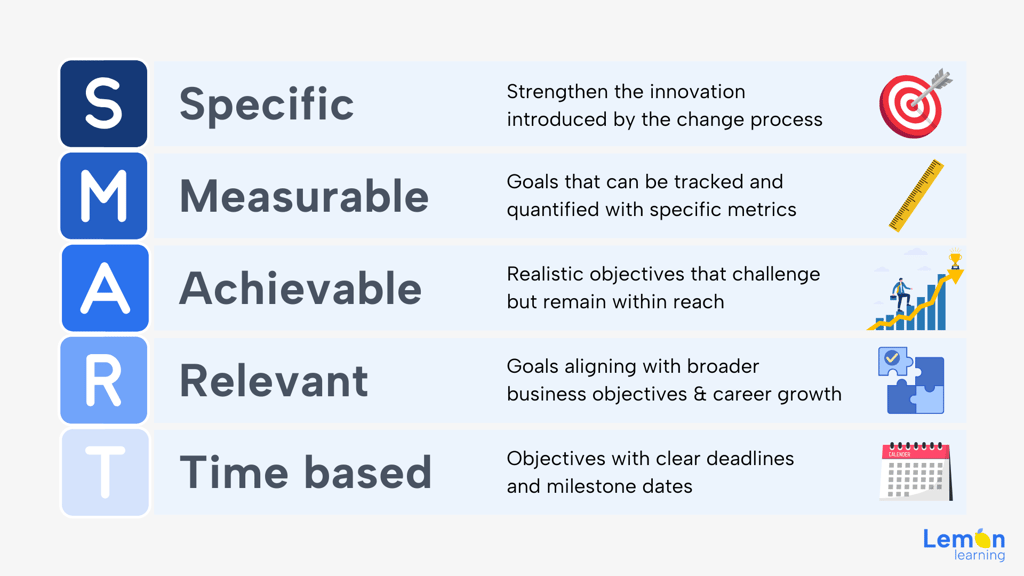
SMART objectives, Specific, Measurable, Achievable, Relevant, and Time-bound, are defined at each stage, giving the model a clear basis for both delivery and instructional design planning.
What Are the 5 Phases of the ADDIE Model?
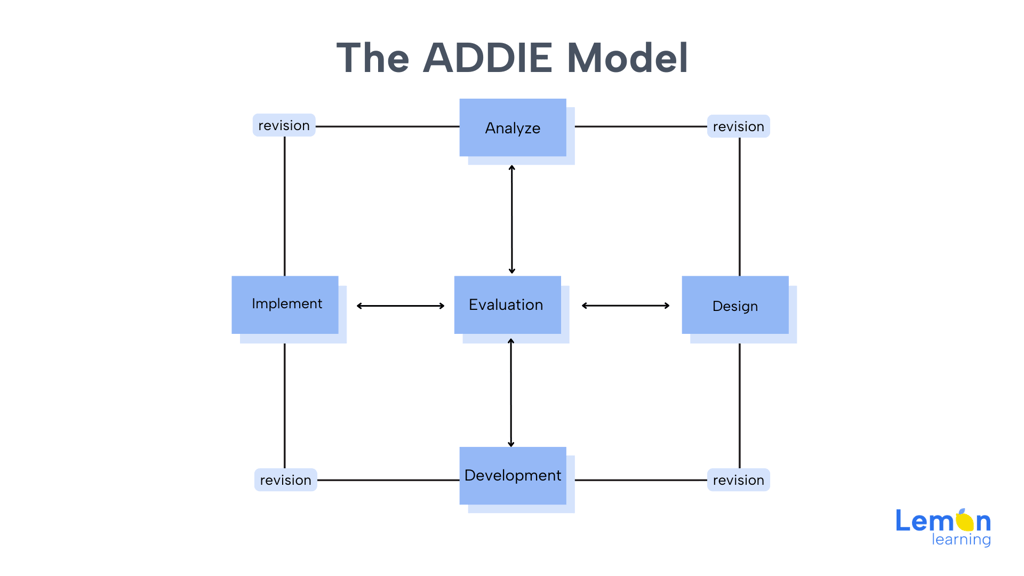
The ADDIE model phases, Analysis, Design, Development, Implementation, and Evaluation, form an integrated instructional design cycle. Each phase builds on the previous one, and evaluation runs throughout rather than only at the end. Below is a detailed breakdown of each stage.
Phase 1: Analysis
The Analysis phase is the foundation of the entire ADDIE process. It diagnoses the training need before any content is created. Without a thorough analysis, subsequent phases risk being built on incorrect assumptions about learner needs or organizational goals.
During this phase, the instructional design team addresses the following questions:
What performance gap or training need exists?
Who is the target audience, and what are their existing knowledge levels and learning preferences?
What are the time, budget, and technology constraints?
What learning outcomes will indicate success?
The output of the Analysis phase is a clear training needs assessment that defines the scope, audience profile, and high-level objectives that will guide every subsequent phase. This diagnostic rigor is what separates an effective training program from one that misses its mark.
Phase 2: Design
The Design phase transforms the needs identified in Analysis into a detailed learning blueprint. The instructional designer converts training needs into specific SMART learning objectives and outlines exactly how those objectives will be achieved.
The design blueprint typically covers:
Learning strategies and pedagogical approaches (for example, coaching, mentoring, simulations, or scenario-based exercises)
Sequence and structure of the training program
Assessment methods and criteria for each learning objective
Selection of instructional materials and media formats
Technology platform or delivery mechanism
A prototype or storyboard is often produced by the end of this phase. For organizations deploying enterprise software, the Design phase may identify that a guided, in-application learning approach suits employees better than a classroom session, allowing workers to practice directly within the tool they need to learn.
Phase 3: Development
The Development phase is where the approved design blueprint becomes actual learning content. Course materials, e-learning modules, video content, job aids, assessments, and any technology tools required for delivery are created or adapted during this phase.
Key activities in the Development phase include:
Building course content and media assets based on the design specifications
Adapting or updating any existing training materials that remain relevant
Conducting internal reviews and quality checks
Running pilot tests with a representative sample of the target audience to identify issues before full rollout
For large-scale e-learning programs, the Development phase often requires a team of specialists, subject-matter experts, content writers, graphic designers, and learning technology developers, working in coordination. The goal is a fully tested, ready-to-deploy set of learning resources that directly map to the SMART objectives set in the Design phase.
Phase 4: Implementation
The Implementation phase is where the training is delivered to learners. This is the most visible stage of the ADDIE model and the one that learners experience directly, whether through an in-person session, an online platform, a blended format, or an embedded in-application guide.
Implementation responsibilities typically include:
Deploying the training to the target audience on schedule
Managing logistics such as learner enrollment, platform access, and facilitator coordination
Communicating with learners and managers about training expectations and timelines
Monitoring learner engagement and addressing technical or access issues in real time
Timing matters significantly in this phase. As training practitioners note, deploying training too far before the relevant activity means learners forget the content before they need it; deploying it too late means they are unprepared. Effective implementation aligns training delivery with the moment of need. For software rollouts, this often means embedding guidance directly within the application interface so employees receive support exactly when they perform a new task.
Phase 5: Evaluation
Evaluation is both a phase in its own right and a process that runs throughout every stage of the ADDIE model. It measures whether the training has achieved its intended outcomes and identifies where improvements are needed.
Evaluation in the ADDIE model typically operates at two levels:
Evaluation Type
When It Occurs
Purpose
Formative evaluation
Throughout each phase (Analysis, Design, Development, Implementation)
Identify and correct problems before they compound; refine content and delivery in real time
Summative evaluation
After training is complete
Assess overall effectiveness, learner achievement of objectives, and return on investment
Summative evaluation methods commonly include learner assessments, post-training surveys, manager observations, and performance data tracking. Cost analysis, comparing projected training budgets with actual expenditure, is also a standard summative evaluation activity. Findings from the Evaluation phase feed back into the Analysis phase, making ADDIE a continuous improvement cycle rather than a one-time linear process.
What Are the Advantages and Limitations of the ADDIE Model?
The ADDIE model offers clear structural benefits, but it also has recognized limitations that instructional designers should understand before choosing it for a given project.
Advantages of the ADDIE Model
Clear, repeatable structure. The five-phase sequence gives design teams a consistent framework that scales from small team training to organization-wide programs.
Learner-centered by design. The Analysis phase anchors the entire program in real learner needs and performance gaps rather than assumed content requirements.
Built-in quality control. Formative evaluation at each phase catches problems early, reducing costly late-stage revisions.
Broad applicability. The model works for in-person, online, blended, and embedded learning formats, and across industries from healthcare to technology.
Strong alignment with organizational goals. SMART objectives set in the Design phase create a direct line between training activities and measurable business outcomes.
Limitations of the ADDIE Model
Sequential rigidity. In its classic linear form, moving through five distinct phases can be slow when rapid content updates are needed.
Front-loaded investment. A thorough Analysis phase requires significant time and stakeholder access upfront, which can be difficult in fast-moving environments.
Less suited to iterative projects. For projects where requirements shift frequently, agile instructional design methods or the SAM (Successive Approximation Model) may provide faster iteration cycles.
Many organizations address these limitations by combining ADDIE's structured phases with agile principles, conducting shorter development sprints within the Development and Implementation phases while keeping the Analysis and Evaluation discipline intact.
How Does ADDIE Compare to Other Instructional Design Models?
The ADDIE model is the most widely recognized framework in the field, but it sits alongside several other established instructional design approaches. Understanding the differences helps learning teams select the right model for each project.
Model
Structure
Best Suited For
ADDIE
Five sequential phases with continuous evaluation
Comprehensive training programs with defined scope and stable requirements
SAM (Successive Approximation Model)
Iterative cycles of design, development, and evaluation
Projects requiring rapid prototyping and frequent stakeholder feedback
Bloom's Taxonomy
Hierarchical classification of learning objectives
Writing and categorizing learning outcomes within any design model
Kirkpatrick Model
Four levels of training evaluation (Reaction, Learning, Behavior, Results)
Measuring training effectiveness and business impact post-delivery
ADDIE and the Kirkpatrick Model are frequently used together: ADDIE guides the design and delivery process, while Kirkpatrick's four levels structure the summative evaluation. Similarly, Bloom's Taxonomy is commonly applied within ADDIE's Design phase to write precise, measurable learning objectives.
Applying the ADDIE Model in Corporate Training and Digital Adoption
The ADDIE model is particularly effective in corporate training contexts where technology rollouts, process changes, and compliance requirements demand structured, evidence-based learning programs. It functions as one of the most reliable change management tools available to learning and development teams, because it forces alignment between training design and organizational objectives from the very first phase.
In software adoption scenarios, for example, the Analysis phase identifies which employee groups need training, what their current digital skill levels are, and which specific application workflows represent the greatest performance gaps. The Design phase then determines whether guided walkthroughs inside the application, short video modules, or structured classroom sessions best match those needs. The Development phase builds the content. Implementation deploys it at the right moment in the rollout. And Evaluation measures whether employees are using the software correctly and confidently.
"Many projects fail because resources go into the project itself, neglecting employees, like millions thrown out the window."
This observation reflects exactly the risk that a well-executed ADDIE process is designed to prevent: ensuring that human performance support is built into any major organizational change, not treated as an afterthought. Lemon Learning's learning and development platform integrates directly with enterprise applications, allowing organizations to embed guided, contextual learning into the tools employees use daily, a practical implementation of ADDIE's Development and Implementation phases at scale.
The Stages of Instructional Design: Key Takeaways
The ADDIE model remains a foundational framework in instructional design because it balances structure with flexibility, grounds every training decision in learner needs, and builds evaluation into the process from the start. Its five phases, Analysis, Design, Development, Implementation, and Evaluation, provide a complete instructional design cycle that applies to any format, audience, or organizational context.
For learning and development professionals and instructional designers, understanding how to execute each phase well is the difference between training that drives measurable performance improvement and training that is forgotten as soon as the session ends. Exploring how to execute an instructional design project step by step is a natural next step after mastering the ADDIE framework itself.
FAQ
Frequently asked questions
What are the five phases of ADDIE?+
The five phases of the ADDIE model are Analysis, Design, Development, Implementation, and Evaluation. Each phase feeds into the next, and evaluation runs continuously throughout the entire process to allow adjustments before moving forward.
What is the ADDIE model in simple terms?+
ADDIE is a structured instructional design framework that guides learning and development professionals through five sequential steps: analyzing learner needs, designing the learning blueprint, developing the content and materials, implementing the training, and evaluating its effectiveness. The full form of ADDIE is Analysis, Design, Development, Implementation, and Evaluation.
What has replaced ADDIE?+
No single model has universally replaced ADDIE. Agile instructional design approaches, SAM (Successive Approximation Model), and rapid prototyping methods are increasingly used alongside or instead of ADDIE when faster iteration is needed. Many organizations blend ADDIE with agile principles to combine structure with flexibility.
What is the ADDIE model of instructional design?+
The ADDIE model is a systematic instructional design process traditionally used by learning designers and training developers. As Robinson and Breen (2022, p. 162) describe it, ADDIE includes the phases of analysis, design, development, implementation, and evaluation. It provides a repeatable, evidence-based framework for building effective training programs in corporate, academic, and government contexts.