The 5 Essential IT Frameworks for Modern Organizations
Discover the 5 most widely used IT frameworks in 2026: ITIL, Agile, DevOps, COBIT, and TOGAF. Learn what each one does and how to choose the right
Discover the most important instructional design models and frameworks, from ADDIE to SAM, Gagné, Bloom, and more. Learn how each method works and when to

Instructional design models are structured frameworks that guide the creation, development, and evaluation of training programs. The most widely used is the ADDIE model (Analysis, Design, Development, Implementation, Evaluation), but several other frameworks, including SAM, Gagné's Nine Events, Bloom's Taxonomy, and Action Mapping, serve different contexts and project types. Choosing the right model is what separates training that changes behavior from training that simply delivers content.
This guide covers seven core instructional design models and methodologies, explains how each works, and helps learning and development (L&D) professionals select the right approach for their organization. For a broader foundation, see the complete guide to instructional design on the Lemon Learning blog.
An instructional design model is a repeatable process framework that instructional designers use to plan, build, and evaluate learning experiences. It defines the activities, sequence, and decision points involved in developing a training program, whether that program is delivered online, in a classroom, or through a blended format.
Instructional design models serve three main purposes:
Instructional design models are often distinguished from instructional design theories. A theory explains how learning happens (for example, cognitivism or constructivism). A model translates that theory into a practical design process. Most working models draw on multiple theories simultaneously.
The right framework determines whether a training program gets built efficiently, whether it engages learners, and whether it produces measurable results. No single model fits every situation. A highly structured model like ADDIE suits large enterprise rollouts with stable requirements. An agile model like SAM (Successive Approximation Model) suits projects where requirements evolve quickly. A performance-focused framework like Action Mapping is best when the root cause of a business problem may not even require training.
Selecting the wrong framework wastes development resources and, more importantly, risks delivering training that does not transfer to on-the-job performance.
"PowerPoint guides are change management of the old world. The open rate of an email with a PowerPoint guide? Generally 5%."
That observation applies directly to instructional design: the format and framework driving your training program determines whether people engage with it at all.
Below are the seven most influential instructional design models used in corporate training and education today. Each section covers how the model works, its key strengths, and when to use it.
ADDIE is the most widely recognized instructional design framework. It organizes the development process into five sequential phases that ensure every element of a training program is purposeful and aligned with learning objectives.
The five phases of the ADDIE model are:
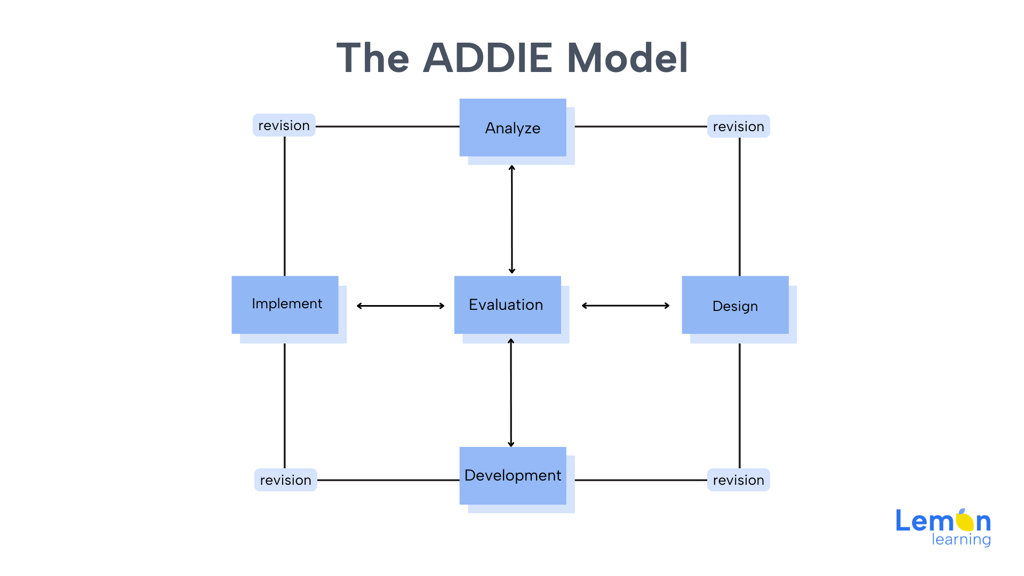
Strengths: ADDIE is methodical, well-documented, and widely understood. It scales well for large-scale training initiatives and makes it easy to onboard new project team members.
Limitations: Its sequential nature can be too rigid when organizational needs change mid-project. Feedback only enters the process formally during the evaluation phase, which means errors can accumulate through development before they are caught.
Best suited for: Large enterprise training rollouts, compliance programs, and any situation where requirements are stable and well-defined before development begins.
The SAM model, created by e-learning designer Michael Allen, is an agile instructional design methodology designed to address the rigidity of traditional sequential models. Where ADDIE moves in a straight line, SAM moves in cycles, using rapid prototyping and continuous stakeholder feedback to refine training before it is fully built.
SAM organizes work into three repeating phases:
Strengths: SAM reduces the risk of investing significant development effort in a flawed design. Early prototypes surface problems cheaply. The iterative nature also tends to produce more learner-centered outcomes because real feedback shapes the product.
Limitations: SAM requires a project team that is comfortable with ambiguity and frequent revision cycles. Organizations accustomed to linear approval processes may find the iterative approach harder to govern.
Best suited for: Fast-paced environments, complex e-learning projects where content is evolving, or any situation where organizational needs are not fully defined at the outset.
Proposed by educational psychologist David Merrill, Merrill's Principles of Instruction (MPI) is a theory-driven framework built on five core principles that Merrill identified as present in virtually every effective instructional design approach. It is less a step-by-step process model and more a set of design principles that can be layered on top of any process model.
The five principles are:
Strengths: MPI is evidence-based and practically orientated. It reinforces active learning and discourages passive content consumption, which is a common failure mode in corporate e-learning.
Limitations: MPI does not prescribe a development process, so it must be used alongside a process model such as ADDIE or SAM rather than independently.
Best suited for: Improving the instructional quality of any course, regardless of which process model is being used. Particularly valuable for performance-based training where learners need to do something new, not just know something new.
Developed by educational psychologist Robert Gagné, Gagné's Nine Events of Instruction is a sequenced instructional framework grounded in cognitive psychology. Each event is designed to support a specific internal cognitive process that leads to durable learning.
The nine events are:
Strengths: The Nine Events framework is highly prescriptive in the best sense: it ensures that no critical cognitive step is skipped during lesson design. It works across formats, including e-learning, blended learning, and instructor-led training.
Limitations: Applying all nine events to every lesson can feel formulaic when learning objectives are simple. Designers must exercise judgment about which events require more or less emphasis for a given topic.
Best suited for: Designing individual lessons or modules within a larger curriculum, particularly for new skill acquisition where cognitive load management is important.
The Kemp Design Model, developed by Jerrold Kemp, is a learner-centered instructional design framework that differs from ADDIE in one important structural way: its nine elements are not arranged in a linear sequence. Designers can enter the model at any point and revisit any element at any time, guided by an ongoing process of evaluation and revision at the center of the model.
The nine elements of the Kemp model are:
Continuous evaluation and revision run through all nine elements rather than being reserved for the end.
Strengths: The Kemp model's flexibility is its defining advantage. It accommodates changing requirements and works particularly well for learner-centered design projects where understanding the audience must inform every other decision. It also eliminates the inefficiency of completing steps that are not relevant to a particular project.
Limitations: The non-linear structure can be disorienting for teams used to sequential processes. It requires experienced designers who can manage the interdependencies between elements without the scaffold of a fixed sequence.
Best suited for: Projects with diverse learner populations, adaptive learning programs, and situations where the designer has a high degree of flexibility in how the curriculum is organized.
Action Mapping is a visual performance-consulting approach to instructional design created by learning designer Cathy Moore. It begins not with learning content but with a measurable business goal, and works backward to identify the specific actions employees must take to achieve that goal. Only then does it ask whether training is the right solution.
The Action Mapping process follows four steps:
Strengths: Action Mapping prevents the most common failure mode in corporate training: building a course that transfers no behavior because it was designed around content rather than performance. It also makes the business case for training explicit and measurable.
Limitations: Action Mapping requires access to business stakeholders and performance data to complete the first two steps properly. It is also less suited to foundational knowledge training where there is no immediate performance behavior to map.
Best suited for: Performance improvement initiatives, sales training, compliance training where behavioral change is the goal, and any project where the return on training investment needs to be demonstrable.
Developed in the 1970s by Walter Dick and Lou Carey, the Dick and Carey model is one of the most comprehensive instructional systems design (ISD) models available. It breaks the entire training development process into ten interconnected steps and places particular emphasis on the relationship between learning objectives, instructional strategy, and assessment.
The ten steps of the Dick and Carey model are:
| Strengths | Challenges |
|---|---|
| Tight alignment between objectives, activities, and assessments | Time and resource-intensive to implement fully |
| Systematic formative evaluation built into the process | Requires significant instructional design expertise |
| Well suited to complex, large-scale instructional systems | Too rigid for small-scale or fast-turnaround projects |
| Produces highly consistent and auditable training programs | Can feel overly prescriptive for simple learning objectives |
Best suited for: Large-scale e-learning development, military or government training programs, and any instructional systems design project where rigorous documentation and alignment are required.
No single instructional design methodology is universally superior. The right choice depends on project scale, timeline, learner diversity, and whether the primary goal is knowledge transfer or behavioral change. The table below summarizes when each model is most appropriate.
| Model | Primary Strength | Best Project Type | Flexibility |
|---|---|---|---|
| ADDIE | Structured, scalable process | Large enterprise rollouts, compliance | Low |
| SAM | Iterative, agile development | Fast-paced or evolving projects | High |
| Merrill's MPI | Evidence-based instructional quality | Any project needing stronger engagement | High (principles, not process) |
| Gagné's Nine Events | Cognitive sequencing per lesson | Individual lesson or module design | Medium |
| Kemp Model | Learner-centered flexibility | Diverse audiences, adaptive learning | High |
| Action Mapping | Business-goal alignment | Performance improvement, behavior change | Medium |
| Dick and Carey | Rigorous systems approach | Complex, large-scale ISD projects | Low |
ADDIE and SAM are the two most discussed instructional design models in corporate L&D, and they represent opposing philosophies about how training should be built.
ADDIE is a waterfall model: each phase must be substantially complete before the next begins. This gives projects a clear structure and makes governance straightforward, but it also means that a design flaw discovered during development requires backtracking through completed phases.
SAM is an agile model: it compresses analysis, design, and development into short iterative cycles. Prototypes are built early and reviewed frequently, so problems surface when they are cheap to fix rather than after significant development effort has been invested.
| Dimension | ADDIE | SAM |
|---|---|---|
| Structure | Sequential, linear | Iterative, cyclical |
| Feedback timing | Primarily at evaluation phase | Continuous throughout development |
| Risk profile | Higher risk of late-stage redesign | Lower risk; errors caught early |
| Best for | Stable, well-defined requirements | Evolving or complex projects |
| Team experience needed | Moderate | Higher (comfortable with iteration) |
| Governance fit | High (clear phase gates) | Moderate (requires agile mindset) |
In practice, many organizations use a hybrid: ADDIE's phase structure for project governance combined with SAM-style rapid prototyping within the design and development phases.
Instructional design models originated largely in academic and military contexts. ADDIE, for example, was developed for the United States military before being adopted widely in higher education and corporate training. The Dick and Carey model similarly has roots in educational psychology research.
In formal education, instructional design models tend to be applied over longer timelines, with more emphasis on theoretical alignment and curriculum coherence across an entire program of study. Bloom's Taxonomy of Educational Objectives, developed by Benjamin Bloom and colleagues in 1956, remains a foundational tool in educational settings for classifying learning objectives across cognitive, affective, and psychomotor domains.
In corporate training, the emphasis shifts toward speed, measurable performance outcomes, and return on investment. Models like Action Mapping and SAM have gained significant traction in corporate L&D precisely because they prioritize demonstrable business results and rapid deployment. Lemon Learning's learning and development solutions are designed to support exactly this kind of performance-focused training delivery at scale.
Despite these differences, the core challenge is the same in both contexts: ensuring that instruction is aligned with objectives, that learners are engaged, and that learning transfers beyond the training environment.
Bloom's Taxonomy is not a full instructional design model in the process sense, but it is used within virtually every instructional design framework to write learning objectives and select appropriate instructional activities and assessments.
The revised Bloom's Taxonomy, updated by Lorin Anderson and David Krathwohl in 2001, organizes cognitive learning into six hierarchical levels:
When instructional designers write learning objectives using Bloom's Taxonomy, they ensure that the verbs used in the objective correspond to the level of cognitive complexity the training is targeting. An objective at the "Apply" level demands different activities and assessments than one at the "Remember" level, and the instructional strategy must match.
Modern instructional design does not happen in isolation from technology. Learning Management Systems (LMSs), digital adoption platforms, authoring tools, and AI-assisted content generation tools all shape how instructional design models are applied in practice.
Several important considerations arise when applying instructional design frameworks in digital contexts:
Understanding how these frameworks apply to real software training challenges is explored further in the article on why software training often fails to produce results.
The instructional design field continues to evolve. Several newer approaches are gaining traction alongside the established models described above.
Design Thinking applied to learning: Some organizations are adapting the Design Thinking process, originally developed at IDEO and Stanford's d.school, to instructional design. This approach emphasizes deep empathy with learners, rapid prototyping, and iterative testing. It overlaps significantly with SAM in its agile orientation but adds an explicit human-centered research phase before design begins.
Backward Design (Understanding by Design): Developed by Jay McTighe and Grant Wiggins, this approach starts with the desired learning outcomes and assessment evidence before determining what instructional activities will produce those outcomes. It is widely used in K-12 and higher education settings and increasingly referenced in corporate learning contexts where outcome definition is a challenge.
Connectivism: Proposed by George Siemens and Stephen Downes in 2005, connectivism describes learning as the process of forming connections between different nodes of information, including people, databases, and digital resources. While primarily a learning theory rather than a design model, it informs instructional design approaches that emphasize networked learning, social learning, and continuous informal skill development.
These approaches do not replace the established models but complement them, offering designers additional tools for specific challenges.
Effective instructional design requires more than familiarity with individual models. It requires the judgment to select the right framework for the context, the skill to apply it rigorously, and the flexibility to adapt when circumstances change.
A few practical principles guide that judgment:
An instructional design model is a structured framework that guides the creation, development, and evaluation of training programs and learning experiences. It provides a repeatable process that helps instructional designers align content, activities, and assessments with defined learning objectives and business goals.
The most widely recognized instructional design models include the ADDIE model (Analysis, Design, Development, Implementation, Evaluation), the SAM (Successive Approximation Model), Bloom's Taxonomy, Gagné's Nine Events of Instruction, the Dick and Carey model, the Kemp Design Model, Merrill's Principles of Instruction, and Action Mapping by Cathy Moore. Each serves different project types and organizational contexts.
ADDIE remains the most widely used instructional design model across corporate and academic settings. Its five sequential phases provide a clear, methodical structure that suits large-scale training projects. However, agile alternatives such as the SAM model are increasingly adopted for fast-paced environments that require iterative development and rapid prototyping.
No single model has fully replaced ADDIE, but the SAM (Successive Approximation Model), created by Michael Allen, is the most cited agile alternative. SAM addresses ADDIE's rigidity by introducing iterative prototyping and continuous feedback loops. Action Mapping by Cathy Moore is another popular alternative that prioritizes measurable business outcomes over traditional content-delivery approaches.
Discover the 5 most widely used IT frameworks in 2026: ITIL, Agile, DevOps, COBIT, and TOGAF. Learn what each one does and how to choose the right
Discover the most common reasons ERP implementations fail, from poor planning to weak user adoption, and learn practical steps to avoid each mistake.
The ADKAR model is Prosci's five-stage framework for individual change management. Learn what each stage means and how to apply it step by step.