McKinsey 7S Model: The Complete Guide to Organizational Alignment
Learn what the McKinsey 7S model is, what each of the seven elements means, and how to apply this change management framework to align your organization.
The McKinsey 7S model is a change management framework that analyzes seven interdependent internal elements of an organization to assess and improve alignment. When all seven elements work in concert, the organization is better positioned to achieve its strategic objectives. This guide covers the model's origins, each of its elements, and how to apply it step by step in a real business context.
What is the McKinsey 7S model?
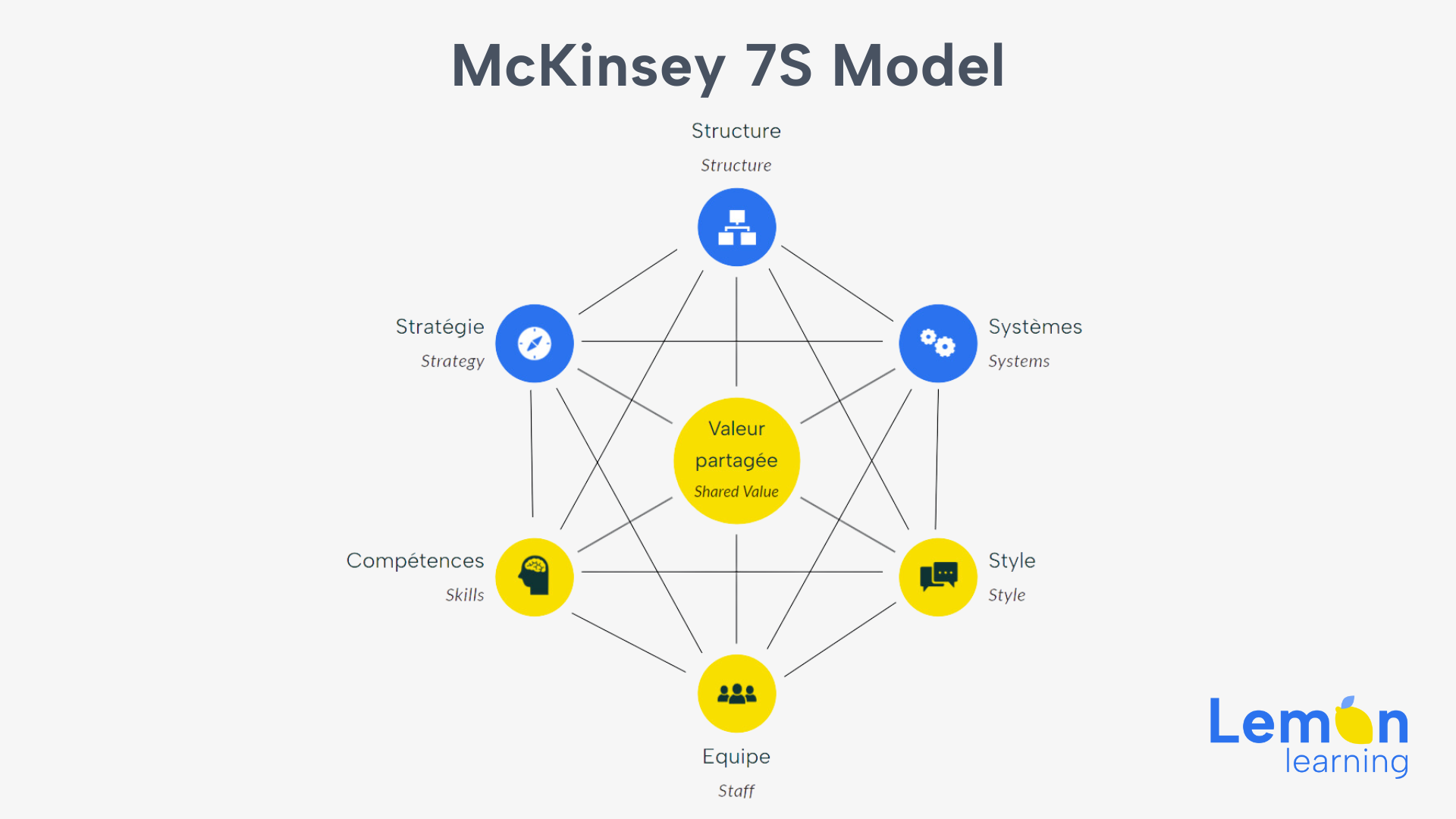
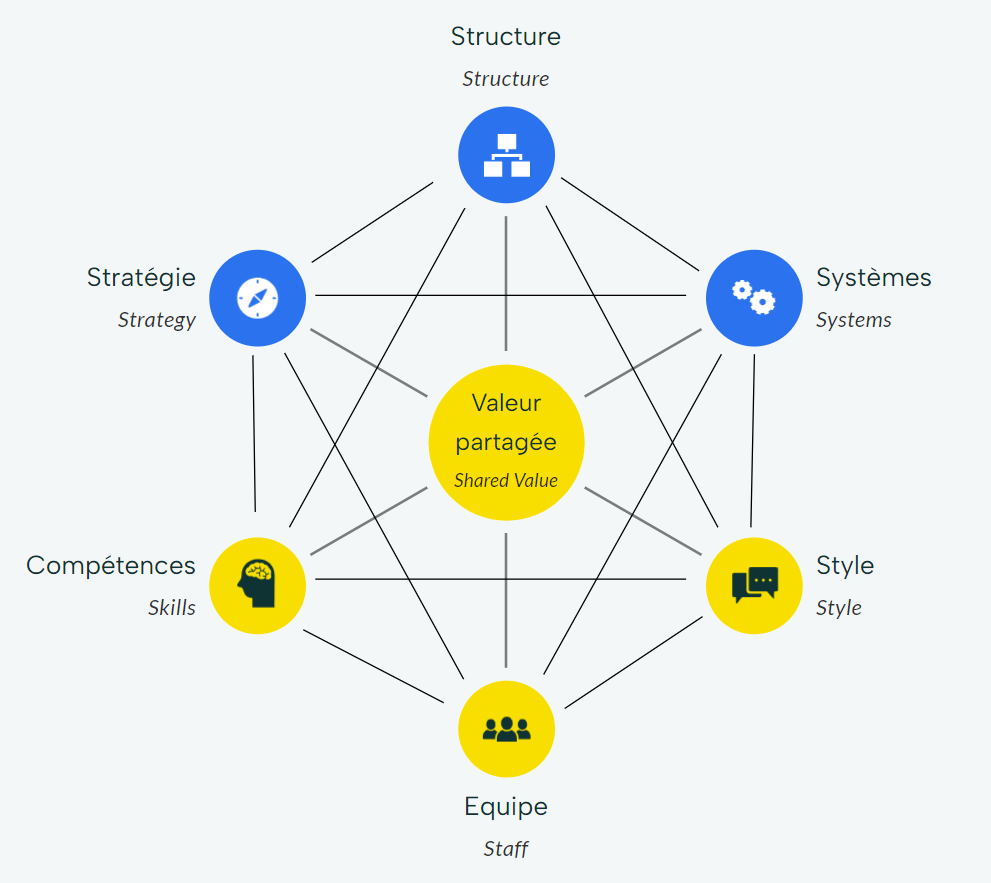
The McKinsey 7S model is a strategic framework used to evaluate how well an organization's internal elements are aligned with one another and with its overall goals. The model groups seven elements into two categories: hard elements, which are tangible and relatively straightforward to identify, and soft elements, which are intangible and often harder to change. Because the seven elements are interdependent, adjusting any one of them creates a ripple effect across the others. This interdependency is what makes the model especially useful when planning organizational change, managing a merger, or diagnosing performance problems.
The McKinsey 7S model was developed in the late 1970s by business consultants Thomas J. Peters and Robert H. Waterman Jr., both working at McKinsey & Company at the time. The framework emerged from their research into what makes organizations effective, with a particular focus on the idea that coordination across multiple internal elements matters more than organizational structure on its own.
The model was introduced to challenge the then-dominant view that strategy and structure were the primary levers of organizational performance. Peters and Waterman argued that companies needed to pay equal attention to the softer, more people-centered dimensions of the business: leadership style, employee skills, workforce composition, and the shared values that underpin corporate culture.
Since its publication, the McKinsey 7S framework has become one of the most widely taught and applied tools in strategic management, organizational design, and change management planning.
When should you use the McKinsey 7S model?
The 7S model of McKinsey is a versatile tool. Organizations commonly use it in the following situations:
Planning or executing a major organizational change initiative
Diagnosing why a strategy is not delivering the expected results
Assessing organizational readiness before a merger or acquisition
Aligning departments around a new technology implementation or digital transformation
Identifying gaps in employee skills or competencies relative to strategic objectives
Improving coordination across business units or functions
Onboarding a new leadership team and clarifying how the organization currently operates
In each of these scenarios, the model provides a structured way to surface misalignments that might otherwise go unnoticed until they become costly problems.
What are the seven elements of the McKinsey 7S model?
Each of the seven elements plays a distinct role in organizational performance. Understanding what each one covers is the foundation for applying the model correctly.
1. Strategy
Strategy is the plan an organization uses to build and sustain a competitive advantage and achieve its long-term objectives. In the context of the McKinsey 7S model, a well-defined strategy is one that is grounded in a clear mission, a coherent vision for the future, and a set of values that guides decision-making. Strategy sets the direction; the other six elements determine whether the organization can actually move in that direction.
2. Structure
Structure refers to the way an organization is formally arranged: its hierarchy, reporting lines, division of responsibilities, and chain of command. Structure determines how information flows, how decisions are made, and how different parts of the business relate to one another. A misaligned structure can prevent even the best strategy from being executed effectively.
3. Systems
Systems are the processes, procedures, and workflows that govern how day-to-day activities are carried out. This includes everything from financial reporting and human resources procedures to information technology systems and quality control processes. Systems are often where a strategy lives or dies in practice: if the operational infrastructure does not support the stated direction, execution will stall.
4. Shared Values
Shared Values sit at the center of the McKinsey 7S diagram, and that positioning is deliberate. They represent the core beliefs and guiding principles that shape organizational culture and individual behavior. All other elements are expected to reflect and reinforce these values. When shared values are weak, unclear, or inconsistent with how the business actually operates, the entire framework loses coherence.
5. Style
Style refers to the predominant leadership and management approach within the organization. It encompasses how senior leaders make decisions, how they communicate, and what behaviors they model and reward. Style also includes the informal norms and cultural patterns that shape how teams interact. A leadership style that conflicts with the organization's stated values or strategy creates friction that is difficult to address through structural or process changes alone.
6. Skills (Competencies)
Skills represent the capabilities and competencies present within the workforce. This element asks whether the people in the organization have the knowledge, technical abilities, and soft skills needed to execute the strategy. Skill gaps are one of the most common sources of misalignment, particularly during periods of change when new tools, technologies, or ways of working are introduced.
7. Staff
Staff covers the human dimension of the organization beyond individual skill sets. It includes how employees are recruited, developed, motivated, and retained, as well as the overall composition of the workforce in terms of size, diversity, and role distribution. A strategy that requires a certain type of talent will fail if the staffing model does not support attracting and keeping that talent.
What is the difference between hard and soft elements in the 7S framework?
The distinction between hard and soft elements is important for understanding how to apply the McKinsey 7S framework in practice.
Hard elements are Strategy, Structure, and Systems. They are described as hard because they are relatively easy to define, document, and measure. A strategic plan, an organizational chart, or a set of documented procedures can be examined, revised, and communicated with relative clarity.
Soft elements are Shared Values, Style, Staff, and Skills. They are described as soft not because they are less important, but because they are harder to observe directly and harder to change. Culture, leadership behavior, and workforce capability are shaped over time and resist rapid adjustment. Many change initiatives fail because leaders focus exclusively on the hard elements while underestimating the resistance embedded in the soft ones.
A balanced application of the McKinsey model requires paying serious attention to both categories.
How do you apply the McKinsey 7S model step by step?
Applying the 7S model McKinsey framework follows a logical sequence. The steps below reflect how practitioners typically use the tool in an organizational assessment or change planning context.
Step 1: Map the current state of each element
Begin by documenting where the organization currently stands across all seven elements. Use interviews, surveys, process documentation, and organizational data to build an honest picture. The goal at this stage is description, not evaluation.
Step 2: Identify misalignments
Once the current state is mapped, examine the relationships between elements. Ask: does our structure support our strategy? Do our systems reinforce our shared values? Are our staff skills aligned with what the strategy requires? Document every gap or conflict you find. These misalignments are the problems the model is designed to surface.
Step 3: Define the desired state
For each element, describe what alignment would look like. This is where the model connects directly to change planning: the gap between current and desired state becomes the scope of the change effort.
Step 4: Develop action plans for each gap
For every misalignment identified, define a specific action, an owner, a timeline, and success criteria. Because the elements are interdependent, adjustments in one area will affect others. Build that interdependency into the planning process so that changes do not inadvertently create new misalignments.
Step 5: Implement, monitor, and iterate
Execute the action plans and track progress. Revisit the full 7S assessment at regular intervals, particularly when new changes are introduced, to ensure the organization stays aligned as it evolves. The model is not a one-time exercise; it is most valuable when used as an ongoing diagnostic tool.
What are the strengths and limitations of the McKinsey 7S model?
Understanding both the strengths and the limitations of the McKinsey 7S framework helps practitioners use it more effectively.
Strengths
Holistic perspective: The model considers both tangible and intangible elements of the organization, reducing the risk of overlooking cultural or capability factors.
Interdependency awareness: By treating all seven elements as connected, the framework naturally prompts leaders to think about second-order effects before making changes.
Flexibility: The model applies to organizations of any size or sector and can be used for a wide range of purposes, from post-merger integration to technology rollouts.
Shared language: It gives cross-functional teams a common vocabulary for discussing organizational issues without getting lost in departmental jargon.
Limitations
No prioritization guidance: The model identifies what to look at but does not tell you which misalignments to address first or how to weigh competing priorities.
Descriptive, not prescriptive: The 7S framework is a diagnostic tool. It surfaces problems but does not provide a detailed method for solving them.
Data quality dependency: The quality of the assessment depends heavily on the honesty and depth of the inputs. Superficial interviews or incomplete data will produce a misleading picture.
Static snapshot risk: If used only once rather than iteratively, the model captures a moment in time and may not reflect how the organization evolves during a change process.
How does the McKinsey 7S model relate to change management?
The McKinsey 7S model is most powerful when used as part of a broader structured change management process. Change initiatives frequently fail not because the strategy is wrong, but because the organization is misaligned in ways that prevent execution. A restructuring program that ignores staff capabilities, or a technology implementation that conflicts with existing systems and culture, will encounter resistance that could have been anticipated and addressed.
Used at the start of a change program, the 7S assessment tells you where the organization stands and which elements need attention. Used during implementation, it helps monitor whether changes to one element are creating new tensions elsewhere. Used after the change, it confirms whether alignment has been achieved or whether further adjustment is needed.
Other frameworks, such as the Burke-Litwin change model, complement the 7S approach by adding a causal structure that distinguishes transformational from transactional factors. Combining frameworks gives change leaders a richer toolkit for complex organizational challenges.
"What was difficult was moving from framework agility to true agility, agility as a capability and not a methodology. It is not because a way of working proved itself once that it will keep working over time."
This observation points to a limitation that applies equally to the McKinsey 7S model: frameworks provide structure, but they must be applied with judgment and revisited regularly. The 7S framework works best when leaders treat it as a living diagnostic tool rather than a checklist completed once.
How does the McKinsey 7S model apply to digital transformation?
Digital transformation is one of the most demanding alignment challenges organizations face, and the McKinsey 7S framework is well suited to diagnosing why digital initiatives struggle. A new enterprise platform might be technically excellent, but if the Systems element conflicts with existing workflows, if the Staff lack the Skills to use the tool effectively, or if the leadership Style does not model the new way of working, adoption will fall short of expectations.
Lemon Learning's change management solution is designed to address exactly the skills and systems gaps that the 7S framework surfaces during digital transformation. By providing in-application guidance at the moment of need, it helps close the distance between a new technology deployment and the workforce's actual ability to use it, which is the Skills and Systems alignment the 7S model highlights as critical.
When organizations conduct a 7S assessment before rolling out a new platform, they are better positioned to design a training and support approach that reflects the real gaps rather than assumed ones. The result is faster adoption, lower support costs, and a change program that delivers the value it promised.
How does the McKinsey 7S model compare to other organizational frameworks?
Several frameworks address organizational alignment and change. Understanding how the McKinsey 7S model relates to them helps practitioners choose the right tool for their situation.
Framework
Primary focus
Best used for
McKinsey 7S
Alignment of seven internal organizational elements
Structuring and communicating a transformation program
The McKinsey 7S model is particularly strong as a diagnostic and alignment tool. It works well alongside individual-focused frameworks like ADKAR, which address how specific people experience change, a dimension the 7S model does not cover in depth. For a fuller view of the change management landscape, see this overview of the four types of change management.
Key takeaways
The McKinsey 7S model gives organizations a structured way to assess internal alignment across seven interconnected elements: Strategy, Structure, Systems, Shared Values, Style, Staff, and Skills. Its core contribution is the recognition that organizational effectiveness depends not on any single element but on the coherence of all seven working together.
Applied correctly and revisited regularly, the 7S framework helps leaders diagnose misalignments before they derail change programs, plan interventions that account for interdependencies, and monitor whether the organization is staying aligned as it evolves. Its longevity as a management tool reflects both its practical utility and the enduring relevance of the problem it was designed to solve: getting every part of an organization to pull in the same direction.
FAQ
Frequently asked questions
What does the McKinsey 7S model explain briefly?+
The McKinsey 7S model is a change management framework that analyzes seven internal elements of an organization: Strategy, Structure, Systems, Shared Values, Style, Staff, and Skills. Its core premise is that all seven elements are interdependent, so a change in one will affect the others. The model helps leaders assess whether their organization is properly aligned to achieve its goals.
What does 7S stand for?+
The 7S stands for the seven elements of the framework: Strategy, Structure, Systems, Shared Values, Style, Staff, and Skills (or Competencies). Three are classified as hard elements (tangible and easier to define): Strategy, Structure, and Systems. Four are classified as soft elements (intangible and harder to manage): Shared Values, Style, Staff, and Skills.
Is the McKinsey 7S framework still relevant?+
Yes. Despite being developed in the late 1970s, the McKinsey 7S framework remains widely used for organizational design, change management, mergers and acquisitions, and strategic planning. Its strength lies in the recognition that structure alone does not drive effectiveness; coordination across all seven elements does. Many practitioners and business schools continue to teach and apply it today.
What is a real-life example of the McKinsey 7S model?+
A commonly cited real-life application involves large organizations undergoing a merger or acquisition. Before integration, leaders use the 7S model to map both organizations across all seven elements and identify misalignments in culture (Style, Shared Values), workforce capabilities (Staff, Skills), and operational processes (Systems). Resolving those gaps before the merger is completed reduces post-integration friction and improves overall adoption of the new combined structure.
Learn what a RACI matrix is, what each letter stands for, how it works in project management, and how to build one that clarifies every role on your...