How to Compare Change Management Models at a Glance
How to Select the Right Change Management Model
Frequently Asked Questions
Change management models are structured frameworks that help organizations plan, implement, and sustain transformation. The most widely adopted frameworks include Kurt Lewin's 3-Stage Model, the ADKAR (Awareness, Desire, Knowledge, Ability, Reinforcement) Model, Kotter's 8-Step Model, the McKinsey 7-S Model, and the Kübler-Ross Change Curve. Each addresses a different dimension of change, from individual psychology to organization-wide alignment. Understanding the differences helps leaders choose the right approach for their context and reduce employee resistance to change.
"Traditional business strategy too often does not bother to create a story or narrative about its actions for its employees and the world to gather around. For the strategy to become reality, people need to see themselves in the story and then take action to make the story happen."
Beth Comstock, Imagine It Forward
What Are Change Management Models?
A change management model is a repeatable framework that guides leaders and teams through organizational shifts, whether those shifts involve new technology, restructuring, process updates, or cultural transformation. These models were developed through observation of real-world organizational behavior and are designed to reduce friction, build employee commitment, and make outcomes more predictable and sustainable.
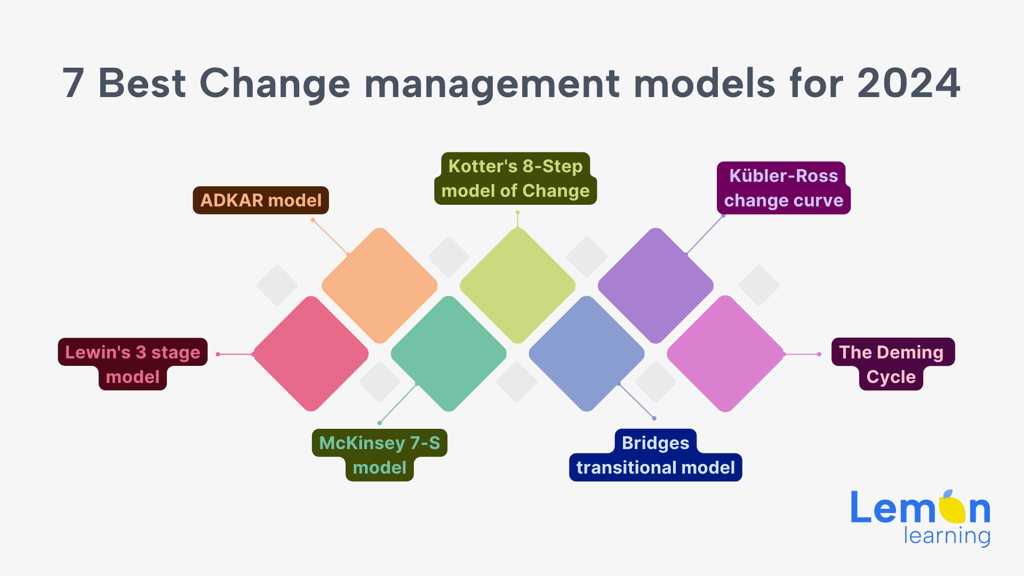
No single model fits every situation. The value of understanding multiple frameworks is that you can select the elements most relevant to your organization's size, culture, and the nature of the change itself. According to change management research and practice, the most effective approaches combine a structural process model with attention to the individual human experience. The seven models below represent the most cited and applied frameworks in the field today.
Kurt Lewin's 3-Stage Model is one of the oldest and most widely referenced frameworks in change management. Developed in the 1940s, it remains relevant because of its simplicity and psychological grounding. The model describes change as a three-stage process: unfreezing existing behaviors, transitioning to new ones, and then stabilizing the new state so that it endures.
The Three Stages Explained
Unfreeze: The organization challenges the status quo and builds awareness of why change is necessary. At this stage, people may feel unsettled or resistant as familiar routines are questioned.
Change (Transition): People begin to adopt new behaviors, processes, or tools. Uncertainty is highest here, making clear communication and visible leadership support critical to progress.
Refreeze: New behaviors are reinforced and embedded into standard practice, aligned with organizational culture so that the change is sustainable rather than temporary.
Lewin's model is best suited to organizations that need a clean, linear framework for a well-defined change initiative. Its main limitation is that it treats change as a discrete event rather than a continuous process, which can be a poor fit for organizations in rapid, ongoing transformation.
2. ADKAR Model: Individual-Level Change
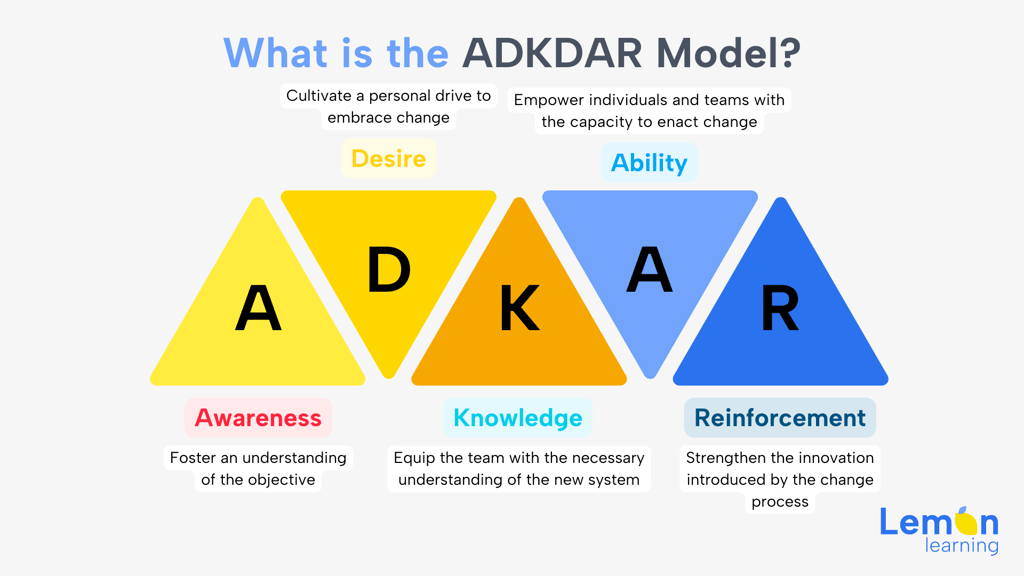
The ADKAR model in detail was created by Jeffrey Hiatt, founder of Prosci, based on analysis of hundreds of organizational change projects. The model is explicitly focused on the individual rather than the organization as a whole, on the premise that organizational change only succeeds when each person successfully navigates their own transition.
The Five Elements of ADKAR
Awareness: The individual understands why the change is necessary.
Desire: The individual is motivated and willing to support the change.
Knowledge: The individual knows how to change, including the skills and behaviors required.
Ability: The individual can apply that knowledge in practice.
Reinforcement: Mechanisms are in place to sustain the change and prevent regression to old habits.
ADKAR is particularly useful as a diagnostic tool. If a change initiative is stalling, the model helps pinpoint exactly where individuals are getting stuck, whether that is a lack of Awareness, insufficient training (Knowledge), or inadequate follow-through (Reinforcement). This makes it actionable as well as descriptive, and it can be layered on top of process-oriented models such as Kotter's framework.
3. McKinsey 7-S Model: Organizational Alignment
The McKinsey 7-S framework explained was developed by consultants at McKinsey and Company in the late 1970s. Rather than guiding a change process step by step, it provides a diagnostic map of the seven internal elements that must be aligned for an organization to perform effectively. The central insight is that these elements are interdependent: changing one creates ripple effects across all the others.
The Seven Elements
Hard S Elements (Tangible)
Soft S Elements (Intangible)
Strategy
Style (leadership approach)
Structure (organizational hierarchy)
Staff (people and capabilities)
Systems (processes and workflows)
Skills (core competencies)
Shared Values (culture and mission)
Shared Values sit at the center of the model because they influence, and are influenced by, all six other elements. The McKinsey 7-S Model is especially valuable during mergers, large-scale restructuring, or digital transformation, where changes to one element (such as Systems) quickly expose misalignments in Staff capabilities or organizational Structure.
4. Kotter's 8-Step Model: Leading Large-Scale Change
Harvard Business School professor John Kotter developed his Kotter 8-Step Change Model after observing more than 100 organizations attempting transformation. The model focuses on the human and leadership dimensions of change rather than the technical process, and it is structured as a sequential roadmap that builds organizational momentum over time.
The Eight Steps
Create a sense of urgency: Help people understand why change is necessary and time-sensitive.
Build a guiding coalition: Assemble a cross-functional team of leaders and advocates with the authority and credibility to drive the initiative.
Form a strategic vision: Define a clear, compelling picture of where the organization is heading and how it will get there.
Communicate the vision: Share the vision consistently and transparently with all stakeholders across every level.
Remove obstacles: Identify and address structural, procedural, or cultural barriers that block progress.
Generate short-term wins: Create and celebrate visible early successes to build confidence and maintain momentum.
Sustain acceleration: Use early wins as a foundation to drive deeper, broader change rather than declaring victory prematurely.
Anchor change in culture: Reinforce new behaviors and practices until they become embedded in the organization's norms and values.
Kotter's model is well-suited to large, complex organizations where winning hearts and minds is as important as executing a plan. Its emphasis on urgency and coalition-building makes it particularly effective for top-down transformation initiatives.
5. Bridges Transition Model: Managing the Human Journey
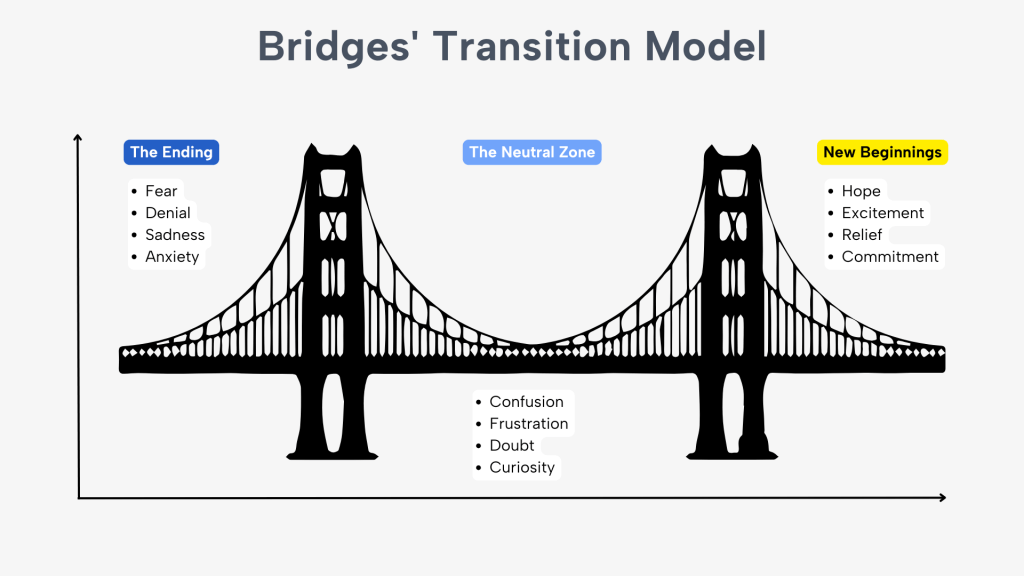
Consultant William Bridges developed the Bridges Transition Model to draw a deliberate distinction between change (an external event) and transition (the internal psychological journey people go through in response to that event). The model argues that organizations often manage the change well but fail to manage the transition, which is why so many initiatives lose momentum after launch.
The Three Transition Stages
Ending, and Letting Go
The first stage begins the moment a change is announced. Employees must let go of familiar roles, processes, or identities. This is where resistance is born, and where leaders must acknowledge loss rather than minimize it.
The Neutral Zone
The second stage is a state of limbo where old ways have been left behind but new ways have not yet taken hold. Productivity may dip, confusion is common, and anxiety can rise. Bridges viewed this stage as both the most difficult and the most creative, because it is where genuine reinvention becomes possible.
The New Beginning
The third stage marks the point at which employees genuinely embrace new behaviors, adopt new identities, and commit to the changed organization. This stage requires consistent reinforcement and recognition from leadership to take root and endure.
6. Kübler-Ross Change Curve: Emotional Stages of Change
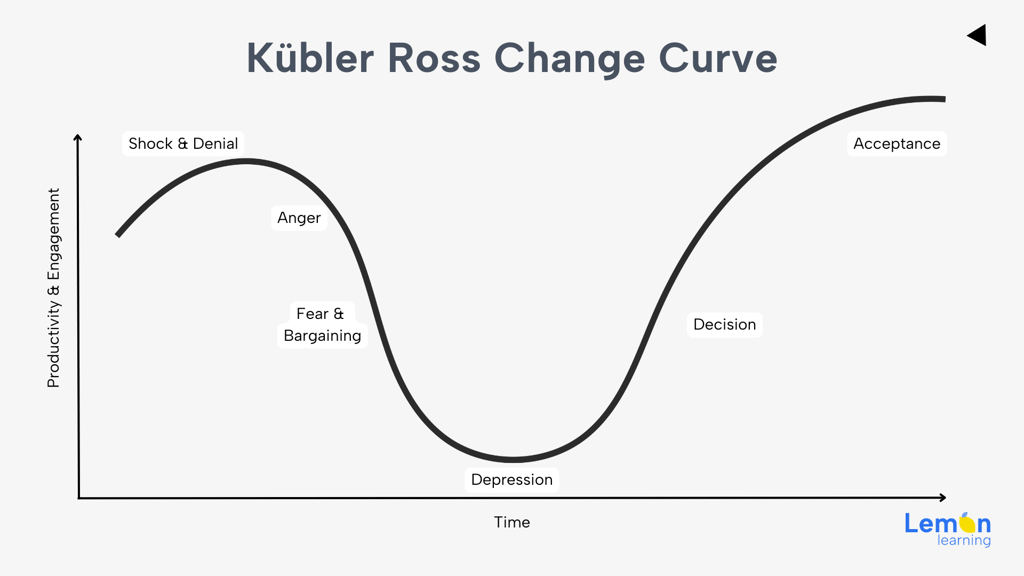
Psychiatrist Elisabeth Kübler-Ross originally developed her five-stage grief model to describe responses to terminal illness. Organizational practitioners subsequently adapted it as the Kübler-Ross Change Curve to describe the emotional journey employees experience during significant workplace disruption. It remains one of the most widely used frameworks for understanding and anticipating emotional resistance to change.
The Five Emotional Stages
Denial: Employees refuse to accept, or minimize, the reality of the change.
Anger: Frustration surfaces as the change becomes unavoidable.
Bargaining: Employees attempt to negotiate a way to limit the impact of the change on their work or roles.
Depression: Motivation and productivity may dip as the full impact of the change settles in.
Acceptance: Employees begin to engage constructively with the new reality.
A critical insight of the model is that individuals cross these stages at different speeds and may cycle back through earlier stages. Leaders who understand this can provide targeted support, such as more intensive communication for employees still in denial, or additional training and encouragement for those who have reached acceptance but lack confidence in new systems or processes.
7. The Deming Cycle: Continuous Improvement
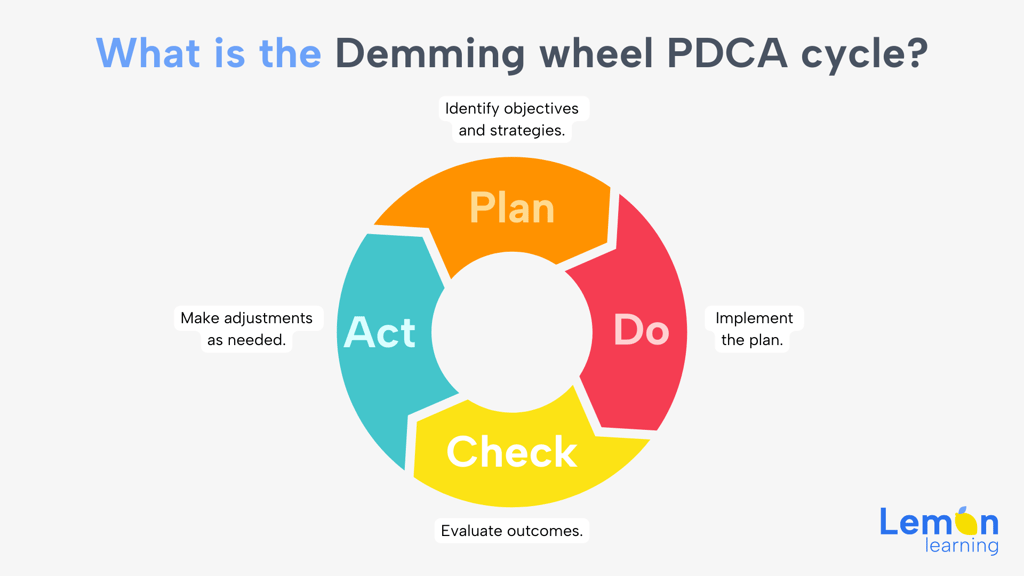
The Deming Wheel, also known as the PDSA (Plan-Do-Study-Act) Cycle, was developed by statistician and management thinker W. Edwards Deming. Unlike the other models on this list, it is not designed to manage a one-time transition. Instead, it is a circular, iterative framework for continuous improvement, making it particularly relevant for organizations that treat change as an ongoing operational discipline rather than a single project.
The Four Stages
Plan: Identify the problem or opportunity, analyze root causes, and design a targeted improvement plan with measurable goals.
Do: Implement the plan on a small scale or in a pilot environment to test its effectiveness before a broader rollout.
Study: Measure and analyze the results of the pilot against the expected outcomes to determine what worked and what did not.
Act: If the pilot succeeded, standardize and scale the change; if not, revise the plan and begin the cycle again with new learning.
The PDSA Cycle's iterative structure makes it well-suited to process improvement, quality management, and technology rollout scenarios where learning and adjustment are expected. Its circular nature also reinforces a culture of continuous learning, where each completed cycle informs the next improvement initiative.
How to Compare Change Management Models at a Glance
Each model addresses a different primary challenge. The table below summarizes the key distinctions to help you identify which framework, or combination of frameworks, best fits your situation.
Process improvement and iterative technology rollouts
Circular (4 stages)
How to Select the Right Change Management Model
There is no universally correct change management model. The right choice depends on the nature and scale of the change, the organizational culture, and the specific challenges you anticipate. In practice, many organizations draw on more than one model simultaneously: for example, using McKinsey 7-S to assess organizational readiness, ADKAR to track individual adoption, and Kotter's framework to structure leadership activities across the initiative.
Regardless of which model you select, the consensus across all seven frameworks is consistent: place employees at the center of the process, communicate transparently at every stage, and build in mechanisms for reinforcement so that new behaviors stick. Change that does not reach people at an individual level rarely endures at an organizational level.
For organizations navigating digital transformation approaches and models, change management frameworks work best when supported by tools that help employees build confidence in new systems from day one. Lemon Learning is a DAP (Digital Adoption Platform) designed to deliver in-application guidance, interactive walkthroughs, and real-time support directly within the tools employees are learning. This approach reinforces the Ability and Reinforcement stages of ADKAR, accelerates the Refreeze stage in Lewin's model, and helps generate the short-term wins that Kotter identifies as critical to sustaining momentum.
The three most foundational change management models are Kurt Lewin's 3-Stage Model (Unfreeze, Change, Refreeze), the ADKAR (Awareness, Desire, Knowledge, Ability, Reinforcement) Model, and Kotter's 8-Step Model. These three frameworks are widely cited because they address change from different angles: psychological readiness, individual adoption, and organizational leadership respectively.
What is the 7-S model of change management?+
The McKinsey 7-S Model was developed by McKinsey consultants in the late 1970s. It identifies seven interdependent elements that organizations must align for effective change: Strategy, Structure, and Systems (the hard, tangible elements) and Style, Staff, Skills, and Shared Values (the soft, intangible elements). Changing any one element creates a ripple effect across all the others.
What are the 5 C's of change management?+
The 5 C's of change management are Context (why the change is needed), Clarity (a clear vision of the end state), Commitment (visible leadership buy-in), Communication (consistent two-way dialogue), and Culture (aligning new behaviors with organizational values). They are not tied to one specific named model but are frequently used as a companion checklist alongside structured frameworks such as ADKAR or Kotter's 8-Step process.
What is Kurt Lewin's 3-step model?+
Kurt Lewin's 3-Step Model, developed in the 1940s, describes organizational change as three sequential stages: Unfreeze (challenging current behaviors and building awareness), Change or Transition (adopting new processes and behaviors), and Refreeze (stabilizing and embedding the new state into everyday practice). It remains widely used because of its clarity and ease of application.